The wealth tax is back. We have previously discussed the constitutional and policy concerns surrounding the push by Democrats like Sen. Elizabeth Warren (D., Mass.) to introduce a wealth tax that would start with billionaires. It would not likely end there. The law would also apply the same type of California approach to wealthy families […]
One year ago in March 2023, Silicon Valley Bank melted down, quickly followed by similar meltdowns at Signature Bank and First Republic Bank. Measured by the nominal size of bank assets, these were three of the biggest four US bank failures in history. (The failure of Washington Mutual Bank in 2008 remains the largest.) Was…
J. Scott Turner explains how the roots of environmental stewardship were poisoned, resulting in the perverted modern decarbonization movement. His Spectator Australia article is Environmentalism: from concern about clean air to throwing soup at the Mona Lisa. Excerpts in italics with my bolds and added images. H/T John Ray Garrett Hardin was a professor of biology […]
Labour’s App Tax is a 15% sales tax paid for by the mum and dad accommodation providers, takeaway joints, and ride share drivers. The App Tax hits sole-traders who sell their services through an app or website such as Uber or Airbnb. It will add even more to the costs of living for every Kiwi…
Demand shocks as technology shocks: We provide a macroeconomic theory where demand for goods has a productive role. A search friction prevents perfect matching between producers and potential customers. Larger demand induces more search, which in turn increases GDP and measured TFP. We embed the product-market friction in a standard neoclassical model and estimate it […]
Reading the new Nicholas Wapshott book and also Krugman’s review (NYT) of it, it all seemed a little too rosy to me. So I went back and took a look at Paul Samuelson the macroeconomist. I regret that I cannot report any good news, in fact Samuelson was downright poor — you might say awful […]
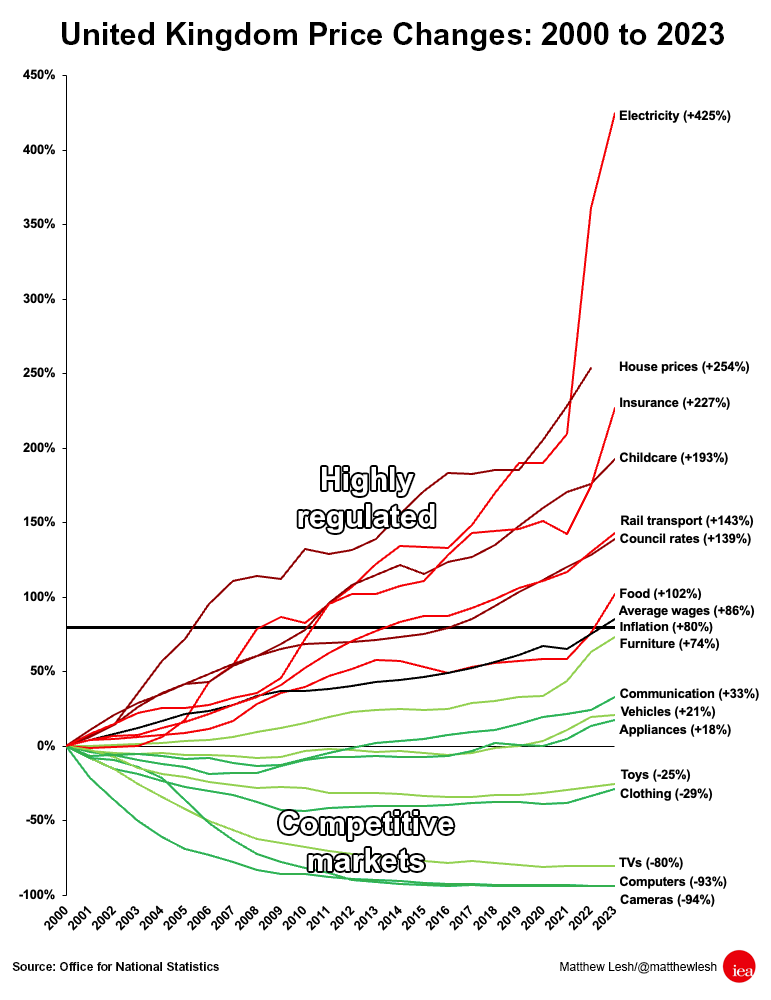
I periodically share Mark Perry’s famous “Chart of the Century” to show that government intervention is a recipe for rising relative prices.* Since economic principles don’t change when you cross national borders, one might expect to see similar patterns in other countries. And we do. Here’s a chart from Matthew Lesh of the Institute for […]
The Retirement Commissioner has released a paper on aspects of New Zealand Superannuation (NZS). Its focus includes affordability, fairness, age of eligibility, and the treatment of those over 65 who continue in the workforce whilst also receiving NZS. What the Commissioner does not discuss is the relationship between superannuation systems, domestic savings rates and capital […]
The upheaval of the UK constitution from 2016 onwards has been associated with a host of individuals, from David Cameron to Boris Johnson to Dominic Cummings, who have received the significant bulk of academic attention in recent years. And yet, another individual has had a substantial impact upon the UK constitution during this time: Nigel […]
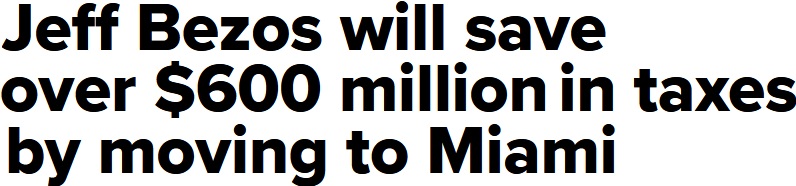
Inflation is having an effect on everything, even policy analysis. Back in 2013, I wrote that Phil Mickelson was “California’s One-Man Laffer Curve” because he wanted to escape the Golden State to save about $1.2 million per year in taxes. But now, when a goose that lays golden eggs wants to escape, the numbers are […]
Cool chart which is split up by regions so it’s easy to find nations like little old New Zealand ($US 252 billion) and Israel ($539 billion). I was a little surprised at the latter as I thought they’d be much bigger with all the high tech companies they have, as well as having a population […]
Nobel Laureate T. C. Koopmans wrote one of the most famous economics articles of the twentieth century, “Measurement Without Theory,” a devastating review of an important, and in many ways useful and meritorious, study of business cycles by two of the fathers of empirical business-cycles research, Arthur F. Burns and Wesley C. Mitchell, Measuring Business […]
Why Evolution is True is a blog written by Jerry Coyne, centered on evolution and biology but also dealing with diverse topics like politics, culture, and cats.
In Hume’s spirit, I will attempt to serve as an ambassador from my world of economics, and help in “finding topics of conversation fit for the entertainment of rational creatures.”
“We do not believe any group of men adequate enough or wise enough to operate without scrutiny or without criticism. We know that the only way to avoid error is to detect it, that the only way to detect it is to be free to inquire. We know that in secrecy error undetected will flourish and subvert”. - J Robert Oppenheimer.




 Utopia, you are standing in it!
Recent Comments