Is this the solution to implicit bias?
13 Mar 2018 Leave a comment
in discrimination, gender, labour economics, managerial economics, organisational economics, personnel economics Tags: customer discrimination, employee discrimination, employer discrimination, sex discrimination

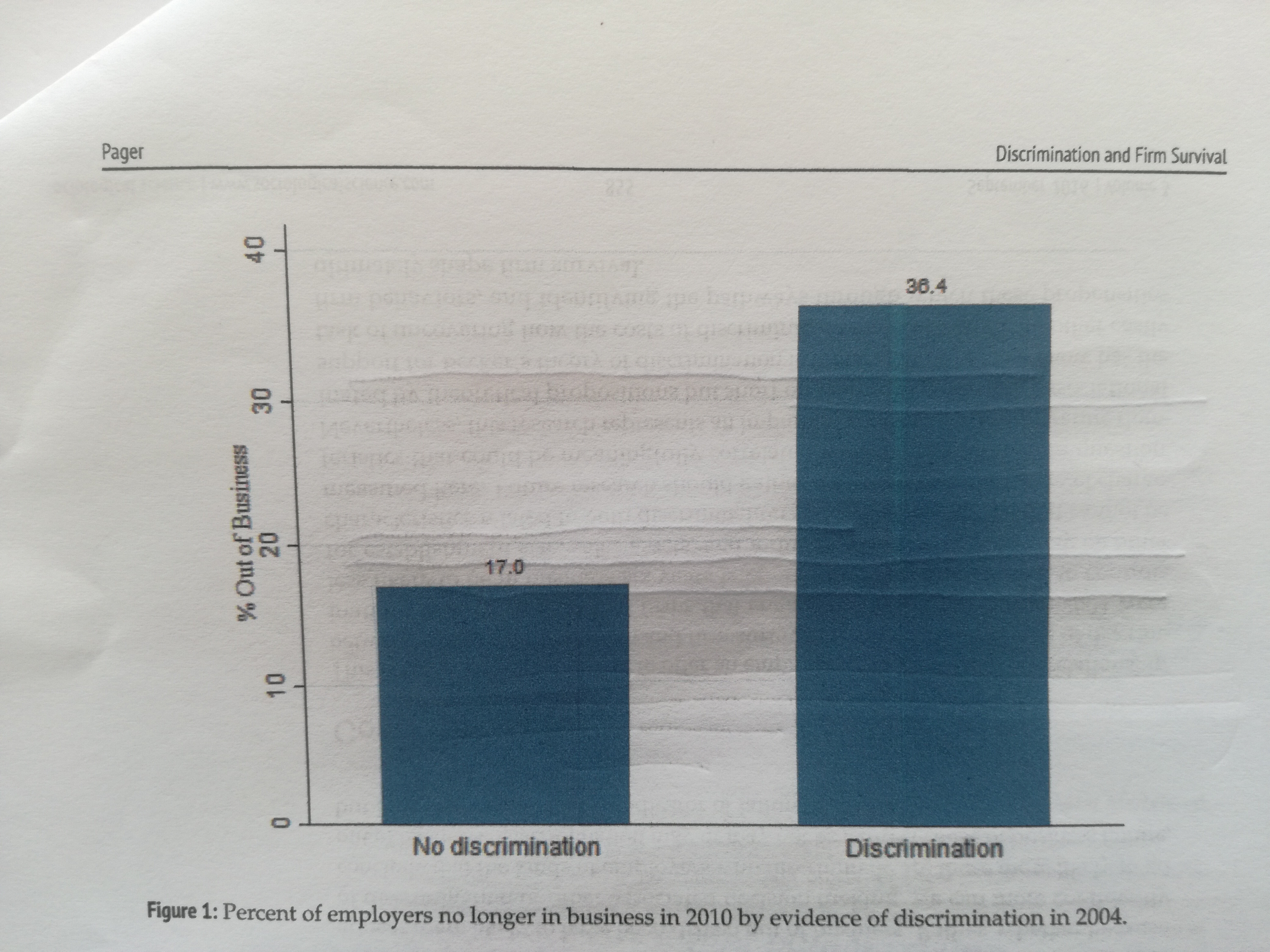
Does racial discrimination pay for employers? Evidence from an audit study follow-up
10 Mar 2018 1 Comment
in applied price theory, discrimination, industrial organisation, labour economics, law and economics, managerial economics, organisational economics, survivor principle Tags: competition and selection, racial discrimination
Why Women Prefer Male Bosses
06 Mar 2018 Leave a comment
in discrimination, gender, labour economics, managerial economics, organisational economics, personnel economics Tags: gender gap
BE BOTH THE MAN & THE BEAST | The Prince by Niccolo Machiavelli
26 Feb 2018 Leave a comment
in comparative institutional analysis, constitutional political economy, defence economics, economics of bureaucracy, law and economics, managerial economics, organisational economics, Public Choice, war and peace Tags: Machiavelli
Machiavelli’s Advice For Nice Guys
25 Feb 2018 Leave a comment
in comparative institutional analysis, constitutional political economy, defence economics, economics of bureaucracy, law and economics, managerial economics, organisational economics, Public Choice, war and peace Tags: Machiavelli
BE PRESENT | The Prince by Niccolo Machiavelli
24 Feb 2018 Leave a comment
in comparative institutional analysis, constitutional political economy, defence economics, economics of bureaucracy, law and economics, managerial economics, organisational economics, Public Choice, war and peace Tags: Machiavelli
Is education worth it?
20 Feb 2018 Leave a comment
in applied price theory, economics of education, economics of information, human capital, labour economics, managerial economics, occupational choice, organisational economics, personnel economics Tags: signalling
Will this be the workplace of the future or already today?
12 Feb 2018 Leave a comment
in discrimination, gender, managerial economics, organisational economics

The difference between Australia and NZ is due to meetings if you ask me. Never heard of a team meeting previously
12 Feb 2018 Leave a comment
in applied price theory, econometerics, managerial economics, organisational economics

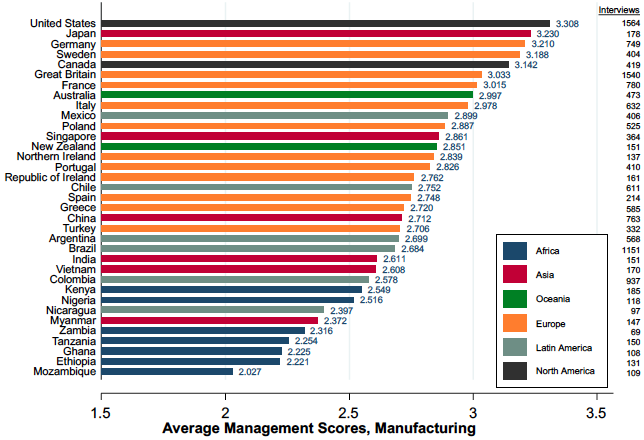
How Much Does Management Matter? – Raffaella Sadun, EEA 2016
05 Feb 2018 Leave a comment
in development economics, industrial organisation, managerial economics, organisational economics, personnel economics
CIA field sabotage manual 1944 was an early classic in managerial economics. Identified countless shortcomings in organisations.
29 Jan 2018 1 Comment
in defence economics, industrial organisation, managerial economics, organisational economics

Organizations and Conferences
-
Insist on doing everything through “channels.” Never permit short-cuts to be taken in order to expedite decisions.
-
Make “speeches.” Talk as frequently as possible and at great length. Illustrate your “points” by long anecdotes and accounts of personal experiences.
-
When possible, refer all matters to committees, for “further study and consideration.” Attempt to make the committee as large as possible — never less than five.
-
Bring up irrelevant issues as frequently as possible.
-
Haggle over precise wordings of communications, minutes, resolutions.
-
Refer back to matters decided upon at the last meeting and attempt to re-open the question of the advisability of that decision.
-
Advocate “caution.” Be “reasonable” and urge your fellow-conferees to be “reasonable” and avoid haste which might result in embarrassments or difficulties later on.
Managers
-
In making work assignments, always sign out the unimportant jobs first. See that important jobs are assigned to inefficient workers.
-
Insist on perfect work in relatively unimportant products; send back for refinishing those which have the least flaw.
-
To lower morale and with it, production, be pleasant to inefficient workers; give them undeserved promotions.
-
Hold conferences when there is more critical work to be done.
-
Multiply the procedures and clearances involved in issuing instructions, pay checks, and so on. See that three people have to approve everything where one would do.
Employees
-
Work slowly
-
Work slowly.
-
Contrive as many interruptions to your work as you can.
-
Do your work poorly and blame it on bad tools, machinery, or equipment. Complain that these things are preventing you from doing your job right.
-
Never pass on your skill and experience to a new or less skillful worker.
Peter Principle
06 Dec 2017 1 Comment
in managerial economics, organisational economics, personnel economics Tags: Peter Principle
Bureaucrats address problems, entrepreneurs seize untapped profit opportunities
26 Oct 2017 Leave a comment
in economics of bureaucracy, entrepreneurship, managerial economics
This distinction between the perspective of an entrepreneur and bureaucracy is essential to problem solving. Bureaucracies look for problems to solve through policy interventions. Alert entrepreneurs grasp for untapped opportunities for profit before others jump ahead of them to seize the day.
Luke Froeb discovered this crisp difference in organisational perspective between entrepreneurs and bureaucrats when his MBA students kept falling asleep when he lectured on market failures and the standard public policy responses. His teaching evaluations were so bad that the Dean of his Business School threatened to fire him if his student evaluations did not improve. This focused his mind.
Froeb repackaged market failures as a business opportunity. His students sat up and paid close attention. Froeb saved his job and later wrote an excellent MBA textbook (Froeb and McCann 2008).
Froeb and McCann (2008) started the problem diagnosing with market failure is an untapped wealth-creating opportunity. Froeb told his students that the first to fill these gaps in the market or be the market maker for the missing market stands to profit. Alert entrepreneurs make money by identifying unconsummated wealth-creating transactions and devise ways to profitably consummate them.
The art of public policy is looking beyond the immediate effect of a policy to trace its consequences not merely for one group but for all. Looking past what is under your nose is not good business. Much of entrepreneurial alertness is seeing what others do not see under their very noses (Kirzner 1997).
The art of business is identifying assets in low-valued uses and devising ways to profitably move them into higher values uses (Froeb and McCann 2008). Wealth is created when entrepreneurs move assets to higher-valued uses. Cost control such as in a mega-project is a standard entrepreneurial challenge.
Froeb and McCann (2008) argued that mistakes – opportunities are missed – for one of two reasons:
- A lack of information; or
- Bad incentives.
Rational, self-interested actors err because either they do not have enough information to make better decisions, or they lack incentives to make the best use of information they already have.
Froeb and McCann (2008) argued that three questions arise about all business problems:
- Who is making the bad decision?
- Does the decision maker have enough information to make a good decision?
- Does the decision maker have the incentives to make a good decision?
For Froeb and McCann (2008), the answers to these questions immediately suggest ways to fix them:
- Let someone else make the decision;
- Give more information to the decision maker; or
- Change the decision makers’ incentives.
Open offices are overrated
05 Oct 2017 Leave a comment
in managerial economics, organisational economics, personnel economics
Graphic that was not published with my op-ed in the @NZHerald
28 Sep 2017 Leave a comment
in financial economics, managerial economics, organisational economics
Op-ed is here.

Source: MSD, Household incomes in New Zealand: Trends in indicators of inequality and hardship, 1982 to 2016; graphic at https://datawrapper.dwcdn.net/cJKvY/1/

Recent Comments