
via Science is often flawed. It’s time we embraced that. – Vox.
Science is often flawed. Here is how.
14 May 2015 Leave a comment
in economics of bureaucracy, organisational economics, personnel economics Tags: data mining, philosophy of science, publish or perish
Are 40% of workers on zero hours contracts, almost?
12 May 2015 1 Comment
in labour economics, labour supply, managerial economics, organisational economics, personnel economics, politics - Australia, politics - New Zealand, politics - USA, theory of the firm Tags: zero hours contracts
4 in 10 hourly workers know their schedules just a week or less in advance brook.gs/1wkfkXW http://t.co/6JNkYlftjL—
Richard V. Reeves (@RichardvReeves) December 11, 2014

Zero hour contracts may be outlawed in New Zealand–updated
13 Apr 2015 1 Comment
in entrepreneurship, industrial organisation, labour economics, labour supply, managerial economics, occupational choice, organisational economics, personnel economics, politics - New Zealand, survivor principle, unions Tags: Aaron Director, creative production, David Friedman, inherent inequality of bargaining power between workers and employers, Richard Epstein, Ronald Coase, The fatal conceit, The pretence to knowledge, zero hours contracts

In another triumph of the Socialist Left of the National Party, the supposedly centre-right New Zealand government is considering outlawing zero hours contracts:
ONE News can exclusively reveal the Workplace Relations Minister is leaning towards outlawing the contracts and other employment provisions that he sees as unfair…
The Minister of Workplace Relations said the most punitive aspects of zero-hour contracts will be banned:
Mr Woodhouse has previously said a ban of zero-hour contracts would be an overreaction, but signalled the outlawing of aspects including:
•Restraint of trade clauses that stop someone working for a competing business if an employer does not provide the desired hours of work.
•The cancellation of shifts at short or no notice.
One reason for this is to neutralise a wedge issue with the Labour Party. The labour parties in both New Zealand and United Kingdom plan to outlaw zero hours contracts.
The NZ Labour Party’s Certainty at Work private member’s bill would require employment agreements to include an indication of the hours an employee will have to work to complete tasks expected of them.

Aaron Director pointed out that there are many real world business practices that behave differently from the caricatures in textbooks and arouse suspicious responses from economists (as well as from lay observers including lay observers with no ideological agenda).
Director said that visions of market power dance their heads and some of these suspect practices have been regulated for reasons he attributed in a large part to intellectual laziness. Ronald Coase made the same observation about knee-jerk responses to perplexing new business practices:
One important result of this preoccupation with the monopoly problem is that if an economist finds something—a business practice of one sort or other—that he does not understand, he looks for a monopoly explanation.
And as in this field we are very ignorant, the number of ununderstandable practices tends to be rather large, and the reliance on a monopoly explanation, frequent.
Much of the lasting influence of Aaron Director and of Ronald Coase came from their ability to show that simple judgements about business practices often cannot withstand rigorous scrutiny.
The organisation of and the contracting practices in the labour market is not a complicated despite the best efforts of the Left over Left and unions to pretend that it is so, as Richard Epstein explains:
Labour markets are not characterized by tricky externalities. They do not pollute streams or require the creation of public goods.
They are not characterized by genuine breakdowns in information, as workers are in a position to observe the conditions of their employment on a day-to-day basis.
Left to their own devices, without explicit support from union activities, they will be highly competitive, and thus work hard to allocate scarce human capital to its most productive use.
Workers have the option to quit for higher wages, and employers can always seek out low cost techniques to reduce their labour costs. Any short-term dislocation for firms or individuals is more than offset by the overall increase in the system productivity, spurred in part by clear signals that should increase investments in human capital.
In the UK, the Work Foundation found that 80% of those on zero hours contracts are not looking for another job; only 26% wanted longer hours. This implies that 74% were content with their current work times arrangements.
Labour's zero hours myth breitbart.com/london/2015/04… http://t.co/M8JsW6NWSF—
Alex Wickham (@WikiGuido) April 07, 2015
The inherent inequality of bargaining power between employers and workers and the reserve army of the unemployed must not be all that they are cracked up to be these days if low paid workers have to sign legally enforceable restraint of trade agreements, which is a common complaint about zero hours contracts. The worker does not have guaranteed hours but must promise not to work for someone else in the same line of business.
Obviously, the few members of the reserve army of the unemployed lucky enough to have a low pay, insecure job that offers no regular hours have so many other job options that their employers must get them to agree not to quit and job-hop at will. Jobs must be readily available to low paid workers for otherwise why do employers insist on this restraint of trade in employment agreements?
If there is an inherent inequality of bargaining power between the bosses and the workers, why do employers seek restraint of trade agreements against these downtrodden workers who are supposed to have few options but to accept the miserable zero hours job offer before them?
The question that must always be asked is why do people deemed competent to vote and drive cars sign zero hours contract? What is in it for them – for the worker who signs these contracts – especially for workers who already have a job and are switching to a zero hours contract? David Friedman asked this question about the economics of restraint of trade agreements for employees:
…the employer who insists on an employee signing a non- competition agreement will find that he must pay, in additional wages or other terms of employment, the cost that the agreement imposes upon the employee, as measured by the employee and revealed in his actions.
It follows that the employer will insist on such an agreement only if he believes that its value to him is greater than its cost to the employee… The contract is designed, after all, with the objective of getting the other party to sign it.
If I am designing the contract and offering it to many other parties, that may put me in a position to commit myself to insisting on terms that give me a large fraction of the benefit that the contract produces. But it is still in my interest to maximize the size of that net benefit-which I do by only insisting on terms that are worth at least as much to me as they cost the other party.
If zero hours contracts are as bad as the Left over Left claim, the job quit rates for these contracts should be high, and people moving from existing jobs should be under-represented in this section of the labour force. If a worker already has a job, they have few reasons to sign up to such a purportedly poor job offer. Show me the evidence.
Unless we have a good idea about why firms are moving to zero hours contracts, which we don’t, and why employees sign these contracts rather than work for other employers who offer more regular hours of work, meddling in these still novel to the officious observer arrangements is risky.

Claudia Goldin on Gender Equality in the Labor Market
02 Apr 2015 Leave a comment
in discrimination, gender, human capital, labour economics, managerial economics, occupational choice, organisational economics, personnel economics Tags: Claudia Goldin, gender wage gap, wage gaps

The North–South theory of product life cycles
23 Mar 2015 Leave a comment
in comparative institutional analysis, entrepreneurship, industrial organisation, law and economics, managerial economics, organisational economics, property rights, survivor principle, theory of the firm Tags: entrepreneurial alertness, foreign direct investment, incomplete contracts, incomplete property rights, North-South product life cycle, product life cycles
Forecasts of the offshoring of service jobs, as an example, can be constituted into a theory of North-South product cycles. The North-South theory of the life cycle of products starts with their research and development and refinement by entrepreneurs in the advanced countries (the North) with some exporting (Grossman and Helpmann 1991a, 1991b). These innovations require resources to be invested with uncertain prospects of success. Entrepreneurs in the North compete to discover new technology-intensive products using the ample supply of R&D workers and human capital-rich workers in the industrialised countries (Grossman and Helpmann 1991a, 1991b).

As a new product matures and its production becomes more standardised, the bulk of its production can migrate to the less developed countries (the South) to take advantage of lower production costs, and these countries will become net exporters. In the South, entrepreneurs focus more on imitation. They invest resources in importing and learning the production processes developed and proven to be a success in the North (Grossman and Helpmann 1991a, 1991b).
The shifting of production of standardised products to lower-wage foreign locations will frequently be within the originating company via a foreign affiliate, because of uncertainties about property rights and contract enforcement institutions in the host countries, and only later to independent foreign firms (Antràs 2005). Within corporate hierarchies, the high-skilled managers in the developed countries will specialise in problem-solving and non-routine tasks. They will interact with middle managers and production workers in developing countries who perform the routine tasks (Antràs et al. 2006, 2008).
Contracts are typically incomplete either because they are difficult to write and/or because the court cannot enforce them. The World Trade Organization (2005, 2008) concluded that, for example, the location of offshored services depends on:
- labour costs,
- trade costs,
- the quality of institutions, particularly the legal framework,
- the tax and investment regime,
- the quality of infrastructure, particularly telecommunications, and
- skills, particularly language and computer skills.
Risks in contract negotiation and enforcement will influence which types of production is outsourced. Roughly one-third of world trade is infra-firm, and this intra-firm trade is concentrated in the capital-intensive industries because of the costs and risks of investing in contracting with arm’s-length suppliers (Antràs 2003). Considerations about R&D incentives, the availability of human capital and the quality of contract enforcement institutions weigh heavily on the development of new products and their initial and later locations of different stages of production.
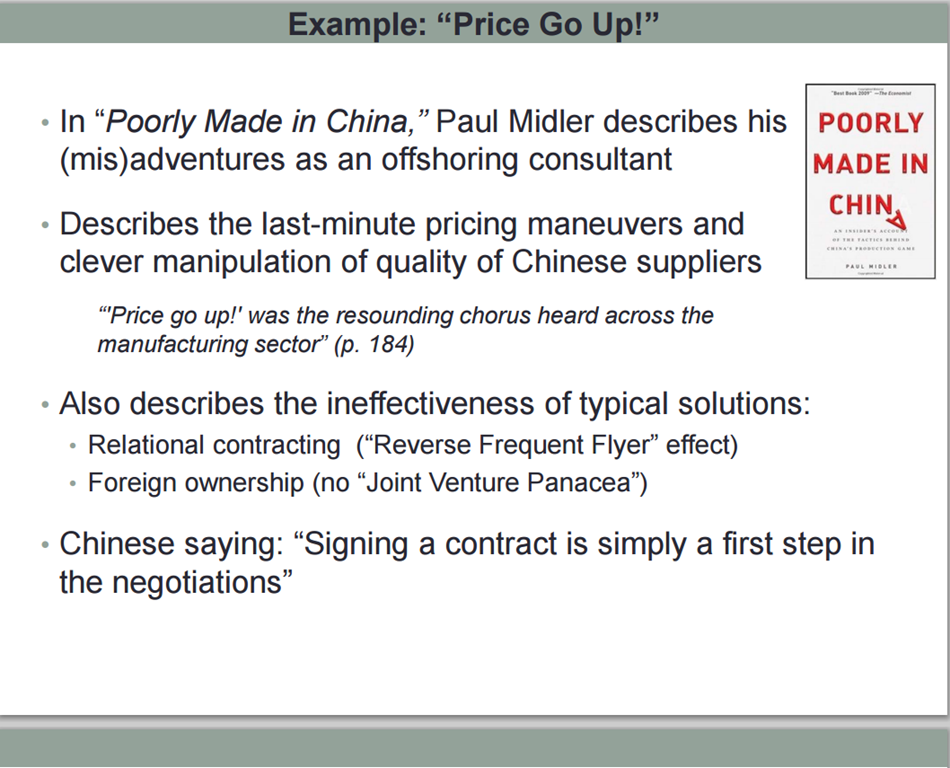
Products are initially developed in the highly industrialised countries because their sophisticated legal systems allow contracts to be enforced. Even then, in industrialised countries, the difficulties of writing and enforcing complicated contracts over the quality of new products early in the product life cycle encourages firms to make those products internally within the firm. Early in the product life cycle, if sub-contractors were used for key imports, there would have to be continual renegotiation of contracts contracts to incorporate new innovations and learning by doing. As Antras says:
Global production networks necessarily entail intensive contracting between parties located in different countries and thus subject to distinct legal systems0
As the new product standardises, and product quality in consequence becomes easier to measure and contract over, initially the innovating firm will sub-contract within the industrialised country but in time will import from developing countries. In the first instance, these imports may be from affiliates established in the developing country to ensure greater control of product quality through direct ownership of the factory. As Antras says:
Firms contemplating doing business in a country with weak contracting institutions might decide to do so within firm boundaries to have more control.
The size and shape of the firm is a direct response to mitigate the costs of contracting over quality that is hard to measure and which is constantly changing early in the product cycle. By assigning ownership rights to the party undertaking the more important investment in quality early in the product life cycle, entrepreneurs and innovators can minimise the losses caused by lack of enforceable contracts over quality when quality is changing rapidly as the firm moves through the product life cycle.

Boeing blamed the delays on the delivery of the Dreamliner on an unwillingness of sub-contractors to stand by their contractual obligations. In response, Boeing acquired some of the key sub-contractors to ensure that they delivered as promised. This is a classic operation of the theory of the firm where the entrepreneur brings within the firm what is too expensive to transact on the market because of difficulties in measuring quality and defining and enforcing property rights over what has been contracted.
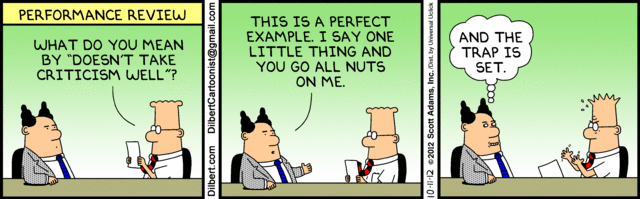
What if you could replace performance evaluations with four simple questions?
20 Mar 2015 Leave a comment
in industrial organisation, managerial economics, organisational economics, personnel economics, survivor principle Tags: Dilbert, performance reviews

at the end of every project, or once a quarter if employees have long-term assignments, managers would answer four simple questions — and only four. The first two are answered on a five-point scale, from "strongly agree" to "strongly disagree;" the second two have yes or no options:
1. Given what I know of this person’s performance, and if it were my money, I would award this person the highest possible compensation increase and bonus.
2. Given what I know of this person’s performance, I would always want him or her on my team.
3. This person is at risk for low performance.
4. This person is ready for promotion today.
via What if you could replace performance evaluations with four simple questions? – The Washington Post.
What are the biggest workplace time wasters?
16 Mar 2015 Leave a comment
in industrial organisation, labour economics, labour supply, managerial economics, occupational choice, organisational economics, personnel economics, survivor principle Tags: cyber loafing

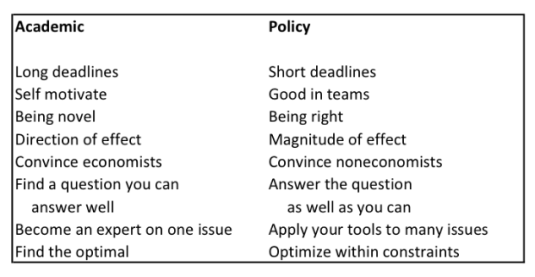
The policy world and academia offer widely different opportunities for early career researchers
15 Mar 2015 Leave a comment
in applied price theory, applied welfare economics, economics of bureaucracy, economics of education, occupational choice, organisational economics, politics, Public Choice
Academia rewards findings that are different and unexpected. In policy it is more important to be right than novel—after all, millions of lives may be impacted by a policy decision. In academia, people argue a lot about the direction of an effect but very little about the magnitude: in policy it’s the reverse…

The Dunning Kruger effect versus non-directional coaching
12 Mar 2015 3 Comments
in economics of education, human capital, managerial economics, organisational economics, personnel economics Tags: coaching, cognitive psychology, Dunning-Kruger effect, John Cleese, psychology of learning, Socratic questions
This seems to be a tension between the Dunning-Kruger effect on the principles of coaching as encompassed by its modern manifestation, non-directional coaching.

Under the modern fad of non-directional coaching, the coach asks open-ended questions which will elicit from the coached his or her own breakthroughs. Questions like what happened, what did you do then, is there another way will lead the student of the coach to reveal their knowledge within?

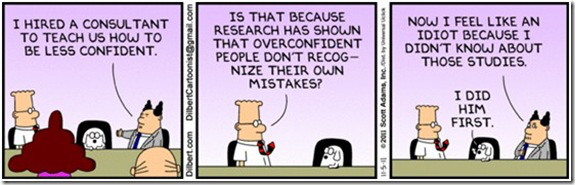
Psychologists David Dunning and Justin Kruger published a paper in which they described cognitive trait that quickly became known as the Dunning-Kruger effect. In a recent article, Dunning summarizes the effect as:
…incompetent people do not recognize—scratch that, cannot recognize—just how incompetent they are
He further explains:
What’s curious is that, in many cases, incompetence does not leave people disoriented, perplexed, or cautious.
Instead, the incompetent are often blessed with an inappropriate confidence, buoyed by something that feels to them like knowledge.

People who lack the skill to do something also lack the skill to recognise that they don’t know how to do it and to develop the skill how to do it. Dunning also points out:
An ignorant mind is precisely not a spotless, empty vessel, but one that’s filled with the clutter of irrelevant or misleading life experiences, theories, facts, intuitions, strategies, algorithms, heuristics, metaphors, and hunches that regrettably have the look and feel of useful and accurate knowledge.
I’m bad at spelling, grammar and proofreading my own work. To know how skilled or unskilled I am at using the rules of grammar, I must have a good working knowledge of those rules to start with the self-assessed myself as not been good at grammar. This is impossible for me to find out for myself because I don’t know the rules of grammar to tell me that I don’t know the rules of grammar and to what extent I don’t know the rules of grammar. I have succumbed to the Dunning-Kruger Effect
“The Dunning–Kruger effect is a cognitive bias in which unskilled people make poor decisions and reach erroneous conclusions, but their incompetence denies them the metacognitive ability to recognize their mistakes.
The unskilled therefore suffer from illusory superiority, rating their ability as above average, much higher than it actually is, while the highly skilled underrate their own abilities, suffering from illusory inferiority.
Actual competence may weaken self-confidence, as competent individuals may falsely assume that others have an equivalent understanding.
As Kruger and Dunning conclude, ‘the miscalibration of the incompetent stems from an error about the self, whereas the miscalibration of the highly competent stems from an error about others’. The effect is about paradoxical defects in cognitive ability, both in oneself and as one compares oneself to others.”
Poor performers fails to see the flaws in their thinking or the answers they lack. As Dunning explains:
A whole battery of studies conducted by myself and others have confirmed that people who don’t know much about a given set of cognitive, technical, or social skills tend to grossly overestimate their prowess and performance, whether it’s grammar, emotional intelligence, logical reasoning, firearm care and safety, debating, or financial knowledge.
College students who hand in exams that will earn them Ds and Fs tend to think their efforts will be worthy of far higher grades; low-performing chess players, bridge players, and medical students, and elderly people applying for a renewed driver’s license, similarly overestimate their competence by a long shot
Dunning and Kruger proposed that, for a given skill, incompetent people will:
- fail to recognize their own lack of skill;
- fail to recognize genuine skill in others;
- fail to recognize the extremity of their inadequacy; and
- recognize and acknowledge their own previous lack of skill, if they are exposed to training for that skill
Going back to my point about the modern trend in coaching of asking non-directive questions and open-ended questions and expecting the student to make their own breakthroughs, this contradicts the Dunning Kruger effect and the requirement that it be fixed through training. Coaching is not training; they are separate activities.
I was taught this non-directive coaching and went round the workplace asking questions of colleagues who are not economists using these open-ended questions of a coach. None of them made breakthroughs as a result of questions such as what happened, what happened then and other Socratic questions such as those below:
Conceptual clarification questions
Get them to think more about what exactly they are asking or thinking about. Prove the concepts behind their argument. Use basic ‘tell me more’ questions that get them to go deeper.
· Why are you saying that?
· What exactly does this mean?
· How does this relate to what we have been talking about?
· What is the nature of …?
· What do we already know about this?
· Can you give me an example?
· Are you saying … or … ?
· Can you rephrase that, please?
Probing their assumptions makes them think about the presuppositions and unquestioned beliefs on which they are founding their argument. This is shaking the bedrock and should get them really going!
· What else could we assume?
· You seem to be assuming … ?
· How did you choose those assumptions?
· Please explain why/how … ?
· How can you verify or disprove that assumption?
· What would happen if … ?
· Do you agree or disagree with … ?
Probing rationale, reasons and evidence
When they give a rationale for their arguments, dig into that reasoning rather than assuming it is a given. People often use un-thought-through or weakly-understood supports for their arguments.
· Why is that happening?
· How do you know this?
· Show me … ?
· Can you give me an example of that?
· What do you think causes … ?
· What is the nature of this?
· Are these reasons good enough?
· Would it stand up in court?
· How might it be refuted?
· How can I be sure of what you are saying?
· Why is … happening?
· Why? (keep asking it — you’ll never get past a few times)
· What evidence is there to support what you are saying?
· On what authority are you basing your argument?
Questioning viewpoints and perspectives
Most arguments are given from a particular position. So attack the position. Show that there are other, equally valid, viewpoints.
· Another way of looking at this is …, does this seem reasonable?
· What alternative ways of looking at this are there?
· Why it is … necessary?
· Who benefits from this?
· What is the difference between… and…?
· Why is it better than …?
· What are the strengths and weaknesses of…?
· How are … and … similar?
· What would … say about it?
· What if you compared … and … ?
· How could you look another way at this?
Probe implications and consequences
The argument that they give may have logical implications that can be forecast. Do these make sense? Are they desirable?
· Then what would happen?
· What are the consequences of that assumption?
· How could … be used to … ?
· What are the implications of … ?
· How does … affect … ?
· How does … fit with what we learned before?
· Why is … important?
· What is the best … ? Why?
And you can also get reflexive about the whole thing, turning the question in on itself. Use their attack against themselves. Bounce the ball back into their court, etc.
· What was the point of asking that question?
· Why do you think I asked this question?
· Am I making sense? Why not?
· What else might I ask?
· What does that mean?
 Utopia, you are standing in it!
Recent Comments