A Conversation with Gary Becker
10 Apr 2024 Leave a comment
in applied price theory, behavioural economics, comparative institutional analysis, discrimination, economic history, economics of education, economics of information, Gary Becker, gender, history of economic thought, human capital, labour economics, labour supply, occupational choice, poverty and inequality

Harris’ Major Malfunction
09 Apr 2024 Leave a comment
in economics of education, economics of media and culture, health economics, human capital, labour economics, labour supply, occupational choice, poverty and inequality Tags: behavioural genetics

Judith Harris’ The Nurture Assumption was a huge influence on me, and the top inspiration for my Selfish Reasons to Have More Kids. Her book’s first main lesson is that family resemblance, defined in the broadest possible way to include physical, psychological, and social outcomes, is mostly driven by genetics rather than upbringing. Her book’s…
Harris’ Major Malfunction
Pro-terrorism campaign in Christchurch
09 Apr 2024 6 Comments
in defence economics, economics of crime, law and economics, laws of war, liberalism, Marxist economics, war and peace Tags: free speech, Gaza Strip, Israel, Middle-East politics, political correctness, regressive left, war against terror

The Canterbury Socialist Society are launching a campaign to justify the slaughter, rapes and torture of Jewish men, women and children on 7 October. They claim it is resistance, not terrorism. The Popular Front for the Liberation of Palestine is a Palestinian revolutionary Marxist group. It has been designated a terrorist organisation by the EU, […]
Pro-terrorism campaign in Christchurch
Pricing the Atlantic
09 Apr 2024 Leave a comment
in applied price theory, entrepreneurship, industrial organisation, survivor principle
A WSJ article by Alexandra Bruell reports that three years ago the Atlantic magazine ran a $20 million deficit which led to layoffs. A new boss, Nick Thompson, was tasked with turning this around. Along with editorial changes toward longer investigative pieces rather than breaking news, the Atlantic raised subscription prices 50%. How did he…
Pricing the Atlantic
Deirdre McCloskey: Innovation Begins in Our Minds
09 Apr 2024 Leave a comment
in applied price theory, applied welfare economics, comparative institutional analysis, constitutional political economy, development economics, economic history, entrepreneurship, growth miracles, history of economic thought
350+ coauthors study reproducibility in economics
08 Apr 2024 Leave a comment
in econometerics Tags: academic fraud, publication bias
Jon Hartley is one I know, here is the abstract: This study pushes our understanding of research reliability by reproducing and replicating claims from 110 papers in leading economic and political science journals. The analysis involves computational reproducibility checks and robustness assessments. It reveals several patterns. First, we uncover a high rate of fully computationally […]
350+ coauthors study reproducibility in economics
The SFO overcharged
08 Apr 2024 Leave a comment
in economics of crime, law and economics, politics - New Zealand, property rights
The Serious Fraud Office said: The SFO welcomes the Court of Appeal’s decision today which corrected the High Court findings in its New Zealand First Foundation (NZFF) case and reinforced the importance of transparency around political donations in a democratic system. Following the NZFF trial in 2022 the High Court found “if the money is […]
The SFO overcharged
Coffee’s Supply & Demand Dance during Prohibition
08 Apr 2024 Leave a comment
in applied price theory, economic history, economics of regulation, health economics Tags: economics of prohibition

I’ve written about coffee consumption during US alcohol prohibition in the past. I’ve also written about visualizing supply and demand. Many. Times. Today, I want to illustrate how to use supply and demand to reveal clues about the cause of a market’s volume and price changes. I’ll illustrate with an example of coffee consumption during […]
Coffee’s Supply & Demand Dance during Prohibition
CITIZEN SCIENCE: Govt continues to be captured by trans ideology
07 Apr 2024 Leave a comment
in discrimination, economics of crime, gender, law and economics, liberalism, Marxist economics, politics - New Zealand Tags: free speech, law and order, political correctness, regressive left, sex discrimination
As the rest of the world wakes up from the trans fever dream, our media and political class continue to trundle along with their fingers in their ears and their eyes firmly shut. Radio New Zealand has avoided the topic for a while, but a couple of weeks ago treated us to a pantomime story…
CITIZEN SCIENCE: Govt continues to be captured by trans ideology
Stopping people dying on the job – Brooke van Velden on workplace safety…
07 Apr 2024 Leave a comment
in economics of regulation, health and safety, labour economics, labour supply, law and economics, politics - New Zealand
An enigmatic statement by George Orwell
07 Apr 2024 Leave a comment
in economics of education, liberalism, Marxist economics

Years ago I read this statement by George Orwell in his collected essays, and from time to time, especially when I suffer a reversal, I think about the second sentence. “Autobiography is only to be trusted when it reveals something disgraceful. A man who gives a good account of himself is probably lying, since any […]
An enigmatic statement by George Orwell
More on how trans female athletes damage women’s sports
06 Apr 2024 Leave a comment
in discrimination, gender, law and economics, sports economics Tags: free speech, political correctness, regressive left, sex discrimination
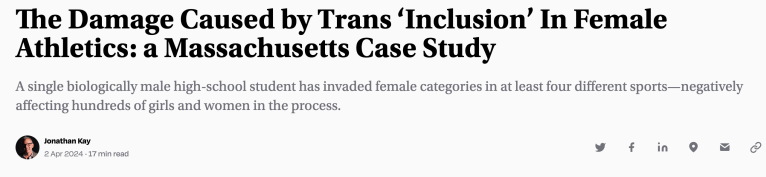
Quillette has a published a “case study” showing how one transgender female athlete can wreak substantial damage not just on one woman, or on one sport, but on a ton of women and in five sports (basketball, rowing, volleyball, tae kwon do, and track). I won’t belabor this, for I’ve already written a lot about […]
More on how trans female athletes damage women’s sports
How NZ and Taiwan differ in disaster preparedness
06 Apr 2024 Leave a comment
in economics of natural disasters, politics - New Zealand Tags: Taiwan
Peter Dunne writes – Taiwan and New Zealand are two small island states with much in common. Both are vibrant, independent democracies, living in the shadow of an overbearing neighbour. (Admittedly, Taiwan’s overbearing neighbour has far more aggressive tendencies than our at-times overbearing neighbour!) There is a strong free trade agreement between the two countries […]
How NZ and Taiwan differ in disaster preparedness


Recent Comments