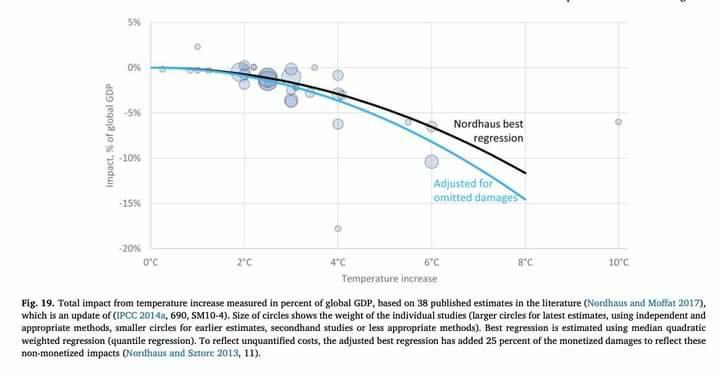
Don’t Assume Global Warming Blunts Economic Growth
26 Jun 2021 Leave a comment

In recent years, a strand of economic literature has argued that warming
not only negatively affects the level of economic activity,
but also the rate of income growth. PHOTO BY BLOOMBERG
Ross McKitrick explains in his Financial Post article Why climate change won’t hurt growth. Excerpts in italics with my bolds.
There is no robust evidence that even the worst-case warming scenarios would cause overall economic losses
It has long been observed that global poverty tends to be concentrated in hot, tropical regions. But persistent poverty in African and South American countries has political and historical roots, especially their embrace of Soviet-backed communism in the 20th century. In places where economic reforms were adopted, like South Asia, growth took off and they quickly converged with the West, despite having tropical climates. So the connection to climate may be coincidental.
But in recent years, a strand of economic literature…
View original post 961 more words
Book Review: “How to Survive in Medieval England” by Toni Mount
26 Jun 2021 Leave a comment

Have you ever wondered what it would be like if you were able to travel back in time to the medieval ages and had to start your life all over again? Could you make the transition from the 21st century to the medieval period with no electronic technology and different customs? What would you wear? How would you get around with no cars and horses being very expensive? Where would you live? What job would you have? These questions and quandaries are answered in the latest nonfiction book by Toni Mount aptly entitled, “How to Survive in Medieval England”.
I would like to thank Pen and Sword Books and Net Galley for sending me a copy of this book. I have found time travel books really interesting in the past few years, so I was intrigued when I heard about this title.
Mount has created a fun and creative guide…
View original post 325 more words
Sargent on fiscal stimulus
26 Jun 2021 Leave a comment
in budget deficits, business cycles, econometerics, economic growth, economics of bureaucracy, fiscal policy, global financial crisis (GFC), great depression, great recession, macroeconomics, monetary economics, Public Choice Tags: Keynesian macroeconomics, multiplier, New Keynesian macroeconomics

Luke Froeb The One Lesson of Business
26 Jun 2021 Leave a comment
in applied price theory, entrepreneurship, industrial organisation, managerial economics, market efficiency, organisational economics, personnel economics, survivor principle
Could This Plane Save The World? (Hint: No.) | Answers With Joe
26 Jun 2021 Leave a comment
in economics of regulation, energy economics, environmental economics, global warming, transport economics
Matthew E. Kahn’s on climate change adaptation
26 Jun 2021 Leave a comment
in applied price theory, applied welfare economics, economic history, energy economics, environmental economics, global warming
The Birth of the Manhattan Project – WW2 Special
26 Jun 2021 Leave a comment
in defence economics, war and peace Tags: Atomic bomb, World War II
Hobo’s Funnies III
25 Jun 2021 Leave a comment

At Westkapelle, however, the story was very different. The assault was to be delivered at the breach in the dyke just south of the town, but the sea approaches to this were covered by three major coast defence batteries. To the north of the gap were Battery W.17 at Domberg, armed with four 220mm French guns and one 150mm gun in open concrete casemates, and Battery W.15 on the northern outskirts of Westkapelle, armed with four British 3.7in AA guns in concrete casemates and two British three-inch AA guns in open emplacements, all of which had been converted to the coast defence role; south of the gap, between Westkapelle and Zoutelande, was Battery W.13, armed with four 150mm guns in concrete casemates, two 75mm guns in casemates and three 20mm AA cannon.
Because of this the landing force would have direct support from the 15in guns of the battleship HMS…
View original post 3,426 more words
JEFFERSON AND HAMILTON: THE RIVALRY THAT FORGED A NATION by John Ferling
25 Jun 2021 Leave a comment
(Alexander Hamilton and Thomas Jefferson)
Before John Ferling delves into the background, philosophies, and careers of his subjects in his JEFFERSON AND HAMILTON: THE RIVALRY THAT FORGED A NATION he exposes the reader to a meditation on how the third president and the first Secretary of the Treasury have been evaluated by successive generations. At the outset Jefferson was seen more favorably as he was deemed to be a democratic populist who defended the liberties of all, while Hamilton was viewed as the spokesperson for the rich upper class or “monarchical party.” This characterization existed through most of the 19th century as Jeffersonian agrarianism fought off the evolution of industrialization. Men like Andrew Jackson and William Jennings Bryan claimed Jefferson’s mantle, while Theodore Roosevelt and his adherents at the turn of the 20th century believed in Hamilton’s vision of American power, influence, and economic interests. By the administration…
View original post 2,680 more words
AMERICA’S FIRST DAUGHTER by Stephanie Dray; Laura Kamoie
25 Jun 2021 Leave a comment
Mrs. Thomas M. Randolph, (Martha Jefferson.)
Thomas Jefferson is one of the most complex figures in American history. Author of the Declaration of Independence, Governor of Virginia, Minster to France, Secretary of State, Vice President, and finally President Jefferson is synonymous with the founding of our nation. His reputation has always been one shrouded in controversy. Was he an ideologue who favored revolution or the pragmatist who engineered the purchase of the Louisiana Territory in 1803? During the last few years, his reputation has experienced a downturn in large part because of Ron Chernow’s biography of Alexander Hamilton which formed the basis for the Broadway production of the musical “Hamilton” which highlighted the rift between Jefferson and our first Secretary of the Treasury. As a result, Hamilton’s persona as perceived by the public has improved, and the sage of Monticello’s declined in the eyes of the public.
According to Stephanie…
View original post 1,107 more words
The House of Lords is too large: party leaders must put aside short-term interests and agree plans to reduce its numbers
25 Jun 2021 Leave a comment
Five years after its creation, the Lord Speaker’s committee on the size of the House has called for firm, fast action on reducing the number of peers in the legislature. Chair of the committee, Lord (Terry) Burns, argues that it is essential that party leaders have the courage to come together and agree the necessary measures.
To mark the retirement of Lord (Norman) Fowler as Lord Speaker, the committee he set up to make recommendations on reducing the size of the House of Lords recently published its fourth report. I have had the intriguing task of chairing the committee, which was ably advised by the Constitution Unit’s Director, Meg Russell.
The House of Lords has too many members
There have been over 1,500 life peers appointed since the enactment of the Life Peerages Act 1958. Of those, just over 800 have now died or retired. The net result is…
View original post 1,953 more words


Recent Comments