
No #climateemergency message discipline
21 Nov 2020 Leave a comment
in economics of bureaucracy, energy economics, environmental economics, global warming, politics - New Zealand, Public Choice Tags: climate alarmists

Very high tech
21 Nov 2020 Leave a comment
in entrepreneurship, financial economics, industrial organisation, survivor principle Tags: creative destruction

No Place For Man or Beast: Irish Family Pockets €225,000 From Wind Power Outfit For Noise Torture
21 Nov 2020 Leave a comment


Wind developers face liability in the millions for the nuisance caused by unrelenting, turbine generated low-frequency noise and infrasound.
Litigation is where the rubber hits the road: myths get replaced with facts; evidence overtakes spin and propaganda. Court rooms (and where they determine the facts, juries) strike fear into the (ordinarily icy) hearts of those that stand behind or run with wind power outfits.
Wherever in the world civil actions have been pursued in nuisance and negligence, wind power outfits have bent over backwards to settle out of court.
Sure, wind power operators have deep pockets (obscenely stuffed with the massive subsidies drawn from their victims, among others). But they have never won a common-law case demonstrating that wind farms do not cause noise nuisance.
Back in February this year, three siblings managed to secure €225,000 from the wind power outfit responsible for the turbine noise that for some to…
View original post 484 more words
How Living at the South Pole Works
21 Nov 2020 Leave a comment
in economics of media and culture Tags: Antarctica
Ten Minute History – World War One and International Relations
21 Nov 2020 Leave a comment
in defence economics, International law, war and peace Tags: World War I
Patton marches on Shreveport, Romania vs. USSR, and Free French intelligence – WW2 – OOTF 019
20 Nov 2020 Leave a comment
in defence economics, laws of war, war and peace Tags: World War II
A Scottish constitution: should it be devised before or after independence?
20 Nov 2020 Leave a comment

If voters choose independence in a referendum, Scotland will need a constitution. Elliot Bulmer argues here that there are advantages to creating and debating a new constitutional document before trying to navigate the choppy waters of becoming a separate nation.
Scotland and a written constitution
Despite being rejected in the 2014 referendum, Scottish independence has not disappeared from the political agenda. With a series of recent polls showing clear majorities in favour of independence, the question is sure to be revisited.
The Scottish National Party (SNP) has long had a policy of adopting a written constitution for Scotland. The party’s substantive proposals have remained remarkably consistent since the publication of a first draft constitution in 1977: a written constitution with an enforceable bill of rights largely based on the European convention, a unicameral parliament elected for fixed terms by proportional representation, and a parliamentary executive operating under a trimmed-down constitutional…
View original post 1,661 more words
Slavery, the Caribbean and English Liberties, 1620-40
20 Nov 2020 Leave a comment

Today’s blog is the first in a three-part series from History of Parliament director Dr Stephen Roberts about parliamentary involvement in the development of slavery in the Atlantic World in the seventeenth century…
During the 400th anniversary year of the voyage of the Mayflower, much attention has focused on English migration to the colonies of New England. By 1640, Massachusetts was the largest of the colonies, with an estimated English immigrant population of 12,000. As discussed in previous blogs about Mayflower, its passengers and well-wishers, a significant number of those who left England for the New World went in the name of religious freedom, but many did not. Even under the auspices of the ruling godly elite in the puritan colonies lived many who did not necessarily share the high ideals of the founding fathers. This was more emphatically the case in other American colonies, in the…
View original post 988 more words
Cultural motivations for wind and solar renewables deployment
20 Nov 2020 Leave a comment

by Andy West
“For me the question now is, now that we know that renewables can’t save the planet, are we going to keep letting them destroy it?”. – Michael Schellenberger
View original post 4,579 more words
Woods sticks to her script (a list of what the government has done) after economist rails about housing
20 Nov 2020 Leave a comment

As Minister of Housing, she is acutely aware of how decades of under-investment in infrastructure and the building of affordable homes has led us to where we are today, Megan Woods said yesterday.
Great. But what is being done about it?
Plenty – but nothing that hasn’t been announced already, it seems.
At least, not according to the speech which Woods delivered to the InfrastructureNZ conference.
Woods ticked off a list of programmes already under way and legislation already passed, and she reiterated the Government’s intention to replace the Resource Management Act. But an audience of infrastructure buffs hoping to be the first to hear of new initiatives would have been disappointed.
Woods’ speech was among the new posts on the Beehive website, since we last checked.
Among the others:
View original post 1,085 more words
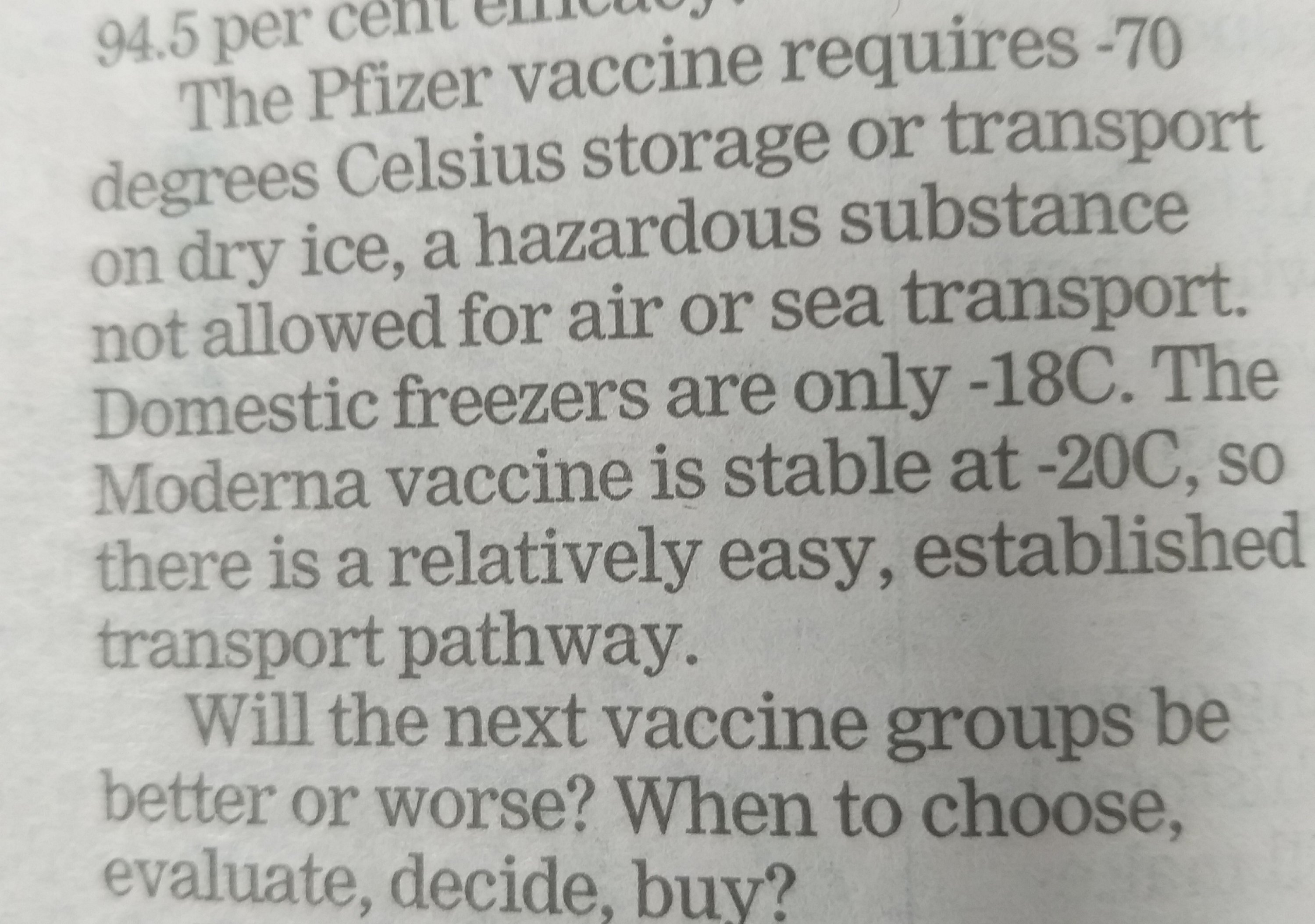
Is Pfizer’s vaccine rather cumbersome?
20 Nov 2020 Leave a comment
in health economics, politics - Australia, politics - New Zealand, politics - USA Tags: economics of pandemics, vaccines
France’s top court gives government three months to honour climate commitments
20 Nov 2020 Leave a comment


It seems courts in some countries are now in effect regarding as proven something that is not proven, namely that rises in Earth’s meagre 0.04% atmospheric carbon dioxide content will necessarily cause serious problems requiring urgent governmental action – whatever that may be – to ‘tackle’ the situation. Not only is this not proven, but science was arguing against such theories in published papers as far back as 1900, and continues to do so in various quarters today. The upshot is that, in these countries at least, governments have lumbered themselves with the legal duty of trying to reduce Earth’s average temperature, on pain of being found in contempt of court (or some such charge) for not trying hard enough, or at all. Not what President Macron would have had in mind when he strutted the stage at his notorious 2015 Paris climate summit.
– – –
France’s top administrative…
View original post 288 more words
November 17, 1558: Death of Mary I, Queen of England and Ireland. Part III.
20 Nov 2020 Leave a comment

Furthering the Tudor conquest of Ireland, under Mary and Felipe’s reign English colonists were settled in the Irish Midlands. Queen’s and King’s Counties (now Counties Laois and Offaly) were founded, and their plantation began. Their principal towns were respectively named Maryborough (now Portlaoise) and Philipstown (now Daingean).
In January 1556, Mary’s father-in-law the Emperor abdicated. Mary and Felipe were still apart; he was declared King of Spain in Brussels, but she stayed in England. King Felipe II negotiated an unsteady truce with the French in February 1556. The following month, the French ambassador in England, Antoine de Noailles, was implicated in a plot against Mary when Sir Henry Dudley, a second cousin of the executed Duke of Northumberland, attempted to assemble an invasion force in France. The plot, known as the Dudley conspiracy, was betrayed, and the conspirators in England were rounded up. Dudley remained in exile in France, and…
View original post 941 more words


Recent Comments