School Transgender Policy 1. Brighton: Allsorts
24 Oct 2020 Leave a comment

I have done a number of twitter threads on School policies, ostensibly, about protecting “transgender children”. The only one I have blogged, thus far, focussed on the way they treat parents. We are treated as potential bigots who need educatingon Gender Identity issues. The Schools, invariably, take it upon themselves to keep parents in the dark about our ” Gender Dysphoric” kids. They blithely inform us our kids are at significant risk of attempting suicide but stillthink it is good practice to hide pertinent information from parents. You can read that post here: Putting the Loco in Loco Parentis.
I will now do a series on the policies I have found. Some have already been withdrawn but we need to preserve a record of the extent of the policy capture. Note that this series will be repetitive as they are clearly modelled on a small number of…
View original post 3,226 more words
Trump vs. Biden on the Minimum Wage
24 Oct 2020 Leave a comment

In another display of selfless masochism, I watched the Trump–Biden debate last night.
The candidates behaved better, for whatever that’s worth, but I was disappointed that there so little time (and even less substance) devoted to economic issues.
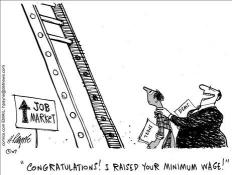 One of the few exceptions was the brief tussle regarding the minimum wage. Trump waffled on the issue, so I don’t give him any points, but Biden fully embraced the Bernie Sanders policy of basically doubling the minimum wage to $15 per hour.
This is very bad news for low-skilled workers and very bad news to low-margin businesses.
The economic of this issue are very simple. If a worker generates, say, $9 of revenue per hour, and politicians say that worker can’t be employed for less than $15 per hour, that’s a recipe for unemployment.
Earlier this month, Professor Steven Landsburg on the University of Rochester opined for…
View original post 754 more words
Book Review: “Cesare and Lucrezia Borgia: Brother and Sister of History’s Most Vilified Family” by Samantha Morris
24 Oct 2020 Leave a comment

 A family mired in myths and rumors of incest, murder, and intrigue for centuries. A brother and sister caught in the middle, attracting the attention of gossips and historians alike. No, I am not referring to a royal family in England. In fact, this story starts in Spain with Alonso de Borja, who moved to Italy and helped create the infamous Borgia family. Caught in the middle were the son and daughter of Rodrigo Borgia, Alonso’s nephew, and his mistress Vanozza Cattanei; Cesare and Lucrezia Borgia. How close were these famous siblings? What were their lives really like? In Samantha Morris’ latest biography, “Cesare and Lucrezia Borgia: Brother and Sister of History’s Vilified Family”, she dives deep into the archives to find out the truth about the legendary Borgia family.
I would like to thank Pen and Sword Books and Net Galley for sending me a copy of this book…
View original post 448 more words
70 Years of China’s Economic Growth In One Chart
24 Oct 2020 Leave a comment
in development economics, economic history, growth disasters, growth miracles, Marxist economics Tags: China, The Great Enrichment

The ultimate market test
24 Oct 2020 Leave a comment
in economics of education, economics of media and culture, entrepreneurship Tags: cranks, Quacks

Declassified footage of the biggest nuclear explosion ever
24 Oct 2020 Leave a comment

Here’s a rare video, previously classified but recently released, of the explosion of the “Tsar Bomba“, which the Soviet Union detonated on October 30, 1961. Wikipedia calls it “the most powerful nuclear weapon ever created and tested”, and it “remains the most powerful human-made explosive ever detonated.”
How powerful was this H-bomb? About 50 megatons of TNT; here’s a comparison to other Big Bombs:
The Tsar Bomba was the single most physically powerful device ever deployed on Earth. For comparison, the largest weapon ever produced by the U.S., the now-decommissioned B41, had a predicted maximum yield of 25 megatons of TNT (100 PJ). The largest nuclear device ever tested by the U.S. (Castle Bravo) yielded 15 megatons of TNT (63 PJ) because of an unexpectedly high involvement of lithium-7 in the fusion reaction; the preliminary prediction for the yield was from 4 to 6 megatons of TNT (17 to…
View original post 222 more words
Rare Economic Disasters: What Role Does Government Play? | Robert Barro
24 Oct 2020 Leave a comment
in applied price theory, applied welfare economics, budget deficits, business cycles, comparative institutional analysis, development economics, economic growth, economic history, economics of bureaucracy, economics of natural disasters, economics of regulation, energy economics, environmental economics, fiscal policy, global financial crisis (GFC), great depression, great recession, history of economic thought, industrial organisation, labour economics, labour supply, law and economics, macroeconomics, monetary economics, poverty and inequality, Public Choice, unemployment
On Stalin’s Secret Service – Richard Sorge – WW2 Biography Special
24 Oct 2020 Leave a comment
in defence economics, war and peace Tags: World War II
THE LAST MILLION: EUROPE’S DISPLACED PERSONS FROM WORLD WAR TO COLD WAR by David Nasaw
23 Oct 2020 Leave a comment


Today we find that immigration reform and related issues like DACA and a southern border wall are at the forefront of our election debate aside from Covid-19. Immigration has been a very controversial issue throughout American history and one of the most contentious involved what to do with the hundreds of thousands of displaced persons that were a result of Nazi racial policy and their conduct during World War II. By the end of 1945 roughly one million displaced persons remained in Germany: Jews, Poles, Estonians, Latvians, Lithuanians, Ukrainians, among other groups who refused to return to their home countries or had no homes to return to. This group labeled the “Last Million” by author David Nasaw in his latest book, THE LAST MILLION: EUROPE’S DISPLACED PERSONS FROM WORLD WAR TO COLD WAR follows these individuals from three to five years as they lived…
View original post 1,537 more words
Sweden vs UK: How my life in lockdown-free Sweden is different | #COVID19
23 Oct 2020 Leave a comment
in health economics Tags: economics of pandemics
Efficient markets as normative systems
23 Oct 2020 Leave a comment

Recently, I came across this outstanding interview with Eugene Fama published by The Market / NZZ. Besides the main subject discussed -the inability of central banks to control inflation-, the interview is intertwined with gripping assertions about the limits of knowledge, such as the following ones:
Bubbles are things people see in hindsight. They don’t identify them in advance. Sure, you can look at the behavior of prices, and you may be able to identify cases where they are too high. But if you only look back and say: «Oh, stocks went down a lot, so that was a bubble», then that’s 20/20 hindsight. At the time, there was no evidence that there was a bubble.
I don’t say markets are completely efficient, but they’re efficient for most questions that I address. Models are never a 100 % true. If they were, we would call them reality…
View original post 728 more words
The First Liberation From Nazism – The Republic of Užice – WW2 Special
23 Oct 2020 Leave a comment
in defence economics, laws of war, war and peace Tags: World War II
Robert E. Lucas Jr. What was the industrial revolution
23 Oct 2020 Leave a comment
in applied welfare economics, comparative institutional analysis, constitutional political economy, development economics, economic growth, economic history, economics of bureaucracy, economics of education, history of economic thought, human capital, income redistribution, industrial organisation, labour economics, labour supply, law and economics, macroeconomics, occupational choice, occupational regulation, poverty and inequality, property rights, Public Choice, public economics, rentseeking, Robert E. Lucas Tags: industrial revolution


Recent Comments