Education Bureaucrat: Choice for Me, Equal Mediocrity for Thee
10 Oct 2020 Leave a comment

Writing about the failed government education monopoly back in 2013, I paraphrased Winston Churchill and observed that, “never has so much been spent so recklessly with such meager results.”
This more-recent data from Mark Perry shows that inflation-adjusted spending has ballooned in recent decades, driven in part by teacher expenses but even more so by the cost of bureaucrats.

Robby Soave recently wrote about the hypocrisy of one of those non-teaching bureaucrats.
In a must-read article for Reason, he notes that the lavishly compensated superintendent of government schools in a suburb of Washington, DC, has decided that one of his kids will get a better education at a private school.
Alexandria City Public Schools (ACPS) Superintendent Gregory Hutchings has always been proud to call himself a parent of two children who attend public school.
…But now, Hutchings has pulled one of his kids from ACPS—which remains all-virtual, to…
View original post 446 more words
New reply from Ayaan Hirsi Ali to Sarah Haider
10 Oct 2020 Leave a comment

Sarah Haider and Ayaan Hirsi Ali are discussing the topic “Is the culture war lost?” on the Letter site. (The “war” is between traditional liberals and the extremist wing of the Left known as Wokeism.)
When Sarah wrote her first email, arguing that yes, the culture war has already been lost to the Woke, I featured her thoughts in a post. Now Ayaan has responded, and is not as pessimistic. Click on the screenshot to read her response:

I won’t quote it in extenso, but I will say that Hirsi Ali mentions her own experience of being canceled for her criticisms of Islam, and argues that now Western sentiments are turning in her favor. (She compares Wokeism to Islamism as forms of religious ideology.) Here are two short quotes, and then you must read the rest for yourself:
My understanding is that you and I mistook many of…
View original post 431 more words
Schumpeter on Marx as Prophet and Sociologist
10 Oct 2020 Leave a comment

Continuing to read Schumpeter’s Capitalism, Socialism, and Democracy(1942) As I mentioned in a previous post, I was surprised to find that, in a book I thought would tell me about the currently prevailing theory of platform monopoly and competition, Schumpeter’s first few chapters are devoted entirely to a consideration of Karl Marx.
Schumpeter’s treatment of Marx is the epitome of respectful disagreement. Each chapter in his treatment, “Marx the Prophet”, “Marx the Sociologist”, “Marx the Economist”, and “Marx the Teacher”, is brimming with praise and reverence for the intellectual accomplishments of Marx. Schumpeter is particularly sensitive to the value of Marx’s contributions in their historical context: they exceeded what came before it and introduced many critical new ideas and questions.
Contextualizing it thus, Schumpeter then engages in a deep intellectual critique of Marx, pointing out many inconsistencies and omissions of the doctrine and of the contemporary Marxist or Marxian…
View original post 2,628 more words
Recalibrating Affirmative Action | Glenn Loury & Peter Arcidiacono
10 Oct 2020 Leave a comment
in applied price theory, discrimination, econometerics, economic history, economics of bureaucracy, economics of education, human capital, labour economics, labour supply, law and economics, Marxist economics, occupational choice, politics - USA, poverty and inequality, Public Choice Tags: affirmative action, offsetting behaviour, racial discrimination, regressive left, The fatal conceit, unintended consequences
Richard Epstein | The Case Against Reparations 2020
10 Oct 2020 Leave a comment
in applied price theory, applied welfare economics, comparative institutional analysis, constitutional political economy, economic history, income redistribution, law and economics, liberalism, libertarianism, Marxist economics, politics - USA, Public Choice, rentseeking, Richard Epstein Tags: racial discrimination
Nick Cohen on a creepy case of cancel culture
10 Oct 2020 Leave a comment
Like me, every once in a while Nick Cohen has to display his bona fides and assert that no, he’s no right-winger. That’s because—also like me—his interest is largely in identifying and decrying the excesses of the Left, which he considers damaging to our side. And so, in September, he wrote a piece in the Guardian asserting (and I’m with him here as well) that the far right is a much greater danger to Western societies than is the far left. We both have to do this from time to time lest we be labeled as Nazis for criticizing our own Left. (While I’m on Cohen, I highly recommend his book on this issue, What’s Left? How Liberals Lost Their Way, as well as his book on modern censorship, You Can’t Read This Book: Censorship in an Age of Freedom.)
So far, so good. But I was…
View original post 1,710 more words
Kate Andrews on the Gender Pay Gap, Feminism, Socialism & the NHS
10 Oct 2020 Leave a comment
in discrimination, economic history, economics of bureaucracy, economics of crime, economics of education, economics of love and marriage, entrepreneurship, gender, health and safety, history of economic thought, human capital, income redistribution, labour economics, labour supply, law and economics, liberalism, Marxist economics, occupational choice, poverty and inequality, property rights, Public Choice, rentseeking Tags: gender wage gap
Glenn Loury | Systemic Racism, Trump and BLM
09 Oct 2020 Leave a comment
in discrimination, economics of crime, law and economics, politics - USA, Public Choice Tags: racial discrimination
Christopher Marlowe (1564 – 93)
09 Oct 2020 Leave a comment

Christopher Marlowe was one of the original bad boy rebels. He lived fast, died young (aged 29) and left a beautiful corpus of exhilarating plays and sensuous poetry. Marlowe’s half dozen plays are the first to use blank verse, demonstrating its power and flexibility, and so can be said to have established the entire format of Elizabethan and Jacobean theatre.
Early life
Marlowe was the son of a Canterbury shoemaker. There’s a record of his being baptised on 26 February 1564. He won a scholarship to King’s School, Canterbury, then another to Corpus Christi College Cambridge where he was awarded a degree in 1584. However the authorities hesitated to award him an MA in 1587 because of rumours that he had spent time abroad, at Rheims, consorting with English Catholic exiles who were ordained as Catholic priests there before being smuggled back into England. If true, this amounted to treason…
View original post 1,410 more words
German in Signals Intelligence Russia I
09 Oct 2020 Leave a comment

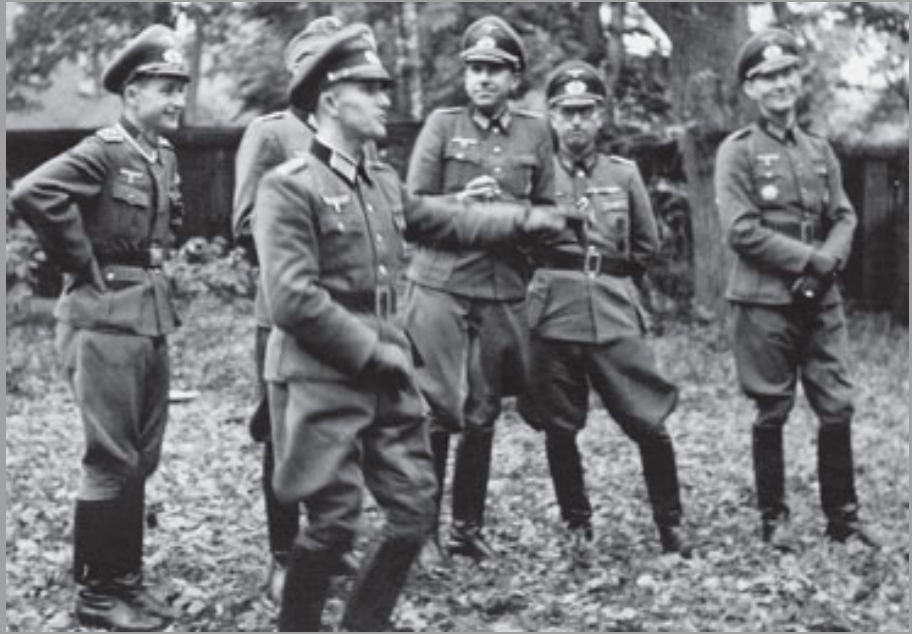
German officers attending an OKW signals intelligence course in Jüterbog, near Berlin, in October 1944. Left to right: Oberwachtmeister Suenkel; behind the tutor, Hauptmann Russ, of the Fenast post at Treuenbrietzen; the tutor, Major Philiptitsch, also of the Fenast post at Treuenbrietzen; Major Wend, commanding the Fenast at Lauf; Regierungsrat Wilhelm Flicke in glasses; and, next to Flicke, Inspecktor Pokojewski. The Allies had liberated Paris in August and were advancing to the German border. Flicke was tutoring Nachrichtenhelferinnen (female operators) at Jüterbog to replace soldiers drafted into fighting units of the German Army.
The High Command of the Wehrmacht (OKW) were not good at accepting intelligence evaluations that they disagreed with. Nowhere was this more obvious than during the Russian campaign. The papers of Colonel Randeweg, who was commanding the German intercept units in southern Russia before Operation Barbarossa in June 1941, showed a clear picture of the Red Army…
View original post 3,047 more words
Bomber Command: The Years of Crisis, 1935-9
09 Oct 2020 Leave a comment



Although Germany’s rearmament plans were alarming enough, the Air Staff were confident that the Germans would not be in a position to offer a serious challenge to Britain in terms of first-line air power until at least the end of 1936. This belief, however, was based on the assumption that there would be no dramatic increase in the rate of German aircraft production; if such an increase took place, the Air Staff were well aware that the Germans had the capability to build up a combat force of two thousand aircraft, with reserves, in a relatively short time. Air Chief Marshal Sir Edward Ellington, who had taken over the post of CAS in May 1933, stated this danger in very clear fashion at a Chiefs of Staff Committee meeting on June 1934.
Parliament, however, seemed unable to grasp the sense of urgency. It was absent even in November 1934, when…
View original post 6,158 more words
The labour market causes and consequences of general purpose technological progress: evidence from steam engines
09 Oct 2020 Leave a comment

by Leonardo Ridolfi (University of Siena), Mara Squicciarini (Bocconi University), and Jacob Weisdorf (Sapienza University of Rome)

Should workers fear technical innovations? Economists have not provided a clear answer to this perennial question. Some believe machines make ‘one man to do the work of many’; that mechanisation will generate cheaper goods, more consumer spending, increased labour demand and thus more jobs. Others, instead, worry that automation will be labour-cheapening, making workers – especially unskilled ones – redundant, and so result in increased unemployment and growing income inequality.
Our research seeks answers from the historical account. We focus on the first Industrial Revolution, when technical innovations became a key component of the production process.
The common understanding is that mechanisation during the early phases of industrialisation allowed firms to replace skilled with unskilled male workers (new technology was deskilling) and also…
View original post 454 more words


Recent Comments