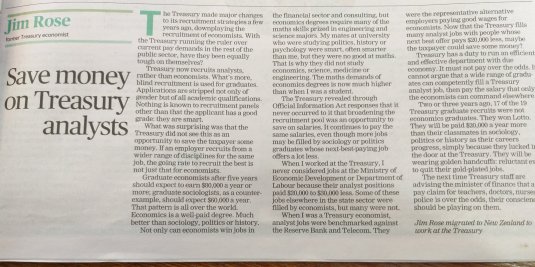
My @DomPost op-ed on @NZTreasury fat cats
27 Nov 2018 Leave a comment
in economics of bureaucracy, economics of education, human capital, labour economics, labour supply, managerial economics, organisational economics, personnel economics, politics - New Zealand, Public Choice
Oh What a Lovely Report! (1977) Arthur Lowe Jeff Rawle UK Training Film
21 Nov 2018 Leave a comment
in managerial economics, movies, organisational economics, personnel economics, television
An underdiscussed example of the Dunning-Kruger effect
18 Nov 2018 Leave a comment
in human capital, labour economics, managerial economics, occupational choice, organisational economics, personnel economics

Steve Landsburg on the efficiency wage as a theory of involuntary unemployment
18 Nov 2018 Leave a comment
in applied price theory, labour economics, labour supply, macroeconomics, managerial economics, organisational economics, personnel economics, unemployment Tags: efficiency wage

The College Scam
30 Oct 2018 Leave a comment
in applied price theory, applied welfare economics, economics of education, economics of information, human capital, labour economics, labour supply, personnel economics Tags: signalling
Myers-Briggs test is totally meaningless
19 Oct 2018 Leave a comment
in applied price theory, health economics, managerial economics, organisational economics, personnel economics Tags: personality psychology
Why Women Prefer Male Bosses
15 Oct 2018 Leave a comment
in discrimination, gender, labour economics, occupational choice, personnel economics
Claudia Goldin (2018) on the last chapter in the Quest for Career and Family @NZPSA @women_nz
08 Oct 2018 Leave a comment
in applied price theory, discrimination, economics of education, entrepreneurship, gender, health economics, human capital, labour economics, managerial economics, occupational choice, organisational economics, personnel economics, poverty and inequality Tags: gender wage gap
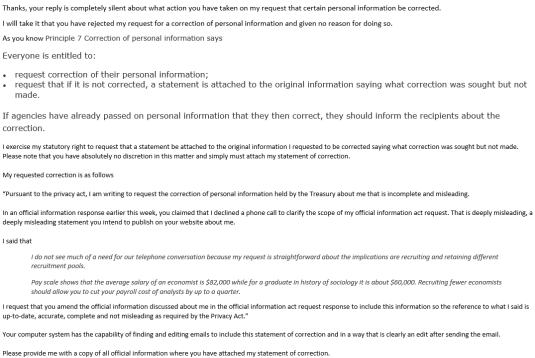
Latest round with @NZTreasury on salary savings on recruiting non-economists OIA #Zugzwang
21 Sep 2018 Leave a comment
in economics of bureaucracy, personnel economics
.
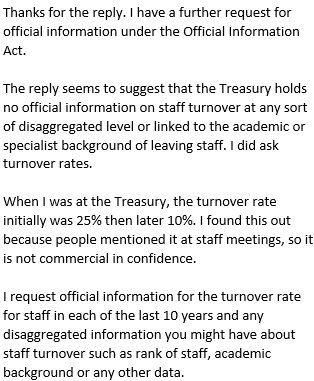
Does @NZTreasury use disaggregated staff turnover rates to set pay? @TaxpayersUnion @EricCrampton
06 Sep 2018 Leave a comment
in economics of bureaucracy, personnel economics, politics - New Zealand
.
.@NZTreasury does not use staff turnover & retention rates & going rates to set pay @TaxpayersUnion @EricCrampton
06 Sep 2018 Leave a comment
in economics of bureaucracy, personnel economics, politics - New Zealand
The average pay for an economist is about $80,000; the average pay for a sociology graduate is $60,000 according to the Careers New Zealand advice on your salary prospects for various degrees over a career.

Obviously going down market for graduates has not saved the taxpayer a single cent because they pay economists the same as non-economists despite it being easier to recruit an equally smart non-economists for less pay because they have fewer well-paid options in the rest of the labour market. It never occurred to the Treasury that changing the mix of their recruitment pool might save money!
Last economist leaving @NZTreasury did turn out the lights; didn’t click to the American Question: if you’re so smart, why aren’t you rich?
07 Aug 2018 Leave a comment
in economics of bureaucracy, entrepreneurship, financial economics, personnel economics

Source: From Treasury email

From The Limits of Expertise: If you’re So Smart, Why ain’t You Rich? – SFU by Deirdre McCloskey.
Stossel: The End of Tipping?
01 Aug 2018 Leave a comment
in applied price theory, economics of regulation, entrepreneurship, industrial organisation, labour economics, labour supply, law and economics, managerial economics, minimum wage, occupational choice, organisational economics, personnel economics, poverty and inequality Tags: tipping
 Utopia, you are standing in it!
Recent Comments