There is much work yet to be done in New Zealand to improve housing affordability, despite recent declines in valuations. Eric Crampton writes – It wasn’t that long ago that New Zealand’s housing market made international news because of its insanity. In 2016, The Guardian tagged Auckland as the “hottest property market in the world” […]
The long road to housing affordability
The long road to housing affordability
11 Feb 2025 Leave a comment
in applied price theory, economics of bureaucracy, economics of regulation, income redistribution, law and economics, politics - New Zealand, property rights, Public Choice, rentseeking, transport economics, urban economics Tags: housing affordability, land supply, zoning
“Insubordination”: FBI Official Accused of Defying White House Reform Efforts
07 Feb 2025 Leave a comment
in economics of bureaucracy, law and economics, politics - USA, Public Choice Tags: 2024 presidential election

Last week, some of us discussed concerns over the demand of the Trump Administration for the names of all FBI agents involved in January 6th cases. While noting that we did not have all of the details, I wrote that this would be a critical test for the Administration between reform and revenge. Line FBI […]
“Insubordination”: FBI Official Accused of Defying White House Reform Efforts
Property, liberty, transparency: the principled basis for the Regulatory Standards Bill
04 Feb 2025 Leave a comment
in Adam Smith, applied price theory, economics of bureaucracy, economics of regulation, law and economics, politics - New Zealand, property rights, Public Choice, rentseeking
Bryce Wilkinson writes – If you believe some of its critics, the pending Regulatory Standards Bill is a demonic measure to end New Zealand society as we know it. This is beyond false; it is ridiculous. In fact, it is a modest transparency measure. It will better inform the public about laws and regulations likely […]
Property, liberty, transparency: the principled basis for the Regulatory Standards Bill
Mocking European Statism
04 Feb 2025 1 Comment
in applied price theory, Austrian economics, comparative institutional analysis, economic growth, economics of bureaucracy, economics of regulation, entrepreneurship, environmental economics, financial economics, industrial organisation, international economics, labour economics, labour supply, law and economics, liberalism, macroeconomics, Marxist economics, property rights, Public Choice, public economics, rentseeking, survivor principle, theory of the firm Tags: employment law, European Union
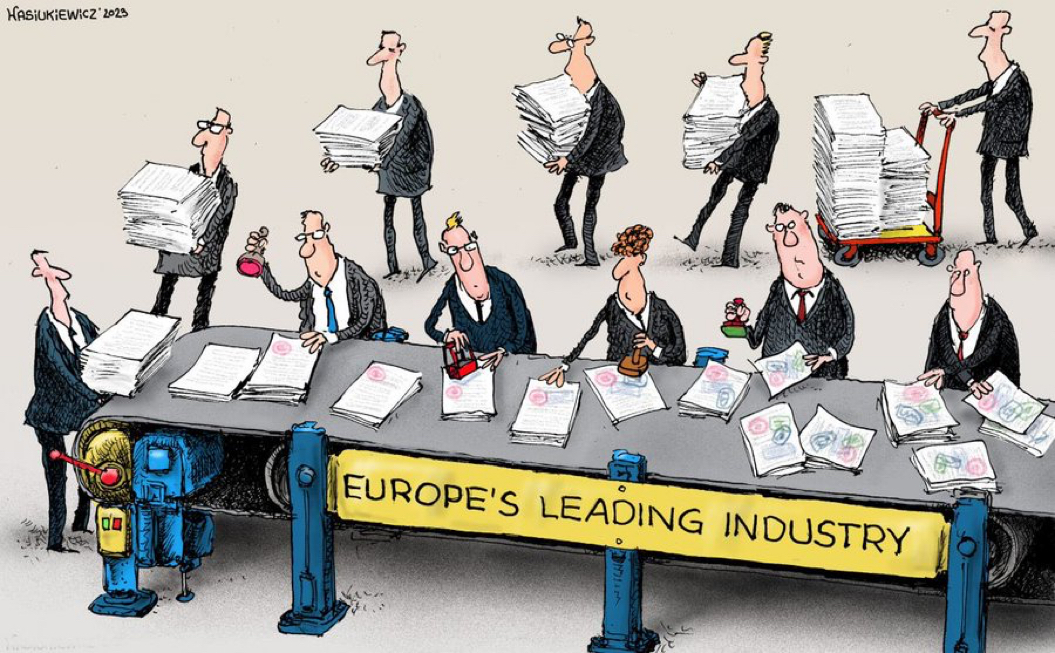
I have a special page for humor involving Europe, but I have not added to it since sharing some Brexit humor in 2016. Let’s being the process of catching up with some amusing cartoons and memes mocking our government-loving cousins on the other side of the Atlantic Ocean. I’ve made the serious point that bureaucrats […]
Mocking European Statism
Reviewing Covid experiences and policies
01 Feb 2025 Leave a comment
in applied price theory, applied welfare economics, comparative institutional analysis, economic growth, economics of bureaucracy, economics of regulation, health economics, macroeconomics, politics - New Zealand, Public Choice Tags: economics of pandemics

Michael Reddell writes – I’ve spent the last week writing a fairly substantial review of a recent book (“Australia’s Pandemic Exceptionalism: How we crushed the curve but lost the race”) by a couple of Australian academic economists on Australia’s pandemic policies and experiences. For all its limitations, there isn’t anything similar in New Zealand. What […]
Reviewing Covid experiences and policies
Reviewing Covid experiences and policies
30 Jan 2025 Leave a comment
in applied price theory, applied welfare economics, economic history, economics of bureaucracy, economics of regulation, fiscal policy, health and safety, health economics, labour economics, labour supply, law and economics, macroeconomics, politics - Australia, politics - New Zealand, property rights, Public Choice Tags: economics of pandemics

I’ve spent the last week writing a fairly substantial review of a recent book (“Australia’s Pandemic Exceptionalism: How we crushed the curve but lost the race”) by a couple of Australian academic economists on Australia’s pandemic policies and experiences. For all its limitations, there isn’t anything similar in New Zealand. What we do have is […]
Reviewing Covid experiences and policies
The DEI preference cascade
23 Jan 2025 Leave a comment
in applied price theory, behavioural economics, discrimination, economics of bureaucracy, economics of education, economics of information, economics of media and culture, economics of regulation, gender, labour economics, law and economics, liberalism, Marxist economics, politics - USA, property rights, Public Choice Tags: affirmative action, Age of Enlightenment, free speech, political correctness, racial discrimination, regressive left, sex discrimination
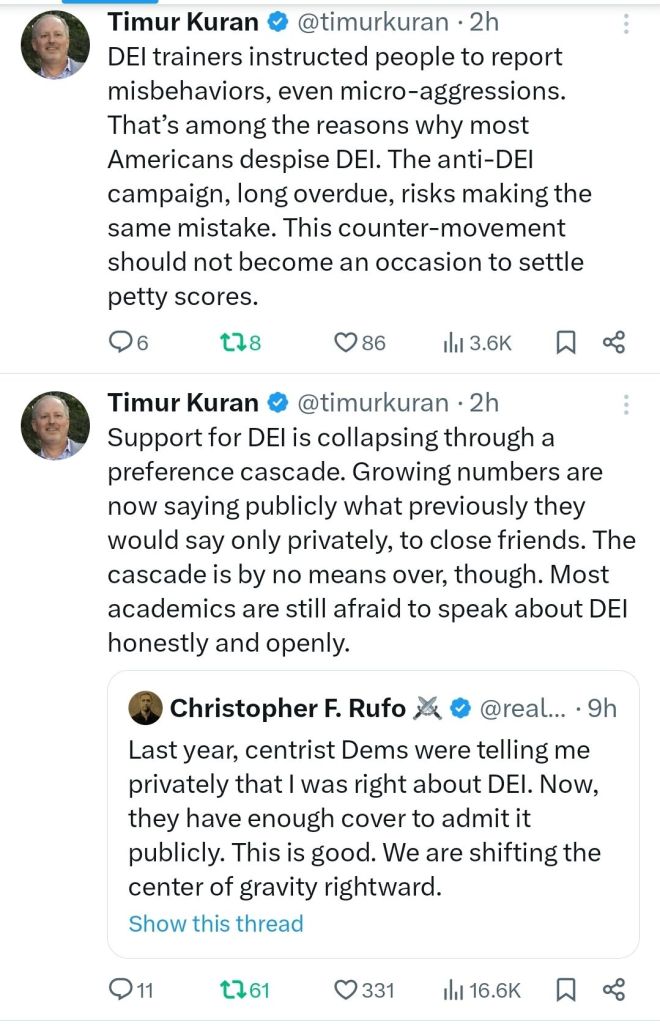
Bill Maher’s latest monologue: the L.A. fires and progressive politics
19 Jan 2025 Leave a comment
in economics of bureaucracy, economics of climate change, economics of natural disasters, environmental economics, environmentalism, global warming, law and economics, politics - USA, property rights, Public Choice Tags: climate alarmism
After a vacation hiatus, Bill Maher is back with a monologue called, “New rules: political firestorm.” Here he parses blame for the L.A. fires between unavoidable causes (no rain, lots of brush) and avoidable ones (blockheaded politicians). The latter, he says, involves cuts in the firse-department budget, stolen or nonfunctional hydrants, empty reservoirs, exposed power […]
Bill Maher’s latest monologue: the L.A. fires and progressive politics
Further proof the Council just made things worse
17 Jan 2025 Leave a comment
in applied price theory, comparative institutional analysis, economics of bureaucracy, economics of regulation, entrepreneurship, industrial organisation, politics - New Zealand, Public Choice, public economics, rentseeking, survivor principle
Stuff reports: Reading Cinemas is set to return to Wellington after it was revealed on Tuesday night that the cinema chain’s owner, Reading International, intends to undertake a redevelopment of the old building. The company has entered into a Sale and Purchase Agreement with Prime Property Group, with part of the deal including a seismic upgrade […]
Further proof the Council just made things worse
Noah Smith on L.A: fire lessons
13 Jan 2025 Leave a comment
in applied price theory, economics of bureaucracy, economics of natural disasters, environmental economics, environmentalism, income redistribution, law and economics, politics - USA, property rights, Public Choice, rentseeking, urban economics Tags: unintended consequences
The best piece I have seen so far, here is one bit: Basically, the lessons I take away from the horrific L.A. fires are: The insurance industry as we know it is in big trouble. Climate change is making wildfires worse, but there’s not much we can do about that right now. Forest management needs […]
Noah Smith on L.A: fire lessons
Smart Growth Burns Thousands of Homes
11 Jan 2025 1 Comment
in economics of bureaucracy, economics of natural disasters, economics of regulation, environmental economics, law and economics, property rights, Public Choice, urban economics Tags: land use planning, unintended consequences, zoning
Los Angeles city and regional planners are just as responsible for the Palisades, Eaton, and other fires that have burned in the past few days as if they had poured gasoline on the homes and lit the matches. The destruction of these homes, including, for what it is worth, homes … Continue reading →
Smart Growth Burns Thousands of Homes
A Reading deal that doesn’t cost ratepayers
08 Jan 2025 Leave a comment
in economics of bureaucracy, entrepreneurship, industrial organisation, law and economics, politics - New Zealand, property rights, Public Choice, rentseeking, survivor principle
NewstalkZb reports: The derelict Reading Cinema complex on Wellington’s Courtenay Place has finally been sold, with a local developer snapping up the 1.5-hectare plot. The property was at the centre of a controversial deal between Wellington City Council and Reading International last year, after the council tried to buy the land under the quake-prone building […]
A Reading deal that doesn’t cost ratepayers
Submission on the Principles of the Treaty of Waitangi Bill
07 Jan 2025 Leave a comment
in comparative institutional analysis, constitutional political economy, economic history, economics of bureaucracy, law and economics, liberalism, Marxist economics, politics - New Zealand, property rights, Public Choice Tags: constitutional law
By Dr Peter Winsley I support the Bill, despite its weaknesses. For expositional clarity, in my submission I use the term “te Tiriti” rather than “the Treaty.” This acknowledges that about 540 rangatira signed te Tiriti versus about 39 who signed the English language document.to a Context is important. Te Tiriti was an international treaty […]
Submission on the Principles of the Treaty of Waitangi Bill
Some Links
06 Jan 2025 Leave a comment
in applied price theory, economics of bureaucracy, economics of regulation, entrepreneurship, income redistribution, industrial organisation, politics - USA, Public Choice, rentseeking, survivor principle
TweetScott Lincicome decries Biden’s abuse of national security to block Nippon Steel’s acquisition of U.S. Steel. Two slices: Today, President Joe Biden blocked Nippon Steel’s proposed acquisition of US Steel on the grounds that “there is credible evidence” the Japanese steelmaker “might take action that threatens to impair the national security of the United States.” What…
Some Links
 Utopia, you are standing in it!
Recent Comments