
It’s not easy to be green: the cost of fossil fuels divestments to the New Zealand superannuation fund
17 Feb 2015 Leave a comment
in economics of bureaucracy, energy economics, environmental economics, environmentalism, financial economics, global warming, Public Choice, rentseeking Tags: efficient market hypothesis, fossil fuel disinvestment, Global disinvestment day, Green Party of New Zealand, index linked investing, privatisation, state ownership
The Green Party of New Zealand wants the New Zealand superannuation fund to sell its $676 million in fossil fuel investments. For those not in the know, this government investment fund is worth about $25 billion and is funded by present taxes to pay for the universal old age pension in New Zealand. Its current investment strategy seems to rely heavily on index linked funds that minimise management and trading costs.
The Government uses the Fund to save now in order to help pay for the future cost of providing universal superannuation.
In this way the Fund helps smooth the cost of superannuation between today’s taxpayers and future generations.
In common with the endowment funds of the American universities, that $676 million is about 2% of the total New Zealand superannuation portfolio of about NZ$25 billion.

Any portfolio manager risks considerable fees if she must monitor the entire portfolio because 2% is of dubious moral stature.

The main cost of divestiture is compliance costs to prevent fossil fuel investments drifting back into the portfolio through the routine day to day investments of other companies within their portfolios as these other firms expand into new businesses or diversified. The entire portfolio must be monitored for this risk.

American universities found that fossil fuels divestment rules out indexed linked funds as a class, along with their low management and trading fees. Ethical investors must move to actively managed investment funds which are perhaps a third more expensive in management fees.

If a move to a fossil fuel free portfolio rules out passive indexed linked funds, that is a major risk to future returns of the New Zealand superannuation fund. Would this fossil fuels disinvestment including selling the recently acquired Z petrol station network by the New Zealand superannuation fund?
Z Energy now owns and manages these businesses, which include:
- a 15.4 per cent stake in Refining NZ who runs New Zealand’s only oil refinery.
- a 25 per cent stake in Loyalty New Zealand who run Fly Buys
- over 200 service stations
- about 90 truck stops
- pipelines, terminals and bulk storage
As usual, in the course of argument for disinvestment by the government investment fund, the Green Party makes an excellent argument for the privatisation not only of state owned enterprises but of the New Zealand superannuation fund.
Rather than have one victory at a time, the Greens want the NZ superannuation fund to use the funds from the disinvestment to reinvest in pet projects of politicians. The green party co-leader said:
Money released from divestment can be reinvested in the rapidly growing renewable energy and energy efficiency sectors, helping to hasten the transition of our economy to a low-carbon future.
This makes government investment funds the playthings of politicians so they can never match the returns of a genuinely privately owned investment fund.
The Law of Crappy Managers
14 Feb 2015 Leave a comment
in economics of bureaucracy, industrial organisation, managerial economics, occupational choice, organisational economics, personnel economics, survivor principle Tags: Peter Principle

A clear conscience – Yes Prime Minister
10 Feb 2015 Leave a comment
in constitutional political economy, economics of bureaucracy, Public Choice, TV shows Tags: Yes Prime Minister
Officially official meeting minutes – Yes Prime Minister
06 Feb 2015 Leave a comment
in economics of bureaucracy Tags: Yes Prime Minister
If the right people don’t have power – Yes Prime Minister
03 Feb 2015 Leave a comment
in constitutional political economy, economics of bureaucracy, Public Choice, TV shows Tags: devolution, federalism, Yes Prime Minister
Why do economic consulting firms exist?
02 Feb 2015 1 Comment
in applied price theory, economics of bureaucracy, economics of information, financial economics, law and economics, managerial economics, organisational economics, survivor principle Tags: advice giving industries, corporate law, Deirdre McCloskey, directors duties, economic consultants

Directors’ duties are the reason why the companies hire economic consultants. What consultants say isn’t important; the fact that simply the directors of a company sought advice is what matters. Same goes for the public sector: you must know what you’re doing, you took advice from outside experts.
Central to avoiding being sued if the company goes broke, or otherwise gets into a spot of bother, is the directors show that they acted responsibly.
Central to this is they can show they took advice from esteemed advisers: an accountant, a lawyer and an economist. If they did so, they must be responsible prudent directors because they took advice.

Deirdre McCloskey argued that the advising industry lives off 19th century case law on directors’ and trustees’ duties.
If you take advice – from an accountant, a lawyer or an economist – and the business or investment still fails, it can’t be your fault that you lost the widow’s and orphans’s inheritance.
You took advice. That is what that 19th-century court held with regard to what directors do and do not have to do given the fact that are not involved in the business on a day to day basis.
James Burk, a sociologist and former stockbroker… found that the advice giving industry sprang from legal decisions in the early 19th century.
The courts began to decide that the trustee of the pension fund or a child’s inheritance could be held liable for bad investing if they did not take advice. The effect would have been the same had the court decided that prudent man should consult a Ouija boards or the flight of birds…
America decided through its courts than an industry giving advice on the stock market should come into existence, whether or not it was worthless.
Therefore, it doesn’t matter what you say as a consultant economist to a company, the fact you’ve said something to them is more important to them than what you are saying. Seeking and receiving your advice excused them from being sued for breach of their directors duties for a couple of days.
The success of monetarism and the death of the correlation between monetary growth and inflation
30 Jan 2015 1 Comment
in business cycles, econometerics, economics of bureaucracy, economics of information, inflation targeting, macroeconomics, Milton Friedman, monetarism, monetary economics, politics - Australia, politics - New Zealand, politics - USA Tags: lags on monetary policy, Levis Kochin, monetary policy

Monetarists blame fluctuations in inflation on excessively volatile growth in monetary aggregates. In 1982, Friedman defined monetarism in an essay on defining monetarism as follows:
Like many other monetarists, I have concluded that the most important thing is to keep monetary policy from doing harm.
We believe that a steady rate of monetary growth would promote economic stability and that a moderate rate of monetary growth would prevent inflation
The U.S. data supported this hypothesis about the volatility of monetary growth and inflationuntil 1982, but since 1983 monetary aggregates have been essentially uncorrelated with subsequent inflation in the U.S.
Levis Kochin pointed out in 1979 that a well designed monetary policy would lead to zero correlation between any measure of monetary policy and subsequent inflation. The reason for this is the correlation between any variable and a constant is zero.
If monetary growth is stable, say, a constant growth rate of 4% per year, as advocated by Milton Friedman, monetary growth will have no correlations with any variable:
Poole (1993, 1994) and Tanner (1993) also argue that one predictable consequence of optimal monetary policy is that the correlation between monetary policy instruments and policy goals will be driven to zero.
Poole further contends that it is obvious to any careful reader of Theil (1964) that optimally variable policy will give rise to a zero correlation between policy and goal variable…
In 1966 Alan Walters, a U.K. monetarist, observed:
If the [monetary] authority was perfectly successful then we should observe variations in the rate of change of the stock of money but not variations in the rate of change of income… [a]ssuming that the authority’s objective is to stabilize the growth of income.
Milton Friedman in 2003, wrote about how the Fed acquired a good thermostat:
The contrast between the periods before and after the middle of the 1980s is remarkable.
Before, it is like a chart of the temperature in a room without a thermostat in a location with very variable climate; after, it is like the temperature in the same room but with a reasonably good though not perfect thermostat, and one that is set to a gradually declining temperature.
Sometime around 1985, the Fed appears to have acquired the thermostat that it had been seeking the whole of its life…
Prior to the 1980s, the Fed got into trouble because it generated wide fluctuations in monetary growth per unit of output. Far from promoting price stability, it was itself a major source of instability as Chart 1 illustrates.
Yet since the mid ’80s, it has managed to control the money supply in such a way as to offset changes not only in output but also in velocity.
Nick Rowe explained the difficulty of causation and correlation under different policy regimes and Milton Friedman’s thermostat superbly as an econometric problem Nick Rowe:
If a house has a good thermostat, we should observe a strong negative correlation between the amount of oil burned in the furnace (M), and the outside temperature (V).
But we should observe no correlation between the amount of oil burned in the furnace (M) and the inside temperature (P). And we should observe no correlation between the outside temperature (V) and the inside temperature (P).
An econometrician, observing the data, concludes that the amount of oil burned had no effect on the inside temperature. Neither did the outside temperature. The only effect of burning oil seemed to be that it reduced the outside temperature. An increase in M will cause a decline in V, and have no effect on P.
A second econometrician, observing the same data, concludes that causality runs in the opposite direction. The only effect of an increase in outside temperature is to reduce the amount of oil burned. An increase in V will cause a decline in M, and have no effect on P.
But both agree that M and V are irrelevant for P. They switch off the furnace, and stop wasting their money on oil.
Subsequent work of Levis Kochin showed that if the effects of fluctuations in monetary aggregates were not precisely known then the optimal policy would produce negative correlations between monetary aggregates and inflation:
The negative correlation results from coefficient uncertainty because the less certain we are about the size of a multiplier, the more cautious we should be in the application of the associated policy instrument.
Therefore, although optimal policy leads to lack of correlation between the goal and control variables if the coefficient is known, it will lead to a negative relationship if there is coefficient uncertainty. The higher the uncertainty, the more cautious will be the optimal policy response. Also, if the control variable can’t be controlled perfectly then the correlation between the goal and the control variable becomes positive i.e., the control errors are random…
Uncertainty about the impact of a policy will stay the hand of any bureaucrat , much less a central banker, as Kochin and his co-author explain:
Uncertainty should lead to less policy action by the policymakers. The less policymakers are informed about the relevant parameters, the less activist the policy should be. With poor information about the effects of policy, very active policy runs a higher danger of introducing unnecessary fluctuations in the economy.
Robert D. Tollison on the main positive contribution of economists to public policy
30 Jan 2015 Leave a comment


Proof at last, that the moon landing was real
26 Jan 2015 Leave a comment
in economics of bureaucracy, politics - USA, technological progress Tags: conspiracy theorists, immigration, moon landing
Gordon Tullock on avoiding difficult decisions about saving lives – updated
24 Jan 2015 Leave a comment
in constitutional political economy, economics of bureaucracy, economics of regulation, Gordon Tullock, health and safety, health economics, income redistribution, James Buchanan, labour economics, Rawls and Nozick Tags: expressive voting, health and safety, James Buchanan, rational ignorance, rational irrationality, statistical life, veil of ignorance, veil of insignificance, veil of uncertainty

Gordon Tullock wrote a 1979 New York Law Review book about avoiding difficult choices. His review was of a book by Guido Calabresi and Philip Bobbitt called Tragic Choices which was about the rationing: the allocation of kidney dialysis machines (a “good”), military service in wartime (a “bad”), and entitlements to have children (a mixed blessing).
Tullock argued that we make a decision about how to allocate resources, how to distribute the resources, and then how to think about the previous two choices. People do not want to face up to the fact resources are scarce and they face limits on their powers.
To reduce the personal distress of making these tragic choices, Tullock observed that people often allocate and distribute resources in a different way so as to better conceal from themselves the unhappy choices they had to make even if this means the recipients of these choices are worse off and more lives are lost than if more open and honest choices were made up about there only being so much that can be done.
The Left over Left and union movement spends a lot of time pontificating about how we must not let economics influence health and safety policy rather than help frame public policy guidance on what must be done because scarcity of resources requires the valuation of life in everything from health, safety, and environmental regulations to road building. health budgeting is full of tragic choices about how much is spend to save so lives and where and for how long.
The Left over Left and the union movement deceive themselves and others into make futile gestures to make themselves feel good. These dilettantes cannot assume that they are safely behind a veil of insignificance. They have real influence on how public policy on health and safety are made.
A major driver of the opposition among the Left over Left and the union movement to the use of cost-benefit analysis and the valuation of statistical lives is its adoption makes people confront the tragic consequence of any of the choices available to them.
By saying how dare you value a statistical life does not change the fact that choices made without this knowledge will still have tragic consequences, and more lives may be lost because people want to conceal from themselves the difficult choices that they are making about others as voters and as policy-makers.
One of the purposes of John Rawls’ veil of ignorance and Buchanan and Tullock’s veil of uncertainty is that the basic social institutions be designed and agreed when we have abstracted from the grubby particulars of our own self-interest. Buchanan and Tullock explain the thought experiment this way
Agreement seems more likely on general rules for collective choice than on the later choices to be made within the confines of certain agreed-upon rules. …
Essential to the analysis is the presumption that the individual is uncertain as to what his own precise role will be in any one of the whole chain of later collective choices that will actually have to be made.
For this reason he is considered not to have a particular and distinguishable interest separate and apart from his fellows.
This is not to suggest that he will act contrary to own interest; but the individual will not find it advantageous to vote for rules that may promote sectional, class, or group interests because, by supposition, he is unable to predict the role that he will be playing in the actual collective decision-making process at any particular time in the future.
He cannot predict with any degree of certainty whether he is more likely to be in a winning or a losing coalition on any specific issue. Therefore, he will assume that occasionally he will be in one group and occasionally in the other.
His own self-interest will lead him to choose rules that will maximize the utility of an individual in a series of collective decisions with his own preferences on the separate issues being more or less randomly distributed.
Behind the veil of ignorance and the veil of uncertainty, we would all agree that resources are limited, including in the health sector and some drugs can’t be funded – choices must be made.
Once we go in front of the veil of ignorance and find out that we are the one missing out on that drug, naturally, our views will change. We agreed to these rules as fair for the distribution of basic social resources when, as John Rawls put it:
…no one knows his place in society, his class position or social status; nor does he know his fortune in the distribution of natural assets and abilities, his intelligence and strength, and the like.
Is always the case that someone just falls on the other side of any line in the sand. If you move that line, there is always another set of people who are just on the other side.

Paul Samuelson’s repeated predictions of the Soviet Union economy catching up with the USA
24 Jan 2015 1 Comment
in economic history, economics of bureaucracy, growth disasters, Marxist economics Tags: fall of communism, fall of the USSR, forecasting errors, Paul Samuelson, The fatal conceit, The pretence to knowledge
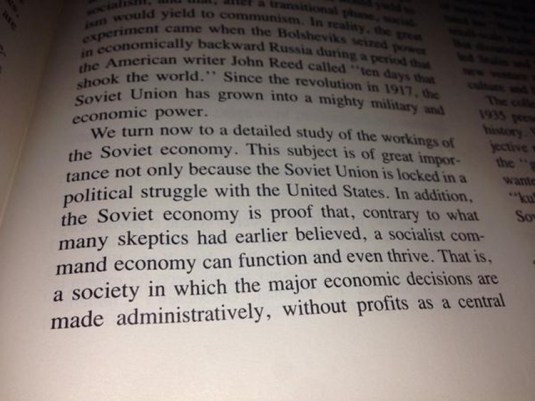
Paul Samuelson wrote in the 1961 edition of his famous economics textbook that GNP in the Soviet Union was about half that in the United States but the Soviet Union was growing faster.
Figure 1: Samuelson’s 1961 Forecast of Soviet catch up

Source: Levy and Peart (2006)
As a result, Soviet GNP would exceed that of the United States by as early as 1984 or perhaps by as late as 1997, depending on whether you were reading the early 1960s or later editions of Samuelson’s immensely popular textbook. In the 1980 edition there was little change in the analysis, though the two dates were delayed to 2002 and 2012
Samuelson predicted that the Soviet Union would catch up with the United States and kept predicting this until 1989 in every edition of his textbook of which there are at least 14. Levy and Peart were good enough to tabulate these predictions by Samuelsson of Soviet catch up with the USA over the editions of his textbook in the table below.
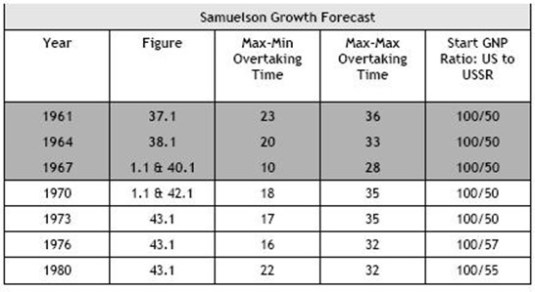
Source: Levy and Peart (2009)
Samuelson’s predictions of the Soviet Union catching up to and overtaking the United States were echoed in most other major economics textbooks of his time.
Plainly, they all got it wrong except for the Austrian economists, Eastern bloc émigrés and G. Warren Nutter.
From 1956 to 1961, Nutter undertook a massive study of the history of the economy of the Soviet Union and published The Growth of Industrial Production in the Soviet Union in 1962.
Nutter’s study concluded that Soviet economic growth over the first half of the 20th Century was indeed remarkable, and that there had been periods of growth spurts, but when the entire Soviet period was taken into consideration, Soviet growth lagged behind Western economies and Soviet economic capacity showed every sign of falling further behind rather than catching up with the West.
Nutter’s conclusions were certainly not welcomed by the Sovietologists of his time. As the fall of the Soviet Union revealed more realistic data, Nutter’s estimates of Soviet growth rates have been vindicated, and in fact, if anything Nutter overstated rather than understated Soviet economic performance.
Paul Craig Roberts found worse exaggeration with the Romanian economy in 1979. A World Bank report, Romania: The Industrialization of an Agrarian Economy under Socialist Planning, credited central planning with achieving a 9.8 annual rate of economic growth over the quarter century from 1950 to 1975. It should be added that in the 1970s, Romania was a western favourite because of its independent stance within the Eastern European bloc.
The World Bank did not realize that using these growth rates to project backward these growth figures on Romanian income per capita quickly produced a figure too low to sustain life. This mistake provoked the Wall Street Journal observation:
We have heard exaggerated claims made for central economic planning, but never that it resurrected a whole nation from the dead.
Samuelson never reflected in his later textbooks after 1989 about how wrong he was for many decades about Soviet economic performance. Few people, thank you for admitting that there you’re wrong – they are more likely to dance on the grave of your error.
In Paul Samuelson’s case, he had more reasons of most to learn from his failed predictions because as his predictions didn’t work out, he had to rewrite and update his book and charts predicting the USSR was going to overtake the USA in about 20 years.
Rather than the suspect that there something wrong with the Soviet economic system, Paul Samuelson looked for excuses – increasingly pathetic excuses. As Larry White explained:
In the seven editions of his textbook published from 1961 to 1980, Samuelson kept including a chart indicating that Soviet output was growing faster that U.S. output, and predicting a catch-up in about twenty-five years. He repeatedly had to move the predicted catch-up date forward from the previous edition because the gap had never actually begun to close. In several editions he blamed low realized Soviet growth on bad weather.
What is more puzzling is Samuelson did update his views on the merits of fiscal and monetary policy in stabilising the economy, and the effectiveness of each over the decades in light of experience and between the 1960s and 1980s. In the 1948 edition of his best-selling textbook, Economics, Samuelson wrote that:
few economists regard Federal Reserve monetary policy as a panacea for controlling the business cycle.
In 1967 Samuelson said that monetary policy had “an important influence” on total spending. His 1985 edition states;
“Money is the most powerful and useful tool that macroeconomic policymakers have,” adding that the Fed “is the most important factor” in making policy.
Samuelson’s 1967 edition said policymakers faced a trade-off between inflation and unemployment. His 1980 edition said there was less of a trade-off in the long run than in the short run. The 1985 edition, he said there is no long-run trade-off between unemployment and inflation.
Samuelson gave quite compelling reasons as to why Keynesianism declined:
- Keynesian macroeconomists and policymakers made the mistake of projecting the experience of the Great Depression onto the post-war era;
- it turned out that, contrary to what Keynes had said, monetary policy mattered a lot; and
- The final blow to Keynesianism was stagflation: There is nothing in Keynesian macroeconomics that would allow you to solve stagflation.
Samuelson did not learn in the same way from brute experience regarding the economics of socialism.
Via Why Were American Econ Textbooks So Pro-Soviet? Bryan Caplan | EconLog | Library of Economics and Liberty and Soviet Growth & American Textbooks.


Recent Comments