David D. Friedman | Market failure
22 Apr 2019 Leave a comment
in applied price theory, applied welfare economics, comparative institutional analysis, constitutional political economy, David Friedman, economic history, economics of bureaucracy, economics of crime, economics of regulation, entrepreneurship, environmental economics, Gordon Tullock, income redistribution, industrial organisation, international economics, law and economics, personnel economics, property rights, Public Choice, public economics, rentseeking, survivor principle, theory of the firm Tags: market failure
Gordon Tullock on voting
28 Dec 2018 Leave a comment
in Gordon Tullock, Public Choice Tags: rational ignorance
The Tullock Paradox. Why is the rent seeking industry so small?
31 Jul 2018 Leave a comment
in applied price theory, comparative institutional analysis, constitutional political economy, development economics, economics of bureaucracy, economics of crime, economics of regulation, Gordon Tullock, growth disasters, law and economics, Public Choice, rentseeking Tags: economics of corruption
Deirdre McCloskey summarises Rawls and Nozick on unequal incomes
02 Jan 2017 Leave a comment
in applied price theory, applied welfare economics, comparative institutional analysis, constitutional political economy, development economics, economic history, Gordon Tullock, growth miracles, history of economic thought, James Buchanan, James Buchanan, labour economics, law and economics, poverty and inequality, property rights, Public Choice, Rawls and Nozick Tags: creative destruction, Deirdre McCloskey, industrial revolution, John Rawls, Robert Nozick, The Great Enrichment, The Great Escape, The Great Fact, top 1%, veil of ignorance, veil of uncertainty
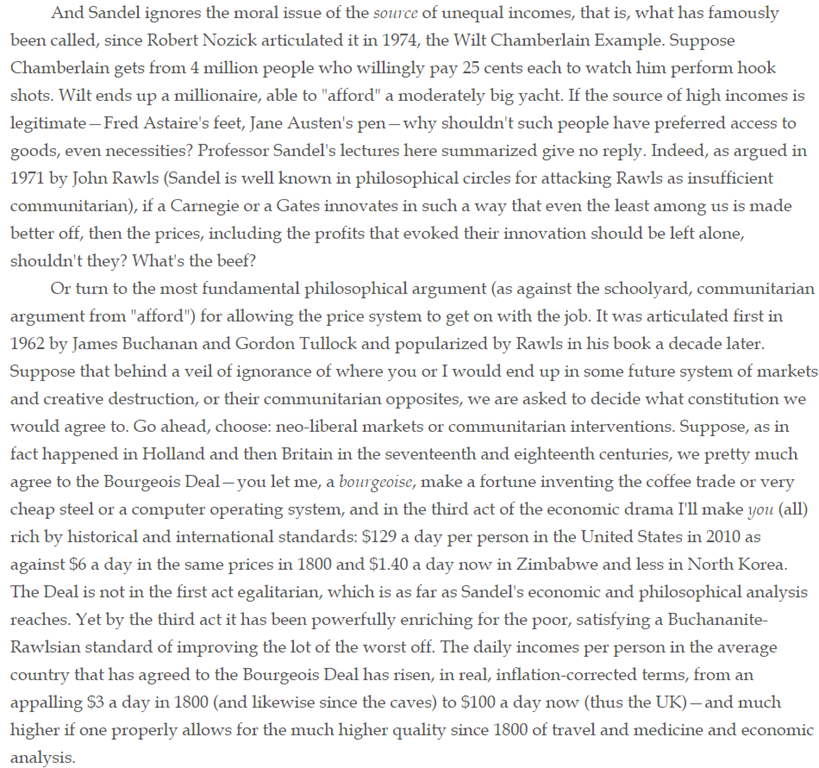
Source: Review of Michael J. Sandel’s What Money Can’t Buy: The Moral Limit of Markets by Deirdre McCloskey August 1, 2012. Shorter version published in the Claremont Review of Books XII(4), Fall 2012 via Deirdre McCloskey: editorials.
Tullock vindicated by how the Romanian revolution succeeded
16 Jul 2016 Leave a comment
in applied price theory, comparative institutional analysis, constitutional political economy, defence economics, economics of bureaucracy, Gordon Tullock, Public Choice, rentseeking Tags: economics of revolutions, fall of communism, military coups, people power, Romania
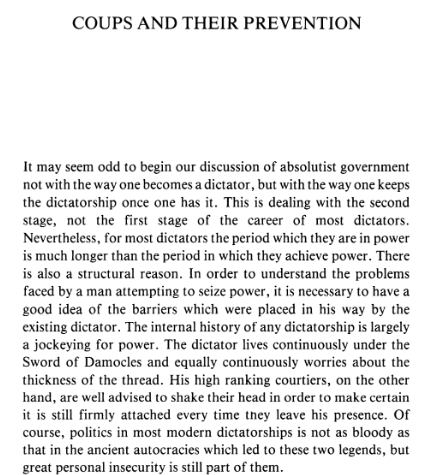
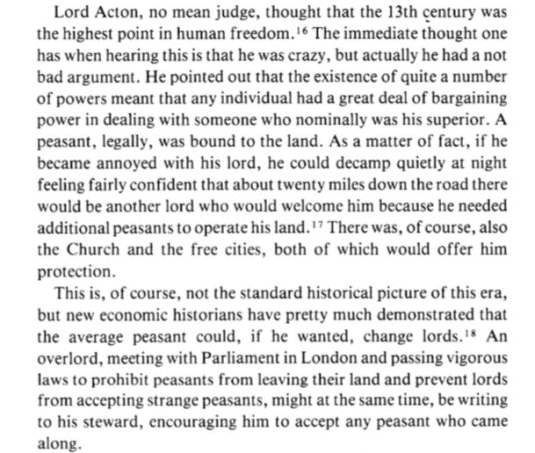
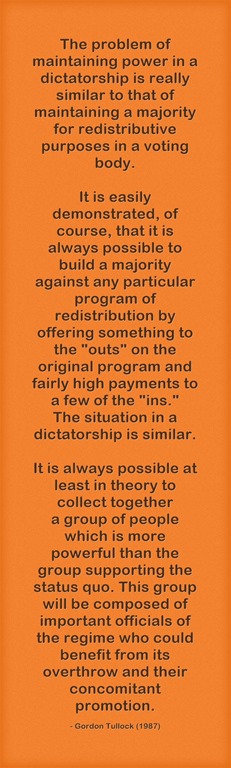
The obituaries today for Victor Stanculescu, the Romanian army chief at the time of the 1989 revolution, vindicated Gordon Tullock’s view that popular revolutions are in fact military coups.
Tullock argues that any dictator can survive popular revolts as long as he has
- a secret police that is moderately competent and willing to torture and kill; and
- offers large rewards for informing on members his own entourage plotting to overthrow him.
Ordinary citizens obey dictators because if they don’t, they are highly unlikely to make any difference in any revolt and could get killed during the uprising even if it succeeds. Worse awaits them if the revolt fails.
Most dictators do not anoint a formal successor while they are in office. Tullock argued that as soon as a likely successor emerges, loyal retainers start to form alliances with that person and may see private advantage in bringing his anointed day forward.
More than a few autocrats were murdered in their sleep. To his very last day, Stalin locked his bedroom door because he did not trust the bodyguards who had been with him since the 1920s.
The role of street protests in the Arab Spring was to throw in the possibility of mutinies and desertions in the army and police. Previous alliances are thrown into doubt especially as the autocrat is old and sick, but had for many years grooming his 39 year-old son to inherit power.
Turning back to the Romanian revolution, Victor Stanculescu was the recently appointed army chief and initially stuck by the regime. He ordered the troops to open fire on protesters and at least 1000 died from in the shootings in the street.
In common with the Arab Spring, a large street protest did led him to reconsider his position:
Sniffing Mr. Ceausescu’s defeat, General Stanculescu quickly returned to Bucharest, where he faked a broken leg to avoid further counterrevolutionary deployment. Promoted to defense minister after the incumbent minister killed himself, he helped Mr. Ceausescu and his wife, Elena, flee by helicopter from the roof of party headquarters.
But fearing that the copter had been spotted by radar and would be shot down, the pilot hastily landed. Mr. Ceausescu hijacked a passing car, but he and his wife were soon surrounded and arrested.
After the couple were captured, General Stanculescu organized their trial by a military court and recruited the firing squad (before the verdict, by some accounts) that executed them on Christmas Day. He then joined the new government.
But for this late switch by the army chief, the popular revolt would never have succeeded. The army was needed to put down the still loyal security police. The army chief’s top priority was to execute Ceausescu as quickly as possible so that he was not a rallying point for a counter coup.
Ceausescu found out that his game was up when who he thought was his still loyal army chief arrived at his hideout with military judges to try and execute him.
About 10 years later, the Romanian government turned against the man who made the revolution and put him in prison for the many deaths in the street when he was on the side of the regime putting down the revolt.
Not so good an idea. A little bit of forgiveness carries a lot of weight encouraging late switching within the ruling elite and army that makes the difference to bringing down the old regime.
why the world isn’t even more corrupt than what we observe
04 May 2016 Leave a comment
in applied price theory, development economics, economic history, economics, economics of crime, economics of regulation, entrepreneurship, Gordon Tullock, growth disasters, growth miracles, income redistribution, law and economics, Public Choice, rentseeking Tags: bribery and corruption, Tullock paradox

Gordon Tullock and Collective Preferences and Democracy
08 Nov 2015 Leave a comment
in constitutional political economy, Gordon Tullock, Public Choice Tags: preference aggregation
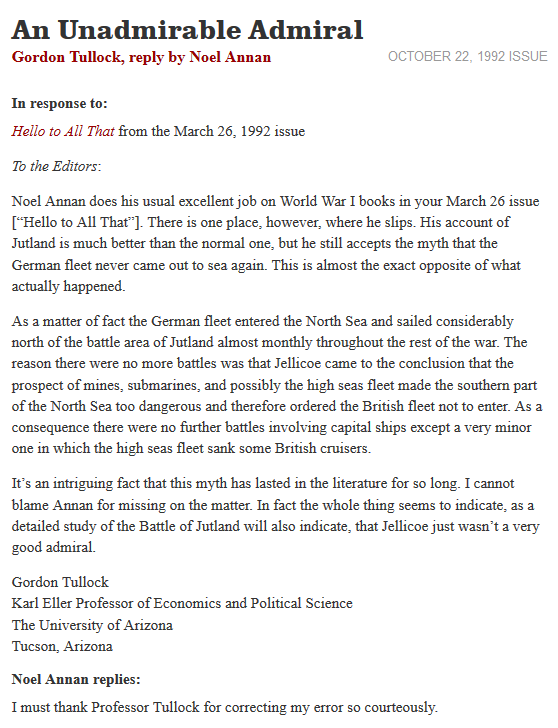
Was the Battle of Jutland decisive?
31 May 2015 1 Comment
in Gordon Tullock, war and peace Tags: World War I
 Utopia, you are standing in it!
Recent Comments