Why I am loathe calls to put politics aside

Image

Best sitcom – Yes minister 2

Best sitcom – Yes minister 1

Gordon Tullock and Peter Bernholz: Collective Preferences and Democracy

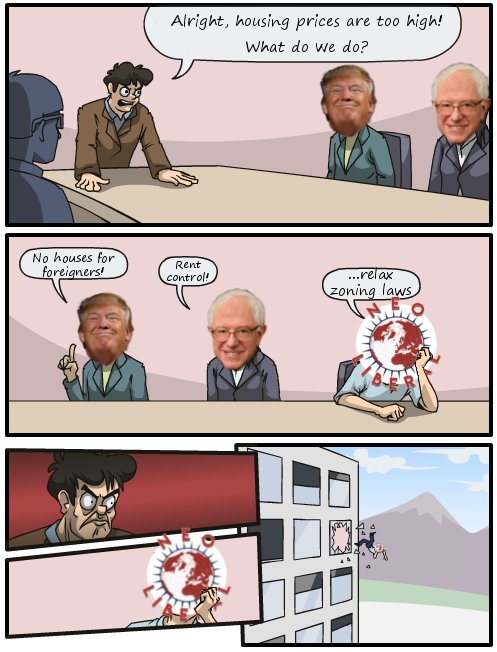
Housing affordability analysis of @NZGreens @julieannegenter

Most demanding part of #Citizenship7 High Court judgement

Renouncing your citizenship could include a trip back to the old country of your parents or grandparents that you have never ever visited. Have do you decide if it is too dangerous? DFAT travel warnings, individual threats of harm or just the level of bribes you have to pay to get anything done.

Image

Bureaucrats address problems, entrepreneurs seize untapped profit opportunities

This distinction between the perspective of an entrepreneur and bureaucracy is essential to problem solving. Bureaucracies look for problems to solve through policy interventions. Alert entrepreneurs grasp for untapped opportunities for profit before others jump ahead of them to seize the day.

Luke Froeb discovered this crisp difference in organisational perspective between entrepreneurs and bureaucrats when his MBA students kept falling asleep when he lectured on market failures and the standard public policy responses. His teaching evaluations were so bad that the Dean of his Business School threatened to fire him if his student evaluations did not improve. This focused his mind.

Froeb repackaged market failures as a business opportunity. His students sat up and paid close attention. Froeb saved his job and later wrote an excellent MBA textbook (Froeb and McCann 2008).

Froeb and McCann (2008) started the problem diagnosing with market failure is an untapped wealth-creating opportunity. Froeb told his students that the first to fill these gaps in the market or be the market maker for the missing market stands to profit. Alert entrepreneurs make money by identifying unconsummated wealth-creating transactions and devise ways to profitably consummate them.

The art of public policy is looking beyond the immediate effect of a policy to trace its consequences not merely for one group but for all. Looking past what is under your nose is not good business. Much of entrepreneurial alertness is seeing what others do not see under their very noses (Kirzner 1997).

The art of business is identifying assets in low-valued uses and devising ways to profitably move them into higher values uses (Froeb and McCann 2008). Wealth is created when entrepreneurs move assets to higher-valued uses. Cost control such as in a mega-project is a standard entrepreneurial challenge.

Froeb and McCann (2008) argued that mistakes – opportunities are missed – for one of two reasons:

  1. A lack of information; or
  2. Bad incentives.

Rational, self-interested actors err because either they do not have enough information to make better decisions, or they lack incentives to make the best use of information they already have.

Froeb and McCann (2008) argued that three questions arise about all business problems:

  1. Who is making the bad decision?
  2. Does the decision maker have enough information to make a good decision?
  3. Does the decision maker have the incentives to make a good decision?

For Froeb and McCann (2008), the answers to these questions immediately suggest ways to fix them:

  • Let someone else make the decision;
  • Give more information to the decision maker; or
  • Change the decision makers’ incentives.


Political activists hold more extreme positions than the average voter for their party

Political activists in any political party have such different opinions to the average supporter for that party is it is often advised that they not go door-knocking. The chart above for 2017 and below for 1994 compares the politically engaged with the views of the median Democrat and Republican.


Political activists who go doorknocking are more likely to put a voter off because of their interest in issues that simply do not interest the average voter for their party, much less the swinging voter.

This gap between the average party activist and average supporter of that party at the ballot box also explains why too many political activists explain political defeat in terms of the voters being wrong.

Feeling of powerlessness and voicelessness was a much better predictor of Trump support than age, race, college attainment, income, attitudes towards Muslims, illegal immigrants, or Hispanic identity

Source: Who Are Donald Trump’s Supporters? – The Atlantic.

Only Nixon could go to China, only @PhilTwyford could reform the RMA?

Right-wing politicians can sometimes implement policies that left-wing politicians cannot, and vice versa under Cowen and Sutter’s only Nixon can go to China theorem:

The point is that politicians with a previous record of opposing a policy shift are often the only ones who can bring it about, because their policy support provides a credible signal of policy quality to the relevant interest groups who would otherwise oppose the policy.

Contemporary wisdom has it that only Nixon could go to China and make a deal because his decades of fierce anti-Communist stance gave him credibility with fellow conservatives and shielded him from any domestic attack.

Cowen and Sutter say that a policy could depend on information – on which policies or values everyone could potentially agree, or on which agreement is impossible.

Politicians, who value both re-election and policy outcomes, realise the nature of the issue better through inside and secret information and superior analytical skills (or access to those skills), whereas voters do not have access to such information base or skills.

Only a right-wing president can credibly signal the desirability of a left-wing course of action. A left-wing president’s rapprochement with China would be dismissed as a dovish sell-out. Nixon must be going to China because that is the best possible policy choice and he would never do so otherwise giving his previous record of firm anti-Communism.

Left-wing parties adopt right-wing policies because they are good ideas that will get them re-elected. Bob Hawke, Tony Blair, and Bill Clinton were centre-left economic reformers who can credibly signal the desirability of their economic reforms because of the brand name capital they invested in distributional concerns and protecting the poor.

The same goes for reforming the Resource Management Act (RMA) in New Zealand. Only a left-wing government can implement major reforms such as abolishing the Auckland urban limit and other restrictions on land supply. Deregulation is normally a right-wing policy.

When a left-wing policy undertake reform of land use regulation, things must be so bad on the housing affordability front that they accept that the reforms must be done despite their natural reluctance to deregulate anything on ideological grounds.

Up until past the 2014 New Zealand election, the Labour Party undertook scare tactics on land use regulation reform as a way winning votes from environmentally leaning voters.

Housing affordability situation is now so bad, with a whole generation locked out of housing, that even the ideological opponents of deregulation accept that restrictions on the housing supply are a bad idea.

Naturally the Greens continue to have their head in the sand. That is the big difference between them and the Labour Party. The Greens are policy dilettantes. The Labour Party is made up of people who believe in making difficult choices and the need for trade-offs.

Why the Chinese growth rate will taper down

Many years ago, Mancur Olson wrote an insightful book about prosperity and dictatorships. He introduced the concept of rights intensive production. As countries become more and more developed, investment horizons lengthen and depends more and more upon the enforcement of contract and property rights in a tolerably honest way.

Instead of being the first entrepreneur to introduce the most basic technologies and profit handsomely, such as in China with the advent of capitalism, entrepreneurs are introducing a product upgrade or new product that is a minor improvement on current offerings. Such investments will take time to pay off.

Many years ago, an article was published in the Journal of Economic Perspectives about a survey of entrepreneurs in Russia and Poland. It was in the early 1990s. Each was asked whether an investment project that doubled their money in two years was worth the risk. The Russian entrepreneurs mostly said no, the Polish entrepreneur said yes. So insecure are the returns from investment in Russia at that time that the phenomenal returns were required before an investment was made. They would only invest if they could double the money in two years.

In many developing countries, China is an example, property rights are insecure. This means short payback periods are essential for investment. Entrepreneurs must make their money quickly. This means that as investment horizons inevitably lengthened, growth will slow because more and more technologies will not be profitable to introduce into China.

The reason that export based industrialisation is a common path to economic development for poor countries is it does not threaten the existing configuration of special interests. It does not involve deregulating any domestic industry. The export industries do not threaten the business interests and profits of existing rent seekers and ruling elites.

Post-war trade liberalisation and tariff cuts gave Korean and the other East Asian Tigers much greater access to major export markets. This allowed export production to expand without limit. This expansion did not threaten local special interests because they kept their privileges and barriers to entry into the domestic markets.

Institutional reforms and imported new technologies increased employment and incomes through this explosion in exporting in Japan and the newly industrialised countries in East Asia. This allowed the losers from the economic changes to be compensated directly or with new opportunities in the export sectors (Parente and Prescott 1999, 2005; Olson 1982, 1984; Acemoglu and Robinson 2005).

Incumbent suppliers and workers are less likely to be hurt by the adoption of more efficient technologies because output expands greatly through exporting. If a market is small and limited to one country, and output cannot be increased without price cuts, greater production efficiency from a new technology can lead to less employment and business closures. Industry insiders may oppose this. Exporting reduce the incentives for insiders to block more efficient technologies (Parente and Prescott 2005; Holmes and Schmitz 1995; Olson 1982). Distributional coalitions slow down a society’s capacity to adopt new technologies and to reallocate resources in response to changing conditions and thereby reduce the rate of economic growth. 

Many other under-developed nations did not grow because institutional sclerosis locked them into yesterday’s technologies and industries with low growth and major declines in relative incomes (Olson 1982, 1984; Heckelman 2007; Bischoff 2007). A growing accumulation of distributional coalitions – institutional sclerosis – slowed down the capacity of these under-developed countries to adopt new technologies and reallocate resources across firms and industries in response to changing conditions and new opportunities (Olson 1982, 1984; Acemoglu and Robinson 2005).

Latin America is a good example of stagnation after initial prosperity because of the accumulation of barriers to efficient production. Latin America has many more international and domestic barriers to competition than do Western and the successful East Asian countries (Cole et al. 2005).

One of the tricks in the tail that the Chinese employed was market preserving federalism. Their local governments were not allowed to block outsiders as was the case in Russia as Olivier Blanchard & Andrei Shleifer explain:

In China, local governments have actively contributed to the growth of new firms. In Russia, local governments have typically stood in the way, be it through taxation, regulation, or corruption.

There appears to be two main reasons behind the behavior of local governments in Russia. First, capture by old firms, leading local governments to protect them from competition by new entrants. Second, competition for rents by local officials, eliminating incentives for new firms to enter. The question then is why this has not happened in China. We argue that the answer lies in the degree of political centralization present in China, but not in Russia.

Transition in China has taken place under the tight control of the communist party. As a result, the central government has been in a strong position both to reward and to punish local administrations, reducing both the risk of local capture and the scope of competition for rents.

By contrast, transition in Russia has come with the emergence of a partly dysfunctional democracy. The central government has been neither strong enough to impose its views, nor strong enough to set clear rules about the sharing of the proceeds of growth. As a result, local governments have had few incentives either to resist capture or to rein in competition for rents. Based on the experience of China, a number of researchers have argued that federalism could play a central role in development. We agree, but with an important caveat. We believe the experience of Russia indicates that another ingredient is crucial, namely political centralization.

The Chinese have also used what succeeded in Latin America for some time. You have politically connected partner; a family member of a politician.

China faces two major barriers to its growth. Firstly, insecure property rights will become more important because investment horizons get longer as a country develops. Secondly, political coalitions will emerge seeking the redistribution of wealth and blocking new competition.

Trump studies!

https://twitter.com/JonHaidt/status/920251868504379392

Room for honest disagreement on tax policy?

Too much of tax policy is debated with pistols drawn at ten paces. Each side accusing the other of ignorance or being steeped in moral turpitude, and preferably often both.

Far too much time is spent feuding over the incentive effects of taxes. If you inspect closely the history of the warring sides, they all agree that incentives matter. If you tax something, you see less of it; if you cut taxes, you will see more of it. The difficulty is the advocates for various causes are disappointingly selective about when they admit this is so.

Incentives do matter

Thomas Piketty could not be more honest about the impact of a higher top tax rate. Piketty welcomes the strong incentive effects of high marginal tax rates!

Why? Piketty wants to use high taxes to put an end to top incomes. He wants few to earn a large income and if they do, they should face ruinously high 70-80% marginal tax rates.

This honesty of Piketty is the basis of a ceasefire. Let us all admit that taxes have incentive effects and argue whether that is good or bad or that other considerations are more important than efficiency. Too often in debates over income tax cuts, the opponents will not give an inch on the labour supply and investment effects of lower taxes.

Incentives count, especially when they bolster your case

But when the same groups argue about poverty traps when welfare benefits are wound back or when tax rates and Working for Families abatement rates interact, they admit that work must pay. Ordinary families will work less and second earners may stop working.

Those deeply troubled about poverty traps from high effective marginal tax rates deny point blank that putting the top tax rate back up to 39% or more will harm labour supply, investment, entrepreneurship and the incentive to go on to higher education.

On taxes on sugar and tobacco, consumers are said to be fairly responsive to higher taxes. Unkind words are said about the motives of those that disagree with these taxes.

The opposition is about how taxes on sugary drinks is a waste of time unless they are prohibitively high because there is plenty of substitute sources of sugar and fattening foods.

A higher tobacco tax is much more likely to cut smoking because there is no reasonable substitute. If the Government really wanted people to quit smoking, rather than raise more revenue, they would legalise the sale of the safer alternative — e-cigarettes containing nicotine.

Opponents of company tax cuts are unwilling to admit that in highly integrated global capital markets that a lower company tax wins more investment. They say that more tax is paid in the home country of the foreign investor if we cut our company tax.

In the next breath, they will rage against Facebook and Google for avoiding New Zealand company taxes. This is despite their previous argument implying this tax avoidance must be futile because Facebook and Google will pay more taxes off-shore if they pay less company tax in New Zealand.

European Union politicians will say in domestic elections that company taxes do not deter investment but still relentlessly bully the Irish for its 12.5% company tax rate because it was winning more investment at their expense. What is the point of the EU and G20 push for tax harmonisation unless it is to stop competition for investment through lower company taxes?

Clashing value judgements

It is perfectly reasonable to agree on the effect of a particular tax policy but have an honest disagreement about its desirability. A higher top tax rate will not raise as much revenue as some hope but that may not matter if you want less income inequality. Sugar taxes may not reduce obesity by much, but it could be a useful first signal about healthy eating.

Others disagree because sugar taxes are ineffective and because people should be able to live their lives for better or for worse by their own lights as long as they do not harm others. People meddling in the lives of others because they know better has always ended in tears.

At least we should keep the conversation civil. Incentives matter. Taxes bite. The disagreement is over who you want the taxes to bite. By how much usually depends on by how you value the competing goals of efficiency, equality and liberty.

Peaceful protesters should always plead guilty

By pleading not guilty to maritime safety charges from his offshore drilling protest, does Russel Norman think that his vote counts for more than mine on environmental policy? He is mounting a greater good defence. Does his views count for more than mine on what is the greater good?

We resolve our differences about what is the greater good on offshore drilling, on environmental policy, on any policy by normal democratic means. That is, by trying to persuade each other and elections. We just had an election which gave us a rich taste of the political views of New Zealanders.

By openly breaking the law non-violently, accepting arrest and pleading guilty, that act of peaceful defiance implores the majority to reconsider their position. Through their passion, their sacrifice, their willingness to risk a conviction on their record, protestors are pleading from the bottom of their heart with the majority to think again and contemplate the possibility that they may be wrong.

Central to political protests is the notion is by making a lot of noise and showing your passionate disagreement, your fellow voters will respect that passion and hear you out. Instead, Greenpeace is trying to impose its conception of the greater good by harassment and court room manoeuvring rather than by their side of the argument winning at the ballot box or on the floor of Parliament.

Greenpeace deserves the respect of taking them at their word; that they want to stop offshore drilling by their protesting alone making it too difficult to continue. They are not saying we are staging a publicity stunt that respects maritime safety laws to implore voters to think again.

Protests should not be attempts to impose views on others. Civil disobedience contributes to the democratic exchange of ideas by forcing the dominant opinion to defend their views. A willingness to accept a conviction is proof that the protest is a passionate, selfless attempt to persuade voters to join their side.

Protests should never be a means of coercing or frightening others in a democracy into conforming to your wishes. Greenpeace expects others to obey the laws for which it successfully lobbied. Why does Greenpeace think they can break laws that others secured through normal democratic means?

Some find democracy frustrating because they cannot win at the ballot box even under proportional representation. Environmentalists such as Greenpeace must be the last to complain so. Greenpeace activists and environmentally conscious voters were spoiled for choice at the most recent election.

Two parties were competing principally for their vote. The older of the two spent the last four weeks of the campaign desperately rebranding itself as principally an environmental party. The new party was an environmental party that was also at peace with the market economy. The two major parties were also campaigning strongly on many policies that might win over environment minded voters.

The great virtue of a democracy is it readily enables the people, over time, to be persuaded that what they took for granted is not so and change the law accordingly. Noisy protesters from across the political spectrum stage publicity stunts to catch the public’s eye in the hope of doing this.

What is holding up legislating in many areas is not that minorities are powerless and individuals are voiceless. It is exactly the opposite. By banding together, passionate minorities can resist the tyranny of the majority. They can trade off their support in other areas in return for policy concessions most dear to them. A small group of concerned and thoughtful citizens can band together and change things by mounting single issue campaigns that influence who wins. An MMP democracy is about building winning coalitions made up of a great many different policy agendas and several parties.

If you want to reform the world, Greenpeace should do what we ordinary folk must do: change our vote, write to an MP, protest, donate to or join a political party, or run for parliament. Sometimes you win, sometimes you lose, but you had your chance at the ballot box every 3 years so you must live with the peace of a fair defeat. By pleading guilty, protesters show that they are trying to win the majority over with their deep-felt passion for which they will willingly pay the price for in court.

Is Growth of Government Inevitable? | Sam Peltzman

Previous Older Entries Next Newer Entries

Bassett, Brash & Hide

Celebrating humanity's flourishing through the spread of capitalism and the rule of law

Truth on the Market

Scholarly commentary on law, economics, and more

The Undercover Historian

Beatrice Cherrier's blog

Matua Kahurangi

Celebrating humanity's flourishing through the spread of capitalism and the rule of law

Temple of Sociology

Celebrating humanity's flourishing through the spread of capitalism and the rule of law

Velvet Glove, Iron Fist

Celebrating humanity's flourishing through the spread of capitalism and the rule of law

Why Evolution Is True

Why Evolution is True is a blog written by Jerry Coyne, centered on evolution and biology but also dealing with diverse topics like politics, culture, and cats.

Down to Earth Kiwi

Celebrating humanity's flourishing through the spread of capitalism and the rule of law

NoTricksZone

Celebrating humanity's flourishing through the spread of capitalism and the rule of law

Homepaddock

A rural perspective with a blue tint by Ele Ludemann

Kiwiblog

DPF's Kiwiblog - Fomenting Happy Mischief since 2003

The Dangerous Economist

Celebrating humanity's flourishing through the spread of capitalism and the rule of law

Watts Up With That?

The world's most viewed site on global warming and climate change

The Logical Place

Tim Harding's writings on rationality, informal logic and skepticism

Doc's Books

A window into Doc Freiberger's library

The Risk-Monger

Let's examine hard decisions!

Uneasy Money

Commentary on monetary policy in the spirit of R. G. Hawtrey

Barrie Saunders

Thoughts on public policy and the media

Liberty Scott

Celebrating humanity's flourishing through the spread of capitalism and the rule of law

Point of Order

Politics and the economy

James Bowden's Blog

A blog (primarily) on Canadian and Commonwealth political history and institutions

Science Matters

Reading between the lines, and underneath the hype.

Peter Winsley

Economics, and such stuff as dreams are made on

A Venerable Puzzle

"The British constitution has always been puzzling, and always will be." --Queen Elizabeth II

The Antiplanner

Celebrating humanity's flourishing through the spread of capitalism and the rule of law

Bet On It

Celebrating humanity's flourishing through the spread of capitalism and the rule of law

History of Sorts

WORLD WAR II, MUSIC, HISTORY, HOLOCAUST

Roger Pielke Jr.

Undisciplined scholar, recovering academic

Offsetting Behaviour

Celebrating humanity's flourishing through the spread of capitalism and the rule of law

JONATHAN TURLEY

Res ipsa loquitur - The thing itself speaks

Conversable Economist

In Hume’s spirit, I will attempt to serve as an ambassador from my world of economics, and help in “finding topics of conversation fit for the entertainment of rational creatures.”

The Victorian Commons

Researching the House of Commons, 1832-1868

The History of Parliament

Articles and research from the History of Parliament Trust

Books & Boots

Reflections on books and art

Legal History Miscellany

Posts on the History of Law, Crime, and Justice

Sex, Drugs and Economics

Celebrating humanity's flourishing through the spread of capitalism and the rule of law

European Royal History

Exploring the Monarchs of Europe

Tallbloke's Talkshop

Cutting edge science you can dice with

Marginal REVOLUTION

Small Steps Toward A Much Better World

NOT A LOT OF PEOPLE KNOW THAT

“We do not believe any group of men adequate enough or wise enough to operate without scrutiny or without criticism. We know that the only way to avoid error is to detect it, that the only way to detect it is to be free to inquire. We know that in secrecy error undetected will flourish and subvert”. - J Robert Oppenheimer.

STOP THESE THINGS

The truth about the great wind power fraud - we're not here to debate the wind industry, we're here to destroy it.

Lindsay Mitchell

Celebrating humanity's flourishing through the spread of capitalism and the rule of law

Alt-M

Celebrating humanity's flourishing through the spread of capitalism and the rule of law

croaking cassandra

Economics, public policy, monetary policy, financial regulation, with a New Zealand perspective

The Grumpy Economist

Celebrating humanity's flourishing through the spread of capitalism and the rule of law

International Liberty

Restraining Government in America and Around the World