Jeremy Corbyn on the future of the left (1988)
24 Sep 2016 Leave a comment
in constitutional political economy, Public Choice Tags: British politics
Do trade and investment sanctions against a dictator work?
24 Sep 2016 Leave a comment
in constitutional political economy, international economics, International law, Public Choice
Sanctions only work at all if there is trade and investment to sanction – think of North Korea. This means the autocrat has already liberalised first for there to be trade and investment to sanction. But if the dictator, be it a tin-pot dictator or a totalitarian, has liberalised, it must build loyalty around that liberalisation quickly or risk a coup. All revolutions are palace coups.
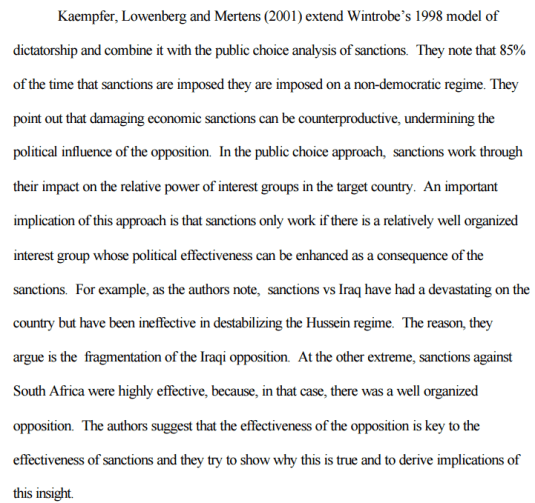
Source: Ronald Wintrobe (2002) Dictatorship.
A dictator who agrees to liberalise puts himself in danger of being deposed, and it is no surprise that dictators like Castro, Hussein and Milosevic were all reluctant to do so. The Austro-Hungarian emperor opposed the introduction of railways because he thought they would bring revolution with them.
Neither trade sanctions nor airstrikes worked against Afghanistan under the Taliban. There is nothing to destroy or degrade.
50% of @PaulineHansonOz @OneNationAus votes come from @AustralianLabor voters
22 Sep 2016 1 Comment
in constitutional political economy, politics - Australia, Public Choice Tags: 2016 Australian federal election, antiforeign bias, antimarket bias, expressive voting, free trade, globalisation, left-wing popularism, makework bias, rational irrationality, right-wing popularism
How can Pauline Hanson be an extreme right-winger if half of her votes come from people who 2nd preference the Australian Labour Party? This strong support for her populism has been well-known since she won the safest Labour Party seed in Queensland in the 1996 Australian Federal Election but is hardly ever mentioned by the media or her critics.
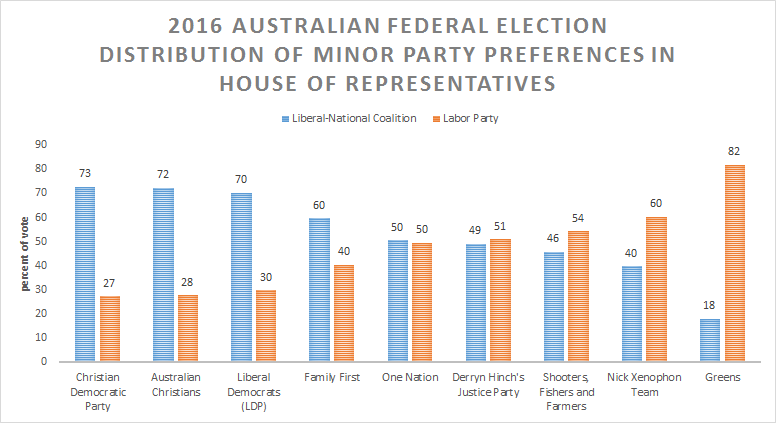
Source: Antony Green’s Election Blog: Preference Flows at the 2016 Federal Election.
It should be therefore no surprise that a lot of her views have popular support because she has support across the political spectrum. Not knowing that will means you will be not very good at combating her views which you simply do not understand where they come from.
Few of her supporters see themselves as extremists and will be insulted when you suggest they are. Listen here dummy is no way to win back votes of people who just voted for you recently.
Hanson’s support among Labour voters is increasing. Only 42% of her voters gave their 2nd preference to Labour in previous federal elections for the House of Representatives.
How expensive are charter schools?
09 Sep 2016 Leave a comment
in economics of bureaucracy, economics of education, industrial organisation, Public Choice, rentseeking, survivor principle Tags: charter schools, expressive voting, New Zealand Greens, New Zealand Labour Party, rational rationality, teachers unions

The Political Economy and Social Philosophy of F. A. Hayek
08 Sep 2016 Leave a comment
in constitutional political economy, F.A. Hayek, history of economic thought, Public Choice
Does it Feel Good or Does it Do Good?
08 Sep 2016 Leave a comment
in applied price theory, applied welfare economics, comparative institutional analysis, constitutional political economy, economics, labour economics, minimum wage, Public Choice Tags: expressive voting, rational irrationality
Hard left @TheDailyBlogNZ has no idea of the power of an effective opposition party
06 Sep 2016 Leave a comment
in constitutional political economy, politics - New Zealand, Public Choice
The hard left Daily Blog is so detached from power that it has forgotten that an effective opposition can slow governments down, sometimes to a dead stop. Stealing the opposition’s policies is a basic political skill. 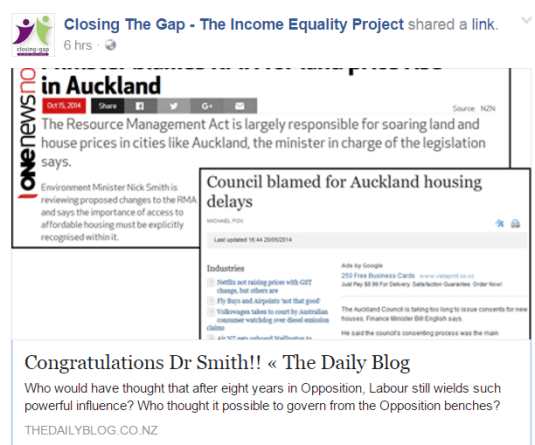
Watching a third term government fight like a cornered animal against an effective opposition in with a good chance of winning the next election is an ugly sight for those who do not like the sight of blood. The current third term government in New Zealand is not particularly tired and certainly is not facing an effective opposition smelling victory at the next election.
This far left blog has little appreciation of the median voter theorem and the propensity of political parties that actually win power to position themselves closely to each other. For that reason, governments are hesitant to adopt policies that take them too far away from what the opposition might do in response and thereby win votes in the next election.
The hard left has little knowledge of this because it really participates in putting up an effective opposition to government policies. Little of what the hard left says appeals to the median voter so a National party government does not have to worry much about what are the hard left says in opposition to its policies. The high left opposing a policy changes few votes.
Housing affordability New Zealand is an obvious example of the power of an effective opposition party. The National party-led government is unwilling to take risks for fear of losing votes to the opposition Labour Party at the next election. New Zealand election is always close because of MMP. Winning margins are one or two seats.
One of the great complaints against the British Labour Party now by ordinary voters including those are never vote for them is that the Tory government faces no effective opposition to their plans and because there is no effective opposition, there is no break on what they could do. They are not challenged; their ideas are not being tested in Parliament and elsewhere and perhaps found wanting.
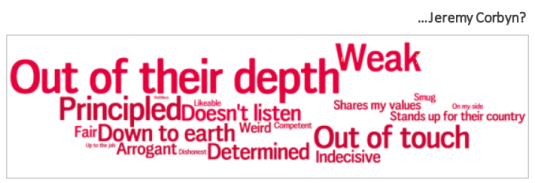
A leading reason for the mass resignations from the shadow cabinet recently was the lack of an effective opposition to government policies was letting the Tories have a free reign. The first step in slowing the Tories down is having a leader in the opposition who is not widely regarded as a clown.
How to start thinking like a public choice economist
04 Sep 2016 Leave a comment
in constitutional political economy, Public Choice

Late switchers alert – when did Obama start supporting gay marriage
28 Aug 2016 Leave a comment
in economics of love and marriage, politics - USA, Public Choice
Why so few successful left-wing populists
16 Aug 2016 Leave a comment
in politics - Australia, politics - New Zealand, politics - USA, Public Choice Tags: economics and immigration, growth of government, left-wing populists, right-wing populists, size of government, social insurance, welfare state
The Twitter Left is doing its best to attribute the surge against globalisation and immigration to inequality. This is despite the main beneficiary at the ballot box is right-wing populists.
The beneficiaries in the last few years were UKIP, the French National Front, Alternative for Germany, various pro-welfare state but anti-immigration parties in the rest of Europe, Pauline Hanson and Donald Trump. Barely a left wing party in sight outside of Greece.
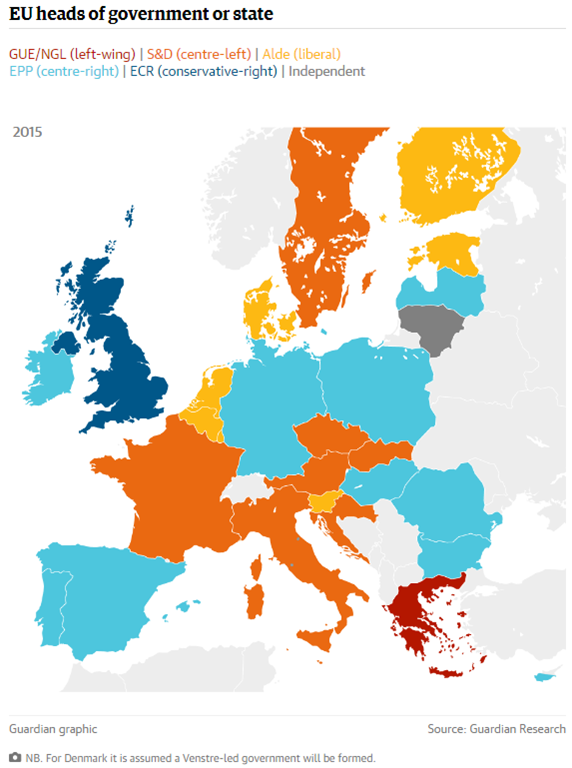
Source: Only a third of the EU is governed by the centre-left | World news | The Guardian.
Bernie Sanders is a fake left-wing populist because much of his support comes from college students and the university educated, not the aroused working class. These college students are unwilling to pay more than $1000 in taxes for the socialist revolution especially if they have a job.
At the last New Zealand election, two-thirds of the electorate voted for other than centre-left and left-wing parties. The hard left party, Mana-Internet, won 1% of the party vote despite having millions of dollars in campaign donations from a criminal fugitive hoping to avoid extradition.
These right-wing populists combine a heady brew of nationalism and social conservatism, scepticism about market competition, strong support for social security and old-age pensions but not welfare dependency, and opposition to immigration, imports and cultural change. The rise of the parties are not the first signs of an aroused working class seeking to overthrow capitalism. Face up to it.
Trump supporters have a pretty low opinion of @realDonaldTrump
15 Aug 2016 Leave a comment
In common with UKIP supporters, Trump supporters have no illusions about who they are supporting. UKIP supporters know their party is led by a bunch of clowns but want their views in the Commons and hope the party will improve once they get in office.


Recent Comments