
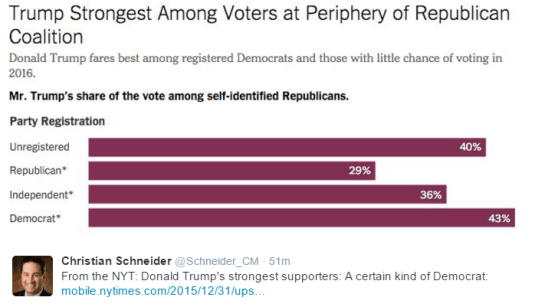
Source: Donald Trump is uniquely unsuited to be president – LA Times.
Celebrating humanity's flourishing through the spread of capitalism and the rule of law
03 Mar 2016 Leave a comment
in politics - USA, Public Choice
02 Mar 2016 Leave a comment
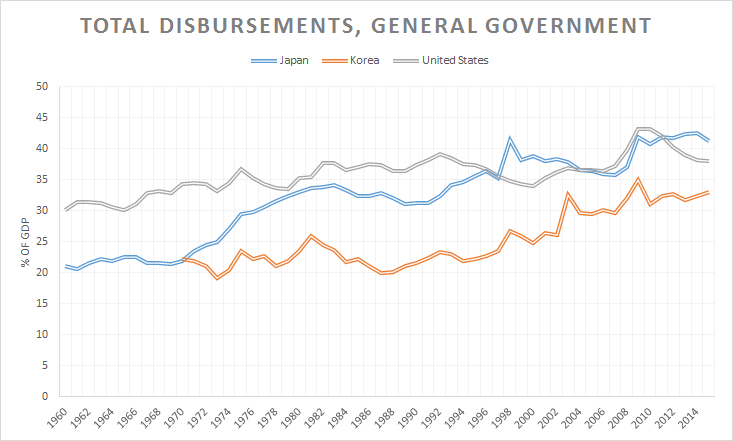
in development economics, economic history, growth miracles, Public Choice, public economics Tags: growth of government, Japan, size of government, South Korea
01 Mar 2016 Leave a comment
in politics - USA, Public Choice

29 Feb 2016 Leave a comment
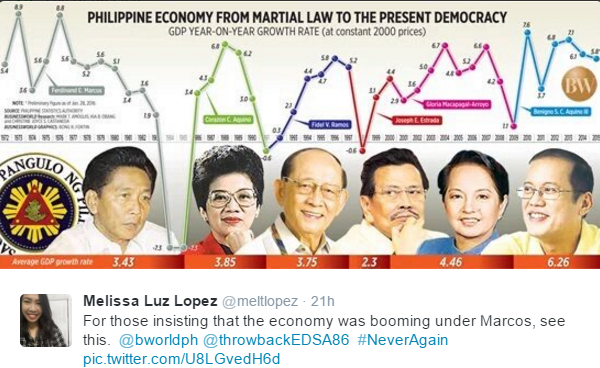
in constitutional political economy, development economics, growth disasters, Public Choice, rentseeking Tags: failed states
28 Feb 2016 Leave a comment
in economics of bureaucracy, environmental economics, global warming, politics - New Zealand, Public Choice, transport economics Tags: carbon footprint, carbon offsets, Left-wing hypocrisy, New Zealand Greens, rational irrationality
Living the clean, green lifestyle means more than just buying carbon-offs in the same way that indulgences for sins were sold by the mediaeval Catholic Church. Russell Norman was an MP for 9 of the 12 months covered by this chart. He consistently had one of the smallest carbon footprints of a Green MP even when he was still co-leader of the Greens and not just a backbench MP.
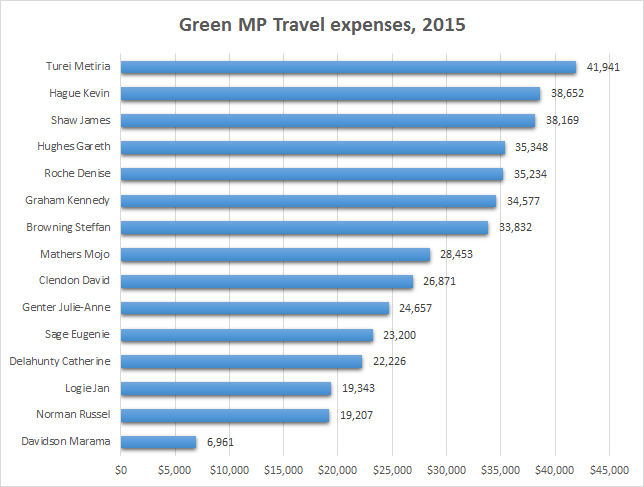
Source: New Zealand Parliament – Members’ expense disclosure from 1 October to 31 December 2015.
28 Feb 2016 1 Comment
in economics of bureaucracy, environmental economics, global warming, politics - New Zealand, Public Choice, rentseeking, transport economics Tags: carbon footprint, New Zealand Greens, rational irrationality
10 of the 14 green MPs have above-average air travel expenses – have an above average carbon footprint for a member of the New Zealand Parliament. It is not easy to be Green.
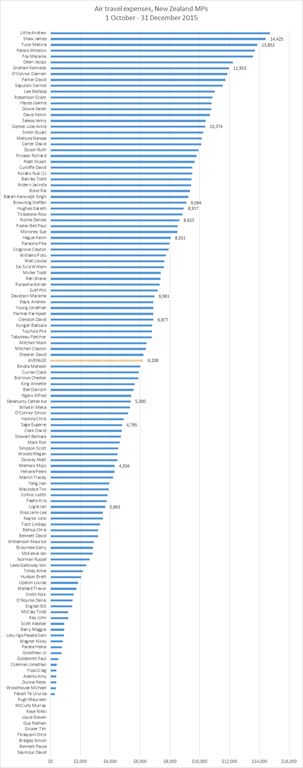
Source: New Zealand Parliament – Members’ expense disclosure from 1 October to 31 December 2015.
25 Feb 2016 Leave a comment
in economics of bureaucracy, international economics, politics - New Zealand
What gave Amnesty International its strength, appeal and political credibility was most could agree with its opposition to the imprisonment of prisoners of conscience and to torture and that political prisoners should be put on trial.
Including child poverty as part of its most recent international annual report proves Robert Conquest’s 3rd law of politics: the behaviour of any bureaucratic organization can best be understood by assuming that it is controlled by a secret cabal of its enemies

Source: 2015/16 Annual report – The State of the World’s Human Rights | Amnesty International NZ.
Amnesty International should not be giving people reasons not to join. It should stick to its original mission, which most people support. An NGO with members from across the political spectrum has much more credibility and influence.
25 Feb 2016 Leave a comment
in applied welfare economics, comparative institutional analysis, economics of bureaucracy, Public Choice
I learnt at the Australian Productivity Commission that the first law of public policy development is plagiarise, plagiarise, plagiarise. Why be original? Copy the successes of others, improve upon them, but do not repeat their failures, just learn from them.
I developed this policy insight from my experience at the Productivity Commission with a smart-arse Commissioner – that was the chairman’s private description of him in a conversation with me, not mine.
This Commissioner with whom I had countless arguments would respond to the many US studies I had marshalled by always asking for Australian evidence – what is the Australian evidence?
He knew that there was no Australian data or studies so he could slow the whole policy process down through this appeal to data chauvinism. The Americans are swimming in data and that is before you get to their cross-sectional data with 50 states.
 Ever since then, I regarded data chauvinism – the request for Australian evidence and studies or New Zealand evidence and studies – as a stalling tactic designed either to defend the status quo.
By and large, all the local evidence shows when it augments the US studies is how a local regulation or tax screws things up further. Local evidence rarely served the interests of my opponents who were fighting against deregulation or privatisation.

It is a good public policy – you are much more likely to implement a proposal or act on a particular empirical study – if there are half a dozen to a dozen overseas studies preferably in several different countries showing much the same thing. Beware the man of one study. Milton Friedman (1957) rightly preferred to emphasize the congruence of evidence from a number of different sources and with due attention to the quality of the data:
I have preferred to place major emphasis on the consistency of results from different studies and to cover lightly a wide range of evidence rather than to examine intensively a few limited studies.
The role of empirical evidence is to resolve disagreements – to bring people closer together. One study in one country rarely does that. Many studies in many countries about the same topic of controversy is far more persuasive.
24 Feb 2016 Leave a comment
in development economics, economic history, entrepreneurship, financial economics, growth miracles, industrial organisation, rentseeking, survivor principle Tags: billionaires, China, entrepreneurial alertness, Hong Kong, Japan, superstar wages, superstars, Taiwan
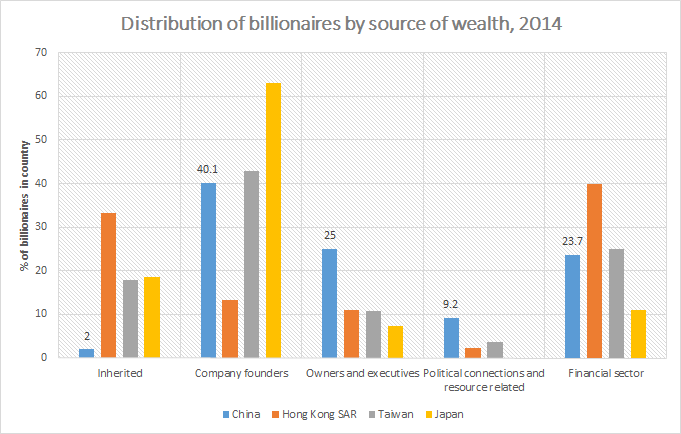
Surprisingly few billionaires in any of the 4 countries obtained their wealth through political connections. Founding a company seems to be still the path of great wealth even in Japan these days. Hong Kong is a financial centre so the large number of billionaires in its financial sector is no surprise.
24 Feb 2016 Leave a comment
in applied price theory, comparative institutional analysis, economics of bureaucracy, industrial organisation, politics - New Zealand, Public Choice, public economics Tags: anti-market bias, New Zealand Greens, privatisation, rational irrationality, state owned enterprises

Green MP Gareth Hughes today nailed the case as to why governments should never run businesses. Too many MPs simply do not understand what dividends represent and what the profits from asset sales represent.
Hughes was reported today saying that taxpayers lost nearly $1 billion in dividends since the recent privatisations of power companies. He is the Green party spokesman on state owned enterprises.

Source: Asset sales cost hits $1 billion | Green Party of Aotearoa New Zealand.
Does the Green Party understand that an asset sells for a price equal to its risk-adjusted discounted net present value of the stream of dividends. When you sell a financial asset, you cash out the net present value of the stream of dividends that might have come from those assets.
The Greens, who are prissy about government transparency and dishonesty of their opponents, did not mention the $4.7 billion in revenue from the asset sale. Taxpayers now receiving more in dividends as a part owner of the privatised power companies than they did as a full owner.
Hughes had the cheek to complain about the politicisation of those privatisations such as favourable terms for small share buyers. That inability of governments to even sell an asset competently is a strong reason why governments should never run businesses in the first place.
If an asset cannot be sold in the full light of day – a major issue in an election campaign and a referendum – without the sale price that is politicised, what is the chance of good management of any state-owned enterprise when it is not the central focus of opposition scrutiny?
It is been many years since dividends from the state-owned enterprise portfolio has been a net positive cash flow for the taxpayer, as the chart below shows.
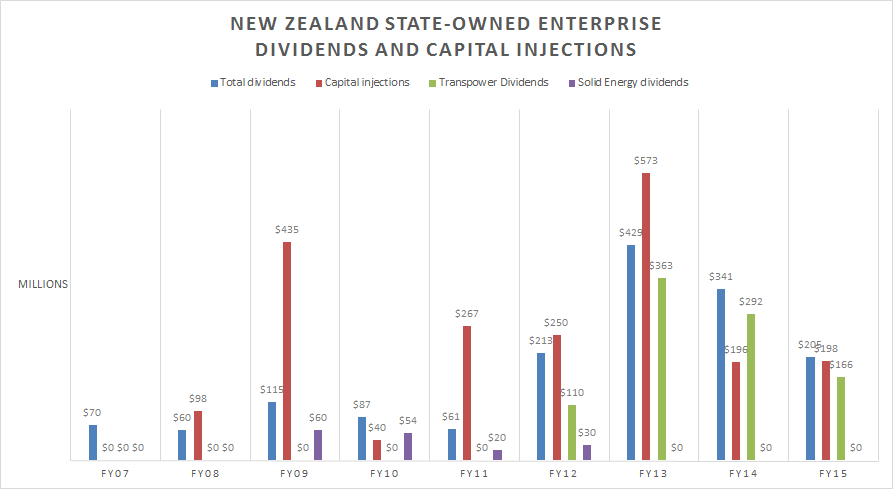
Source: New Zealand Treasury – data released under the Official Information Act.
KiwiRail and Solid Energy gobbled up whatever dividends came out of the power companies. Aside from power companies, state-owned enterprises not really offer much in the way of dividends to the taxpayer as the chart again shows.
24 Feb 2016 Leave a comment
in economic history, energy economics, environmental economics, Public Choice, rentseeking Tags: Big Solar, green rent seeking, rational irrationality, solar energy, solar power

Source: History of Solar Power – IER.
Celebrating humanity's flourishing through the spread of capitalism and the rule of law
Celebrating humanity's flourishing through the spread of capitalism and the rule of law
Celebrating humanity's flourishing through the spread of capitalism and the rule of law
Celebrating humanity's flourishing through the spread of capitalism and the rule of law
Celebrating humanity's flourishing through the spread of capitalism and the rule of law
Celebrating humanity's flourishing through the spread of capitalism and the rule of law
Celebrating humanity's flourishing through the spread of capitalism and the rule of law
Celebrating humanity's flourishing through the spread of capitalism and the rule of law
A History of the Alt-Right
Econ Prof at George Mason University, Economic Historian, Québécois
Celebrating humanity's flourishing through the spread of capitalism and the rule of law
Scholarly commentary on law, economics, and more
Beatrice Cherrier's blog
Celebrating humanity's flourishing through the spread of capitalism and the rule of law
Celebrating humanity's flourishing through the spread of capitalism and the rule of law
Celebrating humanity's flourishing through the spread of capitalism and the rule of law
Why Evolution is True is a blog written by Jerry Coyne, centered on evolution and biology but also dealing with diverse topics like politics, culture, and cats.
Celebrating humanity's flourishing through the spread of capitalism and the rule of law
A rural perspective with a blue tint by Ele Ludemann
DPF's Kiwiblog - Fomenting Happy Mischief since 2003
Celebrating humanity's flourishing through the spread of capitalism and the rule of law
The world's most viewed site on global warming and climate change
Tim Harding's writings on rationality, informal logic and skepticism
A window into Doc Freiberger's library
Let's examine hard decisions!
Commentary on monetary policy in the spirit of R. G. Hawtrey
Thoughts on public policy and the media
Celebrating humanity's flourishing through the spread of capitalism and the rule of law
Politics and the economy
A blog (primarily) on Canadian and Commonwealth political history and institutions
Reading between the lines, and underneath the hype.
Economics, and such stuff as dreams are made on
"The British constitution has always been puzzling, and always will be." --Queen Elizabeth II
Celebrating humanity's flourishing through the spread of capitalism and the rule of law
Celebrating humanity's flourishing through the spread of capitalism and the rule of law
WORLD WAR II, MUSIC, HISTORY, HOLOCAUST
Undisciplined scholar, recovering academic
Celebrating humanity's flourishing through the spread of capitalism and the rule of law
Res ipsa loquitur - The thing itself speaks
In Hume’s spirit, I will attempt to serve as an ambassador from my world of economics, and help in “finding topics of conversation fit for the entertainment of rational creatures.”
Researching the House of Commons, 1832-1868
Articles and research from the History of Parliament Trust
Reflections on books and art
Posts on the History of Law, Crime, and Justice
Celebrating humanity's flourishing through the spread of capitalism and the rule of law
Exploring the Monarchs of Europe



Recent Comments