Under the shy Labour voter theory, countries with low turnouts should have right-wing governments and countries with high turnouts should have left-wing governments. Do they?
Voter turnout among voting age people
Turkey 86%
Sweden 83
France 71
Mexico 65
UK 61
US 54
On 10 July 1991, Boris Yeltsin took office as the first elected President of Russia. #OTDhttp://t.co/8462T7mCJB— History Facts 247 (@historyfacts247) July 10, 2015
Here's the Daily Mirror's polling day advice from days when it was more fair and balanced (h/t Guido) http://t.co/GJ5CNGMoRj— Fraser Nelson (@FraserNelson) May 07, 2015
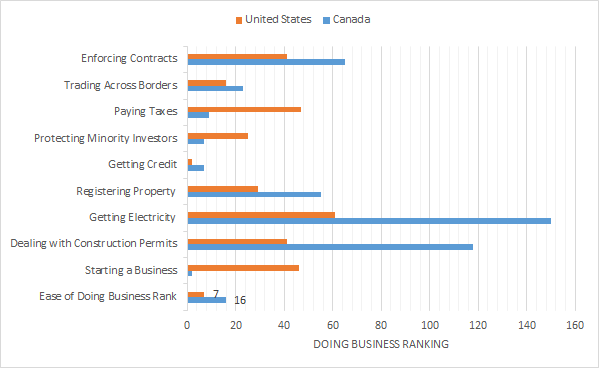
It’s easier to do business in the USA and Canada because of the difficulties with construction permits and getting electricity and few more problems with enforcing contracts and registering property. It is easy to open a business in Canada.
This morning on 9 to noon on Radio New Zealand, Kathryn Ryan, the compere of the program, repeatedly claimed that the government pumped $1 billion into the KiwiRail Turnaround Plan between 2010 and 2014. I was so annoyed by this that I made a broadcasting standards complaint while the program was still being broadcast on my mobile as a one finger typist.
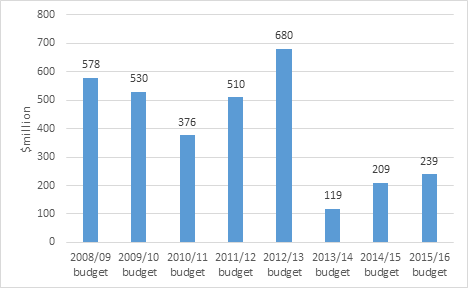
The report on 9 to Noon was in response to the government putting KiwiRail on notice, giving it two years to identify savings and reduce Crown funding required or risk the possibility of closure. Since KiwiRail was acquired in 2008 for $665 million as a commercial investment, Crown investments (taxpayers bailout) totalled $3.4 billion – see Figure 1.
Figure 1: State-owned enterprise welfare, Vote Transport and Vote Finance (KiwiRail), Budgets 08/09 to 15/16
Source: New Zealand budget papers, various years.
Table 1 shows that the KiwiRail Turnaround plan of $1.272 billion since the 2009-10 Budget is only a small part of the bailout of KiwiRail. 9 to Noon simply ignored the $210 million in the 2015 budget for KiwiRail for no explicable reason and instead talked about a $1 billion Turnaround plan rather than the $1.272 billion Turnaround plan.
Table 1: State-Owned Enterprise welfare, Vote Transport and Vote Finance (KiwiRail), Budgets 2008/09 to 2015/16, $million
08/09
09/10
10/11
11/12
12/13
13/14
14/15
15/16
New Zealand Railways Corporation Loans
405
55
250
108
11
KiwiRail Turnaround Plan
20
250
250
250
94
198
210
KiwiRail Equity Injection
323
25
29
Rail Network and Rolling Stock Upgrade
105
71
10
New Zealand Railways Corporation Loans
55
New Zealand Railways Corporation Increase in Capital for the Purchase of Crown Rail
376
Crown Rail Operator Loans
140
Crown Rail Operator Equity Injection
7
Total
578
530
376
510
680
119
209
239
Source: New Zealand budget papers, various years.
Other parts of the bailout of KiwiRail include $405 million in loans to the New Zealand Railways Corporation in the 2009-10 budge – see table 1. There was a $323 million equity injection in the 2012-13 Budget – see table 1. KiwiRail has also caused write-downs in the Crown balance sheet of an incredible $9.8 billion since it was repurchased in 2008.
9 to Noon ignored at least two thirds of the cost to the taxpayer of bailing out KiwiRail by only limiting its reporting to part of the KiwiRail Turnaround Plan. It ignored the contribution in the most recent budget to that plan. That does not meet broadcasting standards of accuracy or professional responsibility.
Any reasonable listener will infer, as I did when listening, that the entire cost of the bailout of KiwiRail is represented by the Turnaround Plan of about $1 billion. If listeners were left with that impression, they were misled by 9 to Noon and Radio New Zealand.
Treasury recommended the Government fund KiwiRail for one more year and undertake a comprehensive public study to look into closing the company. The study is public so that people were informed of the costs of running the rail network compared with any benefits it provided. The Government rejected the idea.
Figure 1: State-owned enterprise welfare, Vote Transport and Vote Finance (KiwiRail), Budgets 08/09 to 15/16
Source: New Zealand budget papers, various years.
KiwiRail has been a constant thorn in the taxpayers’ side. Since this rail business was acquired in 2008 for $665 million as a commercial investment, Crown investments have totalled $3.4 billion – see Figure 1.
Fortunately in the 2015 budget, the Minister of Finance signalled that the government’s patience with the KiwiRail deficits is not unlimited. KiwiRail has a 10-year Turnaround Plan to make its freight business commercially viable. The current network of 4,000 km must be reduced to 2,300 km for the company to even breakeven. The Treasury advised, to no avail, that this massive and painful restructuring was required before KiwiRail was purchased. The purchase went through.
The latest developments where Treasury advised ministers to contemplate shutting the network down is an opportunity for ministers, and the opposition spokesmen on finance and transport both to say how much is too much in accumulated KiwiRail losses.
The Minister of Finance and his Cabinet colleagues must say after the public review that there is only so much more left in the cupboard to bailout KiwiRail losses. After that fiscal cap is reached, KiwiRail is on its own. If that means bankruptcy and network closure, so be it.
In the interim, on the side of every KiwiRail train there should be advertising billboards with the following disclosure statements:
KiwiRail losses adds one percentage point to the company tax rate each year;
KiwiRail losses takes deny sick taxpayers X number of elective surgeries per year; and
X number of doctors, nurses, and teachers could have been hired but for last year’s KiwiRail losses!
Split voting analysis suggests there are not a lot of blue green National voters. Few Green Party voters split their party vote and give their electorate vote to National with the exception of tactical voting in Epsom. The Greens and Labour fight for the left-wing vote and that’s about it.
Source: The Electoral Commission.
In the electorate of Epsom, many Green voters voted for the National candidate as a tactical ploy to defeat the ACT party candidate.
Source: The Electoral Commission.
In Wellington Central, the National Party won the party vote with 14,689 party votes. The Greens came second with 11,545. The deputy leader of the Labour Party, Grant Robertson, came a miserable third in the party vote with 9,306 party votes.
Source: The Electoral Commission.
Grant Robinson nonetheless won the seat easily on Green electorate seat votes and more than a few National Party electorate votes.
Indeed, so many of Grant Robinson’s votes came from Greens and National voters that the Greens have a good chance of winning Wellington Central if they tried. More so now that the Green Party leader stands in the seat.
The Greens have a party vote of 10.7% at the moment. Some of that are Labour voters parking their vote with them while they’re grumpy. A significant part of the rest will be lost when they go into government. Enough of that party vote is risk to push the Greens below the 5% threshold necessary to win any list seats in Parliament.
At the 2014 General Election 31.64% of all voters split their vote compared to 30.70% in 2011. Slightly over 80% of Labour Party and National Party voters give both their party vote and electorate vote to the same party.
Source: The Electoral Commission.
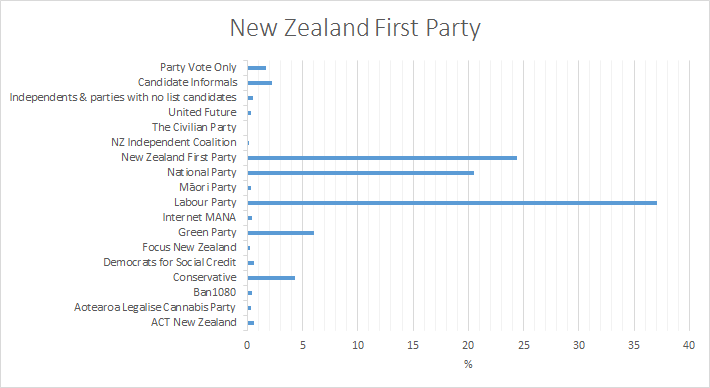
New Zealand First vote splitting data above suggests more Labour voters vote New Zealand First than National Party voters by a noticeable margin. 1/3rd of voters who gave their party vote to New Zealand First voted Labour with their electorate vote. This compares to one in five New Zealand First voters who gave their electorate vote to the National Party.
Source: The Electoral Commission.
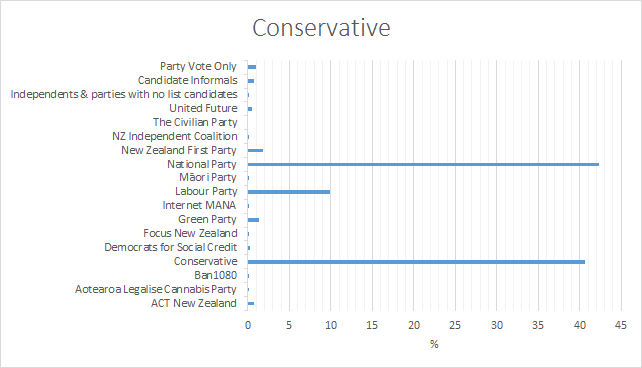
It’s a different story with the Conservative Party. A good 40% of Conservative Party voters give their electorate vote to National. This compares to a 10% split to the Labour Party.
The National Party has much to gain from the collapse of the Conservative Party as does fellow populist party New Zealand First. This split vote analysis does not throw much insight into how New Zealand First would benefit from a collapse in the Conservative Party.
If New Zealand First picks up a significant amount of the current party vote for the Conservative Party if the latter was to fold, New Zealand First will pick up one or two list seats in the next general election giving it the balance of power.
The only thing that could be said is the lack of Labour voters among Conservative Party voters suggest they are reluctant to support New Zealand First because in the past it has supported Labour Governments. The Conservative Party effectively promised to support a National Party Government.
A vote for the Conservative Party is a vote for a National Party government. A vote for New Zealand First is much more likely to see a Labour Government. That suggests to me that many Conservative Party voters are National Party voters at heart.
I didn’t notice any discussion in the Cabinet paper of a government doing this before and whether their investment promotion efforts succeeded or not. This latest policy proposal cannot even count as evidence-based policy dreaming, much less a serious contribution to public policy.
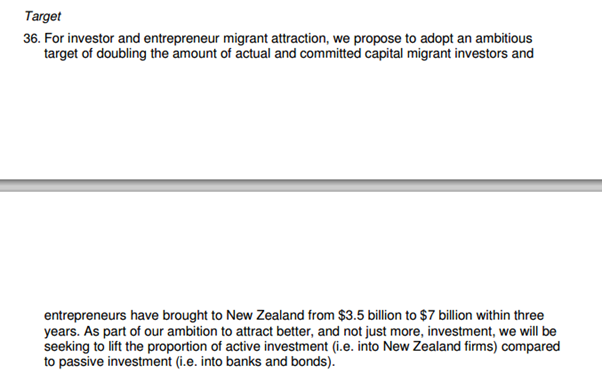
Hoping to double incoming foreign investor and entrepreneur migration from $3.5 billion to $7 billion inside three years without spending any extra public money is breathless public policy making. I am sure lots of governments previously tried to get something for nothing.
It will be helpful if ministers pointed to where overseas governments have been successful in doubling foreign investment by simply reprioritising existing investment promotion efforts.
There are at least 2,500 national, provincial and city investment promotion agencies out. Some of them must have been subject to some sort of evaluation as to their success.
This overseas literature review would be in addition to the recent findings of the Ministry of Economic Development about the poor performance and perhaps futility of the foreign direct investment promotion by New Zealand Trade and Enterprise.
Imagine how much bigger a boost in foreign investor and entrepreneur migration lays before us if actual real new money was put on the table.
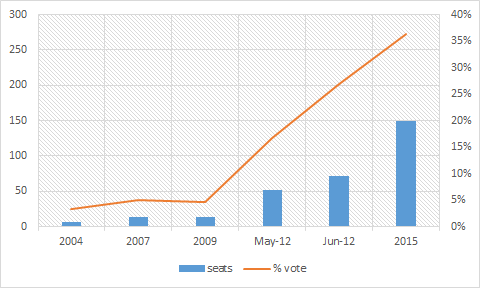
The Coalition of the Radical Left[(Syriza) was founded in 2004 as a coalition of left-wing and radical left Greek parties.
Figure 1: Syriza vote percentages and Parliamentary seats won in Greek national elections
250 seats will be distributed on the basis of proportional representation, with a threshold of 3% required for entry into the Greek parliament. 50 additional seats are awarded as a majority bonus to the party that wins the largest number of votes.
Why Evolution is True is a blog written by Jerry Coyne, centered on evolution and biology but also dealing with diverse topics like politics, culture, and cats.
In Hume’s spirit, I will attempt to serve as an ambassador from my world of economics, and help in “finding topics of conversation fit for the entertainment of rational creatures.”







Recent Comments