Hsieh and Moretti on Allocations across Cities

the implied cost of housing restrictions across the whole U.S., and Chang and Enrico find that aggregate output is lower by about 10-14% because of them.

dvollrath's avatarThe Growth Economics Blog

Last post on the NBER growth session. Chang-Tai Hsieh (Chicago) and Enrico Moretti (Berkeley) presented a paper on wage dispersion across cities in the U.S. Wage dispersion (New Yorkers earn more than people in Cleveland) either represents compensation for living costs (housing in New York is more expensive than in Cleveland), a real difference in productivity (New Yorkers are more productive than Clevelanders), or some combination of the two.

What Chang and Enrico find is that the increase in wage dispersion across cities in the U.S. over the last thirty-ish years is due almost entirely to rising house prices in six cities: NY, DC, Boston, San Fran, San Jose, and Seattle. Wages have gone up rapidly in those cities, but that is basically just compensating their citizens for the higher costs of living.

Now, given the costs of living, the allocation of population across cities in the U.S. is…

View original post 274 more words

George Stigler on income redistribution policies

Charles Krauthammer’s Law of American Politics

Image

Robert Lucas on the defining belief of the Left over Left and the Greens

Image

Voter profiles – utilitarian/instrumental, swinging and expressive | Alex White

I just came across this great blog by Alex White on the three types of voters: utilitarian/instrumental, swinging and expressive. His diagrammatic expressions of them are superb. Most enlightening.

Voter decision making process

His first diagram above shows three consumer types of engagement with a brand: utilitarian, low involvement and expressive.

  • Utilitarian decision making is one that is typically high involvement, but are partly price sensitive;
  • Low involvement buyers do not spend a lot of time researching the features of the product or service, beyond a cursory glance; and
  • Expressive consumers are ones who make in depth purchases where there is a high engagement. Their decision to purchase precedes research. The research itself serves to rationalise the purchase decision. Often, they will feel a relationship with the brand and identify with the brand’s values.

White then overlaps these brand  engagement profiles on voter profiles in the next diagram made up of utilitarian/instrumental, swinging and expressive and then fleshes out these voter types depending on whether they are rusted or swinging.

Voter "policy" usage model


  • The rusted-on utilitarian voter votes on a specific issue and are loyal to the party that represents the best fit with that issue. For example, the Greens and forestry, or Labor and education. So long as they view the party as best fitting or addressing their issue, they’ll vote for that party.
  • A swinging utilitarian voter listens to announcements during campaigns, and tries to make a decision based on what is best for them.  These swinging voters are susceptible to the pork barrel promises. Utilitarian voters are sensitive to their expectations being met.
  • The swinging low engagement voter has no party familiarity, no interest in politics, and do not do any assessment of party policies; they make up their mind based on availability of the party on Election Day (so the presence of people handing out how-to-votes is important). They see no difference between parties; they are completely switchable, so there is no brand loyalty. A low involvement voter is really looking at the absence of negatives.
  • The rusted on expressive voter votes to convey their values or beliefs, and often strongly identify with the party, or with a party leader. They are partisans who seek out research or information to justify their support for that party. The have a strong emotional connection to the party, or they may be ideologues and identify with a political philosophy rather than the party.
  • The swinging expressive voter is an ideologue whose voting decision is based on their political ideology. For example, strong environmentalists who support the Greens Party because of their commitment to conservation rather than to the Party itself. The swinging expressive voter may change their vote if they feel a party ceases to represent their value set or beliefs. The expressive voter expectations align with their values or ideology. Their relationship to the party can be very committed, but also very critical. They may tolerate or forgive lapses on policy areas outside the voter’s core values — and they can be passionate advocates.

Alex White has set out a great  topology of voters, and how a political party or lobby group should appeal to different types of voters based on their engagement and information needs.  White is secretary of UnionsACT, the peak body for 33 unionists  Unions in Canberra.

via Voter profiles | Alex White.

Now we know how many drivers Uber has — and have a better idea of what they’re making​ – The Washington Post

via Now we know how many drivers Uber has — and have a better idea of what they’re making​ – The Washington Post.

Francis M. Bator on the high road and the low road for the public sector economists.

Image

Eamonn Butler on how economical with the truth Oxfam was on global inequality

George Stigler’s theory of economic regulation

Image

Harry G. Johnson on why public sector economists go stale

Image

Today Parliament commemorates 750th anniversary of first Parliament summoned by Simon De Montfort

Schumpeter on the essence of political and academic debate

Image

Offsetting behaviour alert: only fools and politicians would believe that a minimum wage increase increases net pay and conditions

John Schmitt  lists 11 margins along which a minimum wage might cause changes in net pay and conditions:

  1. Reduction in hours worked (because firms faced with a higher minimum wage trim back on the hours they want),
  2. Reduction in non-wage benefits (to offset the higher costs of the minimum wage),
  3. Reduction in money spent on training (again, to offset the higher costs of the minimum wage),
  4. Change in composition of the workforce (that is, hiring additional workers with middle or higher skill levels, and fewer of those minimum wage workers with lower skill levels),
  5. Higher prices (passing the cost of the higher minimum wage on to consumers),
  6. Improvements in efficient use of labour (in a model where employers are not always at the peak level of efficiency, a higher cost of labour might give them a push to be more efficient),
  7. “Efficiency wage” responses from workers (when workers are paid more, they have a greater incentive to keep their jobs, and thus may work harder and shirk less),
  8. Wage compression (minimum wage workers get more, but those above them on the wage scale may not get as much as they otherwise would),
  9. Reduction in profits (higher costs of minimum wage workers reduces profits),
  10. Increase in demand (a higher minimum wage boosts buying power in overall economy), and
  11. Reduced turnover (a higher minimum wage makes a stronger bond between employer and workers, and gives employers more reason to train and hold on to worker.

Richard McKenzie argues that the biggest impact  of a minimum wage increase is reductions to paid and unpaid benefits for minimum wage workers, including  health insurance, store discounts, free food, flexible scheduling, and job security resulting from higher-skilled workers drawn to the higher minimum wage jobs:

  • Masanori Hashimoto found that under the 1967 minimum-wage hike, workers gained 32 cents in money income but lost 41 cents per hour in training—a net loss of 9 cents an hour in full-income compensation.
  • Other researchers in independently completed studies found more evidence that a hike in the minimum wage undercuts on-the-job training and undermines covered workers’ long-term income growth.
  • Wessels found that the minimum wage caused retail establishments in New York to increase work demands by cutting back on the number of workers and giving workers fewer hours to do the same work.
  • Fleisher, Dunn, and Alpert found that minimum-wage increases lead to large reductions in fringe benefits and to worsening working conditions.
  • Marks found that workers covered by the federal minimum-wage law were also more likely to work part time, given that part-time workers can be excluded from employer-provided health insurance plans.

McKenzie also argued that if the minimum wage does not cause employers to make substantial reductions in fringe benefits and increases in work demands, then an increased minimum should cause

(1) An increase in the labour-force-participation rates of covered workers (because workers would be moving up their supply of labour curves),

(2) A reduction in the rate at which covered workers quit their jobs (because their jobs would then be more attractive), and

(3) A significant increase in prices of production processes heavily dependent on covered minimum-wage workers.

Wessels found that minimum-wage increases had exactly the opposite effect as intended: labour force participation rates went down; job quit rates went up, and prices did not rise appreciably.

These are findings by Wessels are consistent only with the view that minimum-wage increases make workers worse off, rather than better off in terms of net pay and conditions. After the minimum wage increase, the net advantages and disadvantages of menial jobs are less than before. Fewer workers enter the workforce and more quit their jobs.

McKenzie was the first economist to argue that a minimum wage increase may actually reduce the labour supply of menial workers. Employment in menial jobs may go down slightly in the face of minimum-wage increases not so much because the employers don’t want to offer the jobs, but because fewer workers want these menial jobs that are offered.

The repackaging of monetary and non-monetary benefits, greater work intensities and fewer training opportunities make these jobs less attractive relative to their other options. This reduction in labour supply by low skilled workers is why the voluntary quit rate among low-wage workers goes up, not down, after a minimum wage increase. As McKenzie explains

Economists almost uniformly argue that minimum wage laws benefit some workers at the expense of other workers.

This argument is implicitly founded on the assumption that money wages are the only form of labour compensation. Based on the more realistic assumption that labour is paid in many different ways, the analysis of this paper demonstrates that all labourers within a perfectly competitive labour market are adversely affected by minimum wages.

Although employment opportunities are reduced by such laws, affected labour markets clear. Conventional analysis of the effect of minimum wages on monopsony markets is also upset by the model developed.

McKenzie argues that not accounting for offsetting behaviour led to a fundamental misinterpretation in the empirical literature on the minimum wage. That literature shows that small increases in the minimum wages does not seem to affect employment and unemployment by that much.

…. wage income is not the only form of compensation with which employers pay their workers. Also in the mix are fringe benefits, relaxed work demands, workplace ambiance, respect, schedule flexibility, job security and hours of work.

Employers compete with one another to reduce their labour costs for unskilled workers, while unskilled workers compete for the available unskilled jobs — with an eye on the total value of the compensation package.

With a minimum-wage increase, employers will move to cut labour costs by reducing fringe benefits and increasing work demands

Proponents and opponents of minimum-wage hikes do not seem to realize that the tiny employment effects consistently found across numerous studies provide the strongest evidence available that increases in the minimum wage have been largely neutralized by cost savings on fringe benefits and increased work demands and the cost savings from the more obscure and hard-to-measure cuts in nonmoney compensation.

McKenzie is correct in arguing that the empirical literature on the minimum wage is dewy-eyed. The first assumption about any regulation is the market will offset it significantly.

In the course of undoing the direct effects of the regulation, there will be unintended consequences such as the remixing of wage and nonwage components of remuneration packages of low skilled workers covered by the minimum wage. Greg Mankiw concludes that:

The minimum wage has its greatest impact on the market for teenage labour. The equilibrium wages of teenagers are low because teenagers are among the least skilled and least experienced members of the labour force.

In addition, teenagers are often willing to accept a lower wage in exchange for on-the-job training. . . . As a result, the minimum wage is more often binding for teenagers than for other members of the labour force.

Denying Problems When We Don’t Like the Solutions

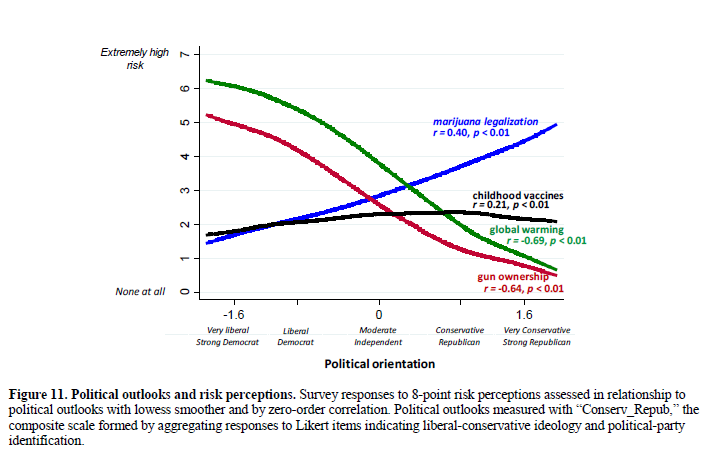
There is often a curious distinction between what the scientific community and the general population believe to be true of dire scientific issues, and this skepticism tends to vary markedly across groups.

…What causes such radical group differences? We suggest, as have previous accounts, that this phenomenon is often motivated.

However, the source of this motivation is not necessarily an aversion to the problem, per se, but an aversion to the solutions associated with the problem.

This difference in underlying process holds important implications for understanding, predicting, and influencing motivated skepticism.

In 4 studies, we tested this solution aversion explanation for why people are often so divided over evidence and why this divide often occurs so saliently across political party lines.

Studies 1, 2, and 3—using correlational and experimental methodologies—demonstrated that Republicans’ increased skepticism toward environmental sciences may be partly attributable to a conflict between specific ideological values and the most popularly discussed environmental solutions.

Study 4 found that, in a different domain (crime), those holding a more liberal ideology (support for gun control) also show skepticism motivated by solution aversion.

Is-It-Humans

1-Is-It-Happening

HT: http://today.duke.edu/2014/11/solutionaversion and http://www.washingtonpost.com/blogs/wonkblog/wp/2014/11/10/conservatives-dont-hate-climate-science-they-hate-the-lefts-climate-solutions/

A guide to government spending

image

Image

Previous Older Entries Next Newer Entries

Bassett, Brash & Hide

Celebrating humanity's flourishing through the spread of capitalism and the rule of law

Truth on the Market

Scholarly commentary on law, economics, and more

The Undercover Historian

Beatrice Cherrier's blog

Matua Kahurangi

Celebrating humanity's flourishing through the spread of capitalism and the rule of law

Temple of Sociology

Celebrating humanity's flourishing through the spread of capitalism and the rule of law

Velvet Glove, Iron Fist

Celebrating humanity's flourishing through the spread of capitalism and the rule of law

Why Evolution Is True

Why Evolution is True is a blog written by Jerry Coyne, centered on evolution and biology but also dealing with diverse topics like politics, culture, and cats.

Down to Earth Kiwi

Celebrating humanity's flourishing through the spread of capitalism and the rule of law

NoTricksZone

Celebrating humanity's flourishing through the spread of capitalism and the rule of law

Homepaddock

A rural perspective with a blue tint by Ele Ludemann

Kiwiblog

DPF's Kiwiblog - Fomenting Happy Mischief since 2003

The Dangerous Economist

Celebrating humanity's flourishing through the spread of capitalism and the rule of law

Watts Up With That?

The world's most viewed site on global warming and climate change

The Logical Place

Tim Harding's writings on rationality, informal logic and skepticism

Doc's Books

A window into Doc Freiberger's library

The Risk-Monger

Let's examine hard decisions!

Uneasy Money

Commentary on monetary policy in the spirit of R. G. Hawtrey

Barrie Saunders

Thoughts on public policy and the media

Liberty Scott

Celebrating humanity's flourishing through the spread of capitalism and the rule of law

Point of Order

Politics and the economy

James Bowden's Blog

A blog (primarily) on Canadian and Commonwealth political history and institutions

Science Matters

Reading between the lines, and underneath the hype.

Peter Winsley

Economics, and such stuff as dreams are made on

A Venerable Puzzle

"The British constitution has always been puzzling, and always will be." --Queen Elizabeth II

The Antiplanner

Celebrating humanity's flourishing through the spread of capitalism and the rule of law

Bet On It

Celebrating humanity's flourishing through the spread of capitalism and the rule of law

History of Sorts

WORLD WAR II, MUSIC, HISTORY, HOLOCAUST

Roger Pielke Jr.

Undisciplined scholar, recovering academic

Offsetting Behaviour

Celebrating humanity's flourishing through the spread of capitalism and the rule of law

JONATHAN TURLEY

Res ipsa loquitur - The thing itself speaks

Conversable Economist

In Hume’s spirit, I will attempt to serve as an ambassador from my world of economics, and help in “finding topics of conversation fit for the entertainment of rational creatures.”

The Victorian Commons

Researching the House of Commons, 1832-1868

The History of Parliament

Articles and research from the History of Parliament Trust

Books & Boots

Reflections on books and art

Legal History Miscellany

Posts on the History of Law, Crime, and Justice

Sex, Drugs and Economics

Celebrating humanity's flourishing through the spread of capitalism and the rule of law

European Royal History

Exploring the Monarchs of Europe

Tallbloke's Talkshop

Cutting edge science you can dice with

Marginal REVOLUTION

Small Steps Toward A Much Better World

NOT A LOT OF PEOPLE KNOW THAT

“We do not believe any group of men adequate enough or wise enough to operate without scrutiny or without criticism. We know that the only way to avoid error is to detect it, that the only way to detect it is to be free to inquire. We know that in secrecy error undetected will flourish and subvert”. - J Robert Oppenheimer.

STOP THESE THINGS

The truth about the great wind power fraud - we're not here to debate the wind industry, we're here to destroy it.

Lindsay Mitchell

Celebrating humanity's flourishing through the spread of capitalism and the rule of law

Alt-M

Celebrating humanity's flourishing through the spread of capitalism and the rule of law

croaking cassandra

Economics, public policy, monetary policy, financial regulation, with a New Zealand perspective

The Grumpy Economist

Celebrating humanity's flourishing through the spread of capitalism and the rule of law

International Liberty

Restraining Government in America and Around the World