
The top 5 world doping champions?
07 Jan 2018 Leave a comment
in economics of crime, sports economics
There are no externalities from hosting the America’s Cup because externalities arise from incomplete property rights
23 Dec 2017 Leave a comment
in applied price theory, applied welfare economics, politics - New Zealand, rentseeking, sports economics
Externalities arise out of incomplete property rights. The only externalities that arise from an airport expansion proposed in Wellington is from noise.
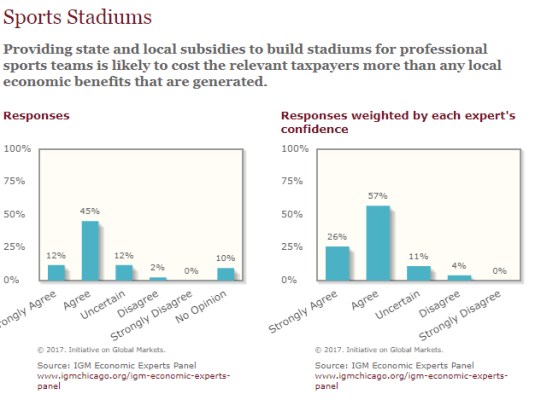
There are no externalities from building sports stadiums or hosting mega sports events because all of the effects are transacted through the market. No inputs are used without the permission of the owner, nothing is produced that is not charged for by the venue or event organisers.
As for the use of benefit cost analysis to strengthen the claim for a government subsidy, you use cost benefit analysis when you are too stupid to charge for the good or service such as a road or you are evaluating regulations because they deal with nonmarket effects, effects that are not mediated through the market process.
Sports stadiums and mega sports events should pass the usual market test. Is it profitable for the entrepreneurs backing the project when they are using their own money.
Where is Occupy Wall Street when they are most needed
09 Dec 2017 Leave a comment
in applied price theory, economic history, labour economics, sports economics Tags: superstars, top 1%
Peter Cook on Parkinson in 1977 explaining why he snubbed Vegas
18 Nov 2017 Leave a comment
in sports economics, television Tags: Peter Cook
Cost of the summer and winter Olympics since 1960
16 Nov 2017 Leave a comment
in sports economics Tags: Olympics

Russian offsetting behaviour
16 Oct 2017 Leave a comment
in applied price theory, sports economics Tags: offsetting behaviour, unintended consequences

Mega-sports events cost overruns
04 Oct 2017 Leave a comment
in economic history, sports economics
There is a large international literature documenting cost overruns in mega-projects and mega-sports events. Mega-projects are large-scale, complex construction ventures that take many years to develop and build.
The cost blow-outs in the Olympic Games, World Cup and Commonwealth Games will be more familiar to the reader because these are in the media in the run-up to these mega-sports events.
The Olympic Games, with one exception, involved massive, multi facility construction projects to a hard deadline. The only Olympics to come in on budget was the 1984 Los Angeles Olympics. It used existing sports facilities in that city. Los Angeles was able to stage the Olympics this way because few wanted to host them after the massive cost blow-out in Montréal – see Figure 1. The Los Angeles Olympics Organizing Committee was a private concern that could host an Olympics on the cheap and still be the winning bidder because Tehran withdrew the only competing bid to host the 1984 Olympics.
Figure 1: Sports-related cost overruns, Olympics 1960-2012; original currencies, real terms
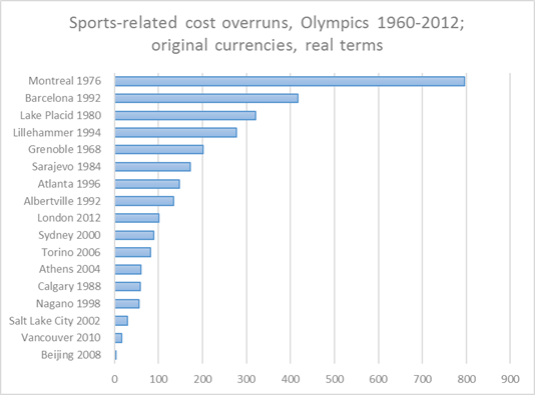
Source: Flyvbjerg and Stewart (2012), table 1.
Why boxing headguards may be making the sport more dangerous
14 Sep 2017 Leave a comment
in health and safety, health economics, labour economics, occupational choice, sports economics Tags: offsetting behaviour
Wisden remembers the best of even the worst
06 Sep 2017 2 Comments
in economics of crime, law and economics, sports economics Tags: cricket
John McEnroe on Serena Williams: A media meltdown | FACTUAL FEMINIST
24 Jul 2017 Leave a comment
in sports economics Tags: gender wage gap
Alan McGilvray: The Game Is Not The Same (Part 1)
25 Jun 2017 Leave a comment
in sports economics Tags: cricket
Macroeconomic Consequences of Taxing the Rich
11 May 2017 Leave a comment
in fiscal policy, macroeconomics, politics - USA, Public Choice, public economics, sports economics Tags: taxation and labour supply, top 1%
 Utopia, you are standing in it!
Recent Comments