


Democratic socialism is pointless
22 Jun 2014 Leave a comment
in F.A. Hayek, income redistribution, Public Choice Tags: democratic socialisim, rotation of power
Democratic socialism is pointless because electoral power is fleeting: sooner or later, the left wing parties representing the socialist alternative lose power, and capitalism is resorted.
How can democratic socialism work without entertaining the certain prospects of the right-wing parties winning office in 6,9, 12 years time and undoing everything?
Under pension fund socialism, with the majority of the share market owned by superannuation funds, any call for wide-spread nationalisations is political suicide. The same for re-nationalisation later when the left-parties get another turn in office.
The rotation of power is common in democracies, and the worst rise to the top. So it is wise to design constitutional safeguards to minimise the damage done when those crazies to the right or left of you get their chance in office, as they will.
Socialists must choose between supporting democracy and supporting socialism. The only way to stop the return for capitalism would be to undermine elections and the rule of law and ignore constitutional rights.

Unfettered power loses its shine when it must be shared with your political opponents at least once a decade.
Too many policies and ideas of the Left assumed that they are the face of the future, rather than just another political party that will hold power as often as not.
As James Buchanan pointed out in 1954, the great strength of democracies is majorities are temporary so the exploitation by the majority of the minority is never permanent. If electoral majorities are other than temporary, the minority would have no choice but to fight.
Costs do not determine prices!
21 Jun 2014 Leave a comment
in applied price theory, Austrian economics, F.A. Hayek Tags: price determination

The misconception that costs determined prices prevented economists for a long time from recognizing that it was prices which operated as the indispensable signals telling producers what costs it was worth expending on the production of the various commodities and services, and not the other way around. It was the costs which they had expended which determined the prices of things produced.
The entrepreneur forecasts whether consumers are willing to pay enough to justify him bringing his product to the market. If consumers are unwilling to pay enough for him to make a profit, he will not supply in the first place.
The order brought about by the mutual adjustment of many individuals in a market
21 Jun 2014 Leave a comment
in applied price theory, comparative institutional analysis, F.A. Hayek, Milton Friedman Tags: Adam Smith, FA Hayek, Milton Friedman, Pete Boetkke, spontaneous order

Pete Boettke has written extensively about how The Wealth of Nations is about social order among strangers. The market is a social order much larger than our span of moral sympathy.
In civilized society [man] stands at all times in need of the co-operation and assistance of great multitudes, while his whole life is scarce sufficient to gain the friendship of a few persons. In almost every other race of animals each individual, when it is grown up to maturity, is entirely independent, and in its natural state has occasion for the assistance of no other living creature.
But man has almost constant occasion for the help of his brethren, and it is in vain for him to expect it from their benevolence only. He will be more likely to prevail if he can interest their self-love in his favour, and show them that it is for their own advantage to do for him what he requires of them.
Whoever offers to another a bargain of any kind, proposes to do this. Give me that which I want, and you shall have this which you want, is the meaning of every such offer; and it is in this manner that we obtain from one another the far greater part of those good offices which we stand in need of.
To realize this social cooperation, Boettke argues that social institutions must be in place such as private property, keeping promises through contract, and the acceptance of the legitimacy of the transfer of property by consent. The division of labour is the key to the ability of the market system to produce social cooperation among distant and different anonymous actors.
The civilising influence of commerce is well-known as is it as the key to peace. We fear neither Russia nor China because of extensive economic interdependencies makes war pointless for all. The common market ended war in Western Europe.
The co-operation and peace is a spontaneous product of Hayek’s concept of catallaxy which is
the order brought about by the mutual adjustment of many individual economies in a market
The youtube clip is Milton Friedman’s discussion of the famous essay I, Pencil and how strangers cooperated in peace and harmony in the market even though they might hate each other if they ever met. I, Pencil details the complexity of its own creation and the numerous people involved is the absence of a master mind, of anyone dictating or forcibly directing these countless actions. Instead, we find the invisible hand at work.
Capitalism is a system which enables cooperation between millions of strangers so that they may jointly pursue their diverse goals.
James Buchanan and a non-discriminatory democracy?
17 Jun 2014 Leave a comment
in constitutional political economy, F.A. Hayek, James Buchanan, liberalism Tags: non-discriminatory democracy, rule of law, veil of ignorance
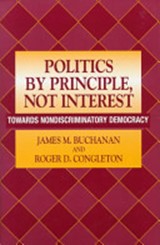
Under Buchanan’s generality norm, governments impose uniform regulation and use flat rate taxes on uniform tax bases to fund an equal-per-head demogrant (or a guaranteed minimum income) to replace all existing government cash transfers. Such a government would account for a large share of GDP. That did not bother him:
It seems to me that far too much of our politics is favourable treatment or unfavourable treatment for particularised groups. If we could somehow introduce into politics the requirement that would be analogous to the rule of law, that is, don’t treat one group differently from another group.
That has a lot of implications. That would not necessarily mean we’d have much smaller politics or government. It would mean there’d be a quite different characteristic of government…
The normative thrust of my current work is to try to push the generalization principle to the maximum extent possible, that is, so you don’t have particularised exemptions. One person gets it, everybody gets it. It cuts in favour of something like a flat tax. It cuts against means testing.
Buchanan has said that all successful welfare states (such as Sweden) apply a generality norm in some form or another.
For Buchanan, the very logic of majority rule implies unequal treatment or discrimination. If left unconstrained, majority coalitions will promote the interests of their own members at the expense of others.
Buchanan proposed a non-discriminatory democracy through the principle of generality:
- If extended to any single industry, tariff or quota protection also be extended and on equal terms to all industries.
- Tax structures would necessarily become simple, since the same tax rate would have to apply across-the-board on all sources or uses of tax base. Flat rate or proportional taxes on all incomes would broadly meet the generality norm.
- On the transfer side of the budget account, payments would have to be made in demogrants, equally available to all persons.
This is equivalent to Rawls’ veil of ignorance: choices must be without knowing where you lie in society so you make choices that are to the benefit of all.
Buchanan argued that if politics generates undesirable results, it is better to examine the rules than to argue about different policies or to elect different representatives. He build on Hayek who called a constitutional amendment that should read:
Congress shall make no law authorizing government to take any discriminatory measures of coercion.
Hayek went on say that, with such an amendment, all of the other rights would be unnecessary. In a non-discriminatory democracy, government choices are limited to those that benefit all.

Radical Economics: Yo Hayek! A BBC Radio interview with Jamie Whyte on Austrian Economics
31 May 2014 Leave a comment
in Austrian economics, F.A. Hayek Tags: FA Hayek, Jamie Whyte
 Other contributors to this talk are: Prof Steven Horwitz, Prof Larry White, Prof Robert Higgs, Philip Booth, Steve Baker, MP, John Papola, and Lord Robert Skidelsky, and Tim Congdon.

 Utopia, you are standing in it!
Recent Comments