Let freedom reign
15 Dec 2014 Leave a comment
in economics of crime, law and economics, liberalism, politics - Australia Tags: war on terror
This is shot that captures the #sydneysiege: sheer terror/relief of escaped hostages, incredible work of @nswpolice http://t.co/iCffJZ9NuZ—
Caroline Marcus (@carolinemarcus) December 15, 2014

Greg Mankiw’s Blog: Spreading the Wealth Around
15 Dec 2014 Leave a comment
in applied welfare economics, liberalism Tags: poverty and inequality

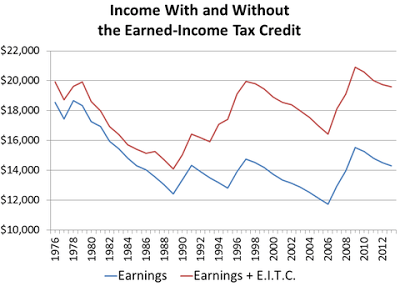
EITC is better than the Minimum Wage
15 Dec 2014 Leave a comment
in applied welfare economics, labour economics, liberalism, minimum wage, poverty and inequality Tags: earned income tax credit, family tax credits, in-work tax credits, minimum wage, negative income tax, poverty and inequality


Is it really too hard for people to bother to feed their kids? – Whale Oil Beef Hooked
13 Dec 2014 1 Comment
in applied price theory, applied welfare economics, labour economics, liberalism, poverty and inequality Tags: causes of poverty, inequality and poverty, school breakfast programmes, The Great Fact

Global Warming Was Worth It – And if we had to, we’d do it again
13 Dec 2014 Leave a comment
in climate change, development economics, environmental economics, global warming, growth disasters, growth miracles, history of economic thought, liberalism, population economics, technological progress Tags: capitalism and freedom, The Great Enrichment, The Great Escape, The Great Fact
Now, my conception (read: European) of progress and a better standard of living would place many advances above composting, organic farming, or even urban chicken coops.
- Higher incomes that allow people to make livings that afford them more than merely survival or avoiding starvation.
- A low poverty rate.
- High quality and diversity of employment opportunities. Rather than the choice of being a farmer or being a blacksmith, the average citizen should have an array of careers to choose from, and the ability to be industrious and take risks for profit.
- The availability of housing. On an average night in the United States, a country with a population of somewhere around 350 million, fewer than one million people are homeless.
- Consistent GDP growth.
- Access to quality health care.
- The availability of quality education. (I suppose we could quibble over the word “quality,” but certainly there is widespread free education availability.)
- High life expectancy. Worldwide life expectancy has more than doubled from 1750 to 2007.
- Low frequency of deadly disease.
- Affordable goods and services.
- Infrastructure that bolsters economic growth.
- Political stability.
- Air conditioning.
- Freedom from slavery, torture and discrimination.
- Freedom of movement, religion and thought.
- The presumption of innocence under the law.
- Equality under the law regardless of gender or race.
- The right to have a family – as large as one can support. Maybe even larger.
- The right to enjoy the fruits of labor without government – or anyone else – stealing it.
There’s much more, of course. If the “sustainability movement” had its way, many of these advances would be degraded.
And since Caradonna offered a few charts highlighting climate change and population growth (a bad thing), I too was assembling a number of graphs that could offer visual examples of the rise of positive developments since the Industrial Revolution. I also soon noticed that all of them looked virtually identical.
So below is what a graph encompassing nearly every one of my bullet points looks like:


Darwin Awards ‘winners’ are overwhelmingly male, analysis reveals
13 Dec 2014 Leave a comment
in economics of media and culture, health economics, liberalism, population economics, technological progress Tags: Darwin awards
- Darwin Awards is an annual review of most foolish way people have died
- Nominees improve the gene pool by eliminating themselves from the human race using foolish methods
- Scientists were surprised to discover 90% of award ‘winners’ were male
- Worthy candidates include a terrorist who opened his own letter bomb
- Another man attempted to travel by hitching a shopping trolley to a train

According to “male idiot theory” (MIT) many of the differences in risk seeking behaviour, emergency department admissions, and mortality may be explained by the observation that men are idiots and idiots do stupid things…
In addition, alcohol may play an important part in many of the events leading to a Darwin Award. It is conceivable that the sex difference is attributable to sociobehavioural differences in alcohol use.
Anecdotal data support the hypothesis that alcohol makes men feel “bulletproof” after a few drinks, and it would be naïve to rule this out.
For example, the three men who played a variation on Russian roulette alternately taking shots of alcohol and then stamping on an unexploded Cambodian land mine.
HT: dailymail.co.uk and The Darwin Awards: sex differences in idiotic behaviour | The BMJ.


Recent Comments