|
Four Distinct Foreign-Policy Orientations |
||
| Internationalist: Willing to intervene in foreign affairs | Isolationist: Reluctant to intervene in foreign affairs | |
| Emphasis on the national interest as primary value in foreign policy | National-interest interventionism | National-interest isolationism |
| Significant emphasis on altruism in foreign policy | Altruistic interventionism | Altruistic isolationism |
|
Source: Reichley 2000. |
||
Four Distinct Foreign-Policy Orientations
03 Dec 2014 Leave a comment
in International law, liberalism, politics - New Zealand, politics - USA, war and peace Tags: non-interventionist foreign policy
Alcohol? Divorce? Affairs? See how views of morality differ around the world
03 Dec 2014 Leave a comment
Jeffrey Miron — “Legalizing Drugs” | Harvard Thinks Big 5 – YouTube
02 Dec 2014 Leave a comment
in economics of crime, law and economics, liberalism Tags: drug decriminalisation, marijuana decriminalisation
More on More Efficient Tax Systems Leading to Bigger Government
02 Dec 2014 Leave a comment
in comparative institutional analysis, constitutional political economy, liberalism, Public Choice Tags: Casey Mulligan, Gary Becker, growth in government, public choice
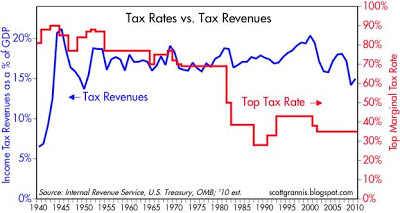
…in Deadweight Costs and the Size of Government (NBER Working Paper Number No. 6789) , [Gary Becker and Casey Mulligan] conclude that flatter and broader taxes also tend to encourage bigger government because taxpayers offer less resistance to increases in flat tax rates than in rates of more onerous and less efficient forms of taxation.
Any decline in the resistance of taxpayers leads to larger government budgets since an endless number of groups agitate for greater government support.
Flat tax rates, such as the VAT and Social Security taxes on earnings, usually start at very low levels but invariably increase over time.
The VAT is now 20 percent and higher in some countries. And payroll taxes began at a modest 2 percent in the 1930s in the United States, but have been increased 21 times to the present 15 percent combined rate on employees and employers.

The perils of foreign interventions – Syria/Iraq version
01 Dec 2014 Leave a comment
in liberalism, war and peace Tags: Iraq, non-interventionist foreign policy, Syria
Constitutions are brakes, not accelerators
30 Nov 2014 Leave a comment
in constitutional political economy, Gordon Tullock, James Buchanan, liberalism, Public Choice Tags: checks and balances, constitutional political economy, economics of constitutions, public choice
Much of constitutional design is about checks and balances. This division of power slows the impassioned majority down.
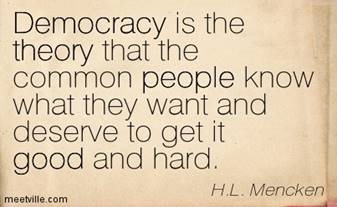
Constitutional constraints are basically messages from the past to the present that you must think really hard, and go through extra hurdles before you do certain things.
The 18th and 19th century classical liberals were highly sceptical about the capability and willingness of politics and politicians to further the interests of the ordinary citizen, and were of the view that the political direction of resource allocation retards rather than facilitates economic progress.
Governments were considered to be institutions to be protected from but made necessary by the elementary fact that all persons are not angels. Constitutions were to constrain collective authority.
The problem of constitutional design was ensuring that government powers would be effectively limited. The constitutions were designed and put in place by the classical liberals to check or constrain the power of the state over individuals.
The motivating force of the classical liberals was never one of making government work better or even of insuring that all interests were more fully represented. Built in conflict and institutional tensions were to act as constraints on the power and the size of government.

Milton Friedman on Competition in Education
30 Nov 2014 Leave a comment
in economics of education, liberalism, Milton Friedman Tags: Milton Friedman, School choice, The meaning of competition
The Top Five Feminist Myths of All Time
30 Nov 2014 Leave a comment
in discrimination, gender, labour economics, liberalism Tags: feminist myths, gender wage gap
Have We Lost the War on Drugs? – Gary Becker and Kevin Murphy – WSJ 2013
29 Nov 2014 Leave a comment
in economics of crime, economics of regulation, Gary Becker, health economics, law and economics, liberalism

One moderate alternative to the war on drugs is to follow Portugal’s lead and decriminalize all drug use while maintaining the illegality of drug trafficking. Decriminalizing drugs implies that persons cannot be criminally punished when they are found to be in possession of small quantities of drugs that could be used for their own consumption.
Decriminalization would reduce the bloated U.S. prison population since drug users could no longer be sent to jail.
Decriminalization would make it easier for drug addicts to openly seek help from clinics and self-help groups, and it would make companies more likely to develop products and methods that address addiction…
A study published in 2010 in the British Journal of Criminology found that in Portugal since decriminalization, imprisonment on drug-related charges has gone down; drug use among young persons appears to have increased only modestly, if at all; visits to clinics that help with drug addictions and diseases from drug use have increased; and opiate-related deaths have fallen.
Why Sir Richard Attenborough slept through a hurricane
29 Nov 2014 Leave a comment
in liberalism, war and peace Tags: Richard Attenborough
Grumpy old hippies on the iPhone generation
28 Nov 2014 Leave a comment
in economics of media and culture, liberalism Tags: grumpy old hippies, grumpy old man, grumpy old women, The Great Enrichment
HT: Sean Fitzpatrick


Recent Comments