
Celebrating diversity – Pat Condell
02 Nov 2014 Leave a comment
in liberalism Tags: Pat Condell, political correctness, The Age of Enlightenment
Would You Rather Be Rich In 1900, Or Middle-Class Now?
02 Nov 2014 Leave a comment
in liberalism, technological progress Tags: The Great Enrichment, The Great Fact

There’s no racist like a liberal racist – Pat Condell
01 Nov 2014 Leave a comment
in liberalism Tags: Leftover Left, Pat Condell, political correctness, progressives
Pat Condell: Progressivism Destroyed in 8 Minutes
31 Oct 2014 Leave a comment
in liberalism, politics, Rawls and Nozick Tags: Leftover Left, new inquistion, Pat Condell, political corrections, progressive left, superiority of western civilisation, The Age of Enlightenment
Homeopathic A and E
30 Oct 2014 Leave a comment
in health economics, liberalism Tags: Quacks
https://www.youtube.com/watch?v=HMGIbOGu8q0#t=21
HT: Sane Bob
Rod Liddle: The most fatuous phrases in the English language
30 Oct 2014 Leave a comment
in liberalism Tags: grumpy old men
1. Battling my demons It was demons who held down that actress/pop singer/reality TV star and rammed four kilos of charlie up her left nostril leaving her with the IQ of an aspidistra and, alas, sans septum…
2 Vulnerable: It’s official — the most abused word in the English language these days. Today, as used by the whining liberal left, it means anyone who isn’t an able-bodied middle-aged white heterosexual male in full possession of his mental faculties…
3. Diversity Something brilliant, to be championed. We all love diversity, don’t we? As used by the left it means ‘lots of ethnic minorities’. Quite often it is deployed to mean precisely the opposite of its original meaning.
4. Denier: A horrible and recent confection of, again, the liberal left. You can be a ‘climate change denier’, which means you might doubt that global warming will cause quite the catastrophic circumstances — annihilation of all living creatures, earth burned to a crust, polar bears howling in agony — dreamed up by the maddest, gibbering eco-warriors…
5. Classic: I bought some lavatory paper the other day which was described as having a ‘classic design’. ..
6. Wrong side of history: If someone says you’re on the wrong side of history, it is their smug and stupid way of telling you that you are wrong and they are right, no more…
7. Let me absolutely clear about this, Evan…: Any politician who tells you that he is about to be absolutely clear about anything is actually about to lie to you and probably steal your spoons…
8. Vibrant: Used as a synonym for ‘noisy’ or ‘thieving’…
9. Community: Yes, Huw, it’s a vibrant and diverse community, but it’s also a very vulnerable community, which is why the police have been brought in to stop angry local people attacking them…
Source: spectator
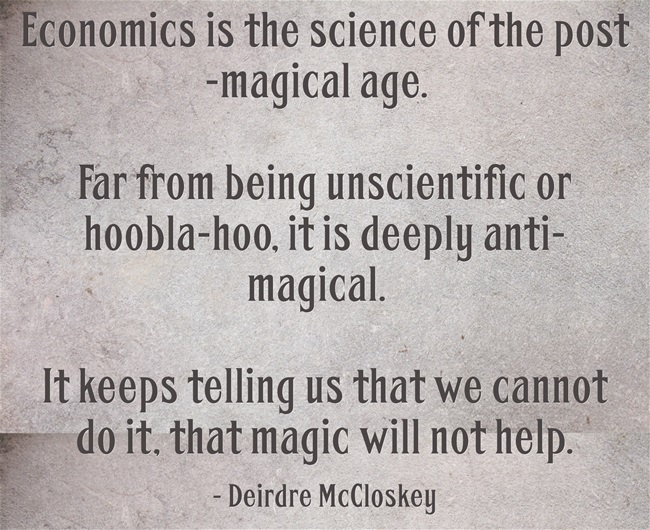
Deirdre McCloskey on the fatal conceit
30 Oct 2014 Leave a comment
in applied price theory, applied welfare economics, comparative institutional analysis, development economics, entrepreneurship, liberalism Tags: Deirdre McCloskey, The fatal conceit, The pretence to knowledge
HT: Cafe Hayek

The Berlin Wall: 1989 and now
29 Oct 2014 Leave a comment
in liberalism Tags: Berlin wall, collapse of communism
 |
 |
 |
 |
 |
 |
 |
 |
 |
 |
After the Berlin wall fell, the local German club in Canberra purchased a piece of the Berlin wall and mounted it o the wall over its entrance. There are markets and everything, including historical icons of liberty.
Within hours of the fall of the Berlin wall, a buddy German entrepreneur or two noticed that a lot of people will want to buy a piece of the Berlin wall, including expatriate Germans. One way these entrepreneurs would have noticed would have been local Berliners sticking pieces of the wall in the boots of their cars to take home as souvenirs.

There were 184 kilometres (114 miles) of concrete, or 45,000 individual segments, and its commercial value was recognised early.

Showing a notable nascent capitalist instinct, ministers of the provisional GDR government passed a resolution to take commercial advantage of the Berlin Wall on December 29, 1989, before official demolition even began.

An East German foreign trade company, Limex-Bau, received the job of marketing the individual segments, which it apparently did with some success. Three-hundred-sixty segments were taken for their artistic value and sold all over the world for prices as high as 40,000 marks.

There are segments in Las Vegas casinos, South Korean parks and on Caribbean islands. The city of Berlin has also kept a few dozen segments to give away as ceremonial state gifts.
HT: spiegel.de
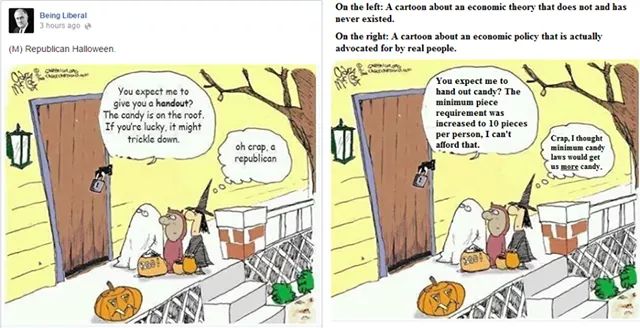
‘Being liberal’ logic on Halloween night
29 Oct 2014 Leave a comment
in liberalism Tags: do gooders
HT: Stephen Berry
Deirdre McCloskey’s Crossing: A Memoir
29 Oct 2014 Leave a comment
in liberalism Tags: cricket, Deirdre McCloskey, gender wage gap

When Donald at the age of 52 told his university dean, a conservative economist, he had decided to become a woman a stunned silence was followed by:
Thank God … I thought for a moment you were going to confess to converting to socialism.
The dean also joked it would be good for the department’s affirmative action program – one less man, one more woman – and that McCloskey’s pay could now be cut to about 70¢ in the dollar, since she would be a female.
Sadly, his son, daughter and former wife turned away from this new person.
His sister and one of her academic colleagues conspired to have him committed as mentally incompetent — unfit to sign papers for optional surgical procedures.
They devised a theory that he was manic and that his mania could be treated with psychopharmacology.
Twice during his determined journey into womanhood, they managed to have him incarcerated — handcuffed, locked away where he could not harm himself, at first in the University of Iowa Hospital’s mental ward and later in the University of Chicago Hospital.
Deirdre McCloskey’s mother and brother were bulwarks of support; her sister is moving toward reconciliation. She has finally stopped calling her ”Donald.”
McCloskey expected to lose everything because of the gender transition but her academic career survived. McCloskey’s former wife and two adult children have not spoken to her since 1995.
Her 16 books and 400-odd academic articles range from highly technical economics to philosophy, ethics and transgender advocacy. McCloskey’s Twitter biography is a reasonable 15-word summary of her:
Postmodern, quantitative, literary, ex-Marxist, economist, historian, progressive Episcopalian, coastie-bred Chicagoan woman who was once not.
More unusually for an American, she loves cricket. McCloskey even played wicket-keeper for the University of Illinois cricket team, which was made up mostly of players from the subcontinent and Jamaica.
HT: Sydney Morning Herald and New York Times


Recent Comments