Good old fashioned altruism versus a grubby market for kidneys
30 Jun 2014 Leave a comment

via Carpe Diem

People say things they later regret and their friends regret they said it at all
25 Jun 2014 1 Comment
in liberalism, Marxist economics Tags: second thoughts, the overweening conceit of youth, the road to serfdom

There are plenty, now on the left and the right, who in the past, and sometimes too recent past, dabbled in ideologies that did not include an unwavering commitment to democratic government, the rule of law, and peaceful change through the ballot box.
Ex-communists: they are allowed back into polite society and into left-wing political parties often without have to admit and openly repent for being the fools that they were. Some of these ex-communists took a long time and were well past their immature youth to see the foolishness of their ways.
The forgiveness for ex-communists is odd as Hayek in the Road to Serfdom challenged the general view among British academics that fascism was a capitalist reaction against socialism, instead arguing that fascism and socialism had common roots in central economic planning and the power of the state over the individual.
The inter-war communists hated the Fascists because both competed for the working class vote and because ex-comrades such as Mussolini had worked out that co-opting nationalism with anti-big business rhetoric was a sure path into the hearts of the working class, lower-middle class, and small business and greatly increased the chances to seize power quickly and legally with wide support in times of discontent.
The economist Joan Robinson gazed on China and North Korea with “starry eyes”, as Geoffrey Harcourt put it, as well as making some utterly devastating criticisms of Marxian economics at earlier points in her long career. Robinson became more left wing as she aged, and in Economic Management in China (1975), she praised the Cultural Revolution! Her colleagues were quite embarrassed.
Noam Chomsky spoke when he should have listened on Cambodia under Pol Pot.
Orwell’s Proposed Preface to ‘Animal Farm’ is a wonderful dissection of renegade liberal that glorified communist experiments. For Orwell, these intellectuals loved the Stalin’s Soviet Union despite the purges, mocked bourgeois liberty despite their own pleasing bourgeois circumstances, and identified with communists would who have shipped them off to camps straight after the revolution. The renegade liberals excused the Moscow purges because communists were just ‘liberals in a hurry’!


Hero worship in left-wing politics
18 Jun 2014 Leave a comment
in liberalism, politics - Australia Tags: hero worship, Ludwig von Mises, The fatal conceit
It is the Left who hero worships its leaders and even have photos of them on the walls inside their houses. Right-wing party leaders are mostly forgotten 5 minutes after they left office.
Do you recall the wide smiles on the faces of Bob Brown and Adam Bandt when the parliament was addressed by the Drone Commander-in-Chief Obama.

Did Bob Brown interrupt Obama’s speech to ask about the war in Afghanistan and drone strikes? He interrupted Bush when he addressed parliament.
The Left is inherently prone to hero worship because the Left wants to reshape the world and the leaders of that movement have heroic missions. As Mises explained:
The incomparable success of Marxism is due to the prospect it offers of fulfilling those dream-aspirations and dreams of vengeance which have been so deeply embedded in the human soul from time immemorial. It promises a Paradise on earth, a Land of Heart’s Desire full of happiness and enjoyment, and—sweeter still to the losers in life’s game—humiliation of all who are stronger and better than the multitude.


James Buchanan and a non-discriminatory democracy?
17 Jun 2014 Leave a comment
in constitutional political economy, F.A. Hayek, James Buchanan, liberalism Tags: non-discriminatory democracy, rule of law, veil of ignorance
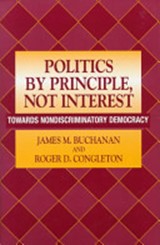
Under Buchanan’s generality norm, governments impose uniform regulation and use flat rate taxes on uniform tax bases to fund an equal-per-head demogrant (or a guaranteed minimum income) to replace all existing government cash transfers. Such a government would account for a large share of GDP. That did not bother him:
It seems to me that far too much of our politics is favourable treatment or unfavourable treatment for particularised groups. If we could somehow introduce into politics the requirement that would be analogous to the rule of law, that is, don’t treat one group differently from another group.
That has a lot of implications. That would not necessarily mean we’d have much smaller politics or government. It would mean there’d be a quite different characteristic of government…
The normative thrust of my current work is to try to push the generalization principle to the maximum extent possible, that is, so you don’t have particularised exemptions. One person gets it, everybody gets it. It cuts in favour of something like a flat tax. It cuts against means testing.
Buchanan has said that all successful welfare states (such as Sweden) apply a generality norm in some form or another.
For Buchanan, the very logic of majority rule implies unequal treatment or discrimination. If left unconstrained, majority coalitions will promote the interests of their own members at the expense of others.
Buchanan proposed a non-discriminatory democracy through the principle of generality:
- If extended to any single industry, tariff or quota protection also be extended and on equal terms to all industries.
- Tax structures would necessarily become simple, since the same tax rate would have to apply across-the-board on all sources or uses of tax base. Flat rate or proportional taxes on all incomes would broadly meet the generality norm.
- On the transfer side of the budget account, payments would have to be made in demogrants, equally available to all persons.
This is equivalent to Rawls’ veil of ignorance: choices must be without knowing where you lie in society so you make choices that are to the benefit of all.
Buchanan argued that if politics generates undesirable results, it is better to examine the rules than to argue about different policies or to elect different representatives. He build on Hayek who called a constitutional amendment that should read:
Congress shall make no law authorizing government to take any discriminatory measures of coercion.
Hayek went on say that, with such an amendment, all of the other rights would be unnecessary. In a non-discriminatory democracy, government choices are limited to those that benefit all.
If I Gave a High School Graduation Speech | Arnold Kling
13 Jun 2014 Leave a comment
in liberalism Tags: Arnold kling, The Great Fcat

I am going to talk about community service…and why I am against it…
If you judge people by how their life’s work contributed to better lives for people and less poverty in the world, then I will gladly stack up the Henry Fords and Thomas Edison’s against the Mother Theresa’s. Collectively, the capitalists and entrepreneurs have a much better claim on our gratitude than do the icons of community service.
What would you rather have in your community? Would you rather have the Wal-mart that hires the workers that other businesses cannot use and for whom politicians can offer no assistance–people with little education or training, including people with disabilities? Or would you rather have the “activists” who fight to keep out Wal-Mart or who insist that they should dictate Wal-Mart’s labour policies?
Murray Rothbard and the Bourbon Democrats
13 Jun 2014 Leave a comment
in liberalism, libertarianism, Murray Rothbard, Public Choice Tags: Bourbon Democrats, Third party sytem
The American political system is complicated with the Republicans and Democrats moving around the political spectrum. Remember, Teddy Roosevelt’s Progressive Party, with its rather left wing agenda split from the Republicans, not from the Democrats in 1912.
Murray Rothbard saw a lot of anti-big government sentiments in the pre-1896 Democratic Party under the Third Party System, and especially in the Second Party System prior to the Civil War with Andrew Jackson and Martin Van Buren. The 19th century Democratic Party tended to be the party of peace, anti-militarism, and anti-imperialism. Rothbard referred to Grover Cleveland
The Third Party System was dominated by the newly created Republican Party, which supported national banks, railroads, high tariffs, homesteading rights and aid to the land-grant colleges.
The Fourth Party System from 1896 to 1932 was made up of a majority centrist Republican Party against a minority Democratic Party from the South together with urban Catholics in the Northern cities – a volatile brew – which soon had an ideology scarcely distinguishable from the Republicans.
Both parties under the Third party System that operated prior to 1896 comprised broad-based voting coalitions divided between the parties on racial, ethnic and religious lines with high voter turnout and strong partisanship.
- Methodists, Congregationalists, Presbyterians, and Scandinavian Lutherans were closely linked to the Republican Party.
- Catholics, Episcopalians, and German Lutherans, looked to the Democratic Party for protection from moralism and prohibition.
- The Democrats gained more support from the lower classes than did the Republicans.
Bourbon Democrat was a term used in the US from 1876 to 1904 for members of the Democratic Party, conservative or classical liberal, and especially those who supported President Grover Cleveland in 1884–1888 and 1892–1896. Rothbard referred to Grover Cleveland as “a hard-money laissez-faire Democrat” and
the continuity of quasi-libertarian thought that the Democrat Party brought to the United States throughout the nineteenth century
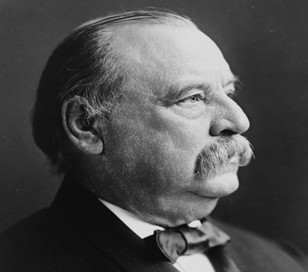
The Bourbon Democrats represented business interests, generally supporting the goals of banking and railroads but opposed to subsidies for them and were unwilling to protect them from competition.
Bourbon Democrats were promoters of laissez-faire capitalism (which included opposition to the protectionism that the Republicans advocated). The Bourbon Democrats opposed imperialism and U.S. overseas expansion, fought for the gold standard, and opposed bimetallism.
The notion that the Democratic Party was once the home of classical liberals in the USA at one time and the Republican Party was the party of regulation and big government is so foreign to the modern party divides in the USA today. Political parties in the United States certainly are big tents as they say.
Good monopolies and bad price cuts
10 Jun 2014 Leave a comment
in industrial organisation, liberalism Tags: monopoly, progressivism
A surprising number of well-meaning people want to protect consumers from the scourge of lower prices. These abominations come from imports, new entry or cost reductions.

Richard Epstein talked about how progressives think they can tell the difference between a good monopoly and a bad monopoly.

There is one instance in which monopoly could arise in the free market – exclusive ownership of an essential input (Kirzner 1973):
Monopoly … in a market free of government obstacles to entry, means for us the position of a producer whose exclusive control over necessary inputs blocks competitive entry into the production of his product.
Monopoly thus does not refer to the position of a producer who, without any control over resources, happens to be the only producer of a particular product. This producer is fully subject to the competitive market process, since other entrepreneurs are entirely free to compete with him.
In all other cases, monopoly is the grant by government of an exclusive privilege to produce or sell a product (Rothbard 1962). This definition is from the common law as per Lord Coke:
A monopoly is an institution or allowance by the king, by his grant, commission, or otherwise . . . to any person or persons, bodies politic or corporate, for the sole buying, selling, making, working, or using of anything, whereby any person or persons, bodies politic or corporate, are sought to be restrained of any freedom or liberty that they had before, or hindered in their lawful trade.
All Men Are Created Equal – To Kill a Mockingbird
08 Jun 2014 Leave a comment
My High School Class read the book. One of the greatest books ever.


Recent Comments