The Whitehouse recently released a document titled: Make America Healthy Again. The health trends listed are stark – and the needed solutions are clear (even if is going to be like doing an Aircraft Carrier doing a u-turn in the Suez Canal). In many of the crisis stats NZ is not far behind. These are […]
A hugely important document for NZ to learn from.
A hugely important document for NZ to learn from.
07 Jun 2025 Leave a comment
in economic history, health economics, politics - New Zealand, politics - USA
Ardern: If she insists on being remembered, I will oblige
06 Jun 2025 Leave a comment
One thing children who get murdered never seem short of is names. The latest example is Catalya Remana Tangimetua Pepene, the four-year-old Kaikohe child who recently met a violent death. Late 2023 it was Taita toddler, Ruthless-Empire Souljah Reign Rhind Shephard Wall. Or in 2016, 14 week-old Richard Royal Orif Takahi Winiata Uddin. Examples abound.What…
Ardern: If she insists on being remembered, I will oblige
Productivity growth languishing
05 Jun 2025 Leave a comment
in economic growth, macroeconomics, politics - New Zealand

I hadn’t had a look for a while at the OECD labour productivity (real GDP per hour worked) data, but the release of the latest OECD Economic Outlook the other day prompted me to spend some time in the (less user-friendly than it was) OECD database. It takes a while for all the data to […]
Productivity growth languishing
The Ultra Vires Reach of the Resource Management Act: Te Tiriti Obligations, Private Citizens, and the Erosion of Legal Boundaries
05 Jun 2025 Leave a comment
in economics of bureaucracy, economics of regulation, law and economics, politics - New Zealand, property rights, Public Choice, rentseeking Tags: constitutional law
Zoran Rakovic writes – This essay argues that the New Zealand government has acted ultra vires by interpreting and applying the Resource Management Act 1991 (RMA) in ways that impose Te Tiriti o Waitangi obligations upon private citizens and resource consent applicants without express statutory authority or due compensation. The practice violates foundational principles of […]
The Ultra Vires Reach of the Resource Management Act: Te Tiriti Obligations, Private Citizens, and the Erosion of Legal Boundaries
Labour’s first and most urgent mission is to knock Te Pāti Māori out of the race
05 Jun 2025 Leave a comment
in discrimination, politics - New Zealand Tags: constitutional law, political correctness, racial discrimination, regressive left
Chris Trotter writes – “Your mission, Mr Hipkins, should you choose to accept it, is to lead Labour to victory in 2026.” Except, as always, the drama of a Mission Impossible movie lies not in the what, but in the how. Of course Chris Hipkins is willing to lead Labour to a win. The real question is […]
Labour’s first and most urgent mission is to knock Te Pāti Māori out of the race
Advertising for a Governor
03 Jun 2025 Leave a comment
in economics of bureaucracy, inflation targeting, macroeconomics, monetary economics, politics - New Zealand, Public Choice Tags: monetary policy

If you want to be Reserve Bank Governor, think you have what it takes, (and haven’t yet been approached by the Board’s recruitment company) you will need to get moving. Applications close on Friday. As a reminder, much of the process (unusually by international standards) is controlled by the Bank’s Board, most of whom were […]
Advertising for a Governor
Deputy Prime Minister David Seymour
02 Jun 2025 Leave a comment
David Seymour said: Not only is our mission fundamentally hard, but sometimes we’ve made it harder than necessary. I hesitate to bring it up, but we’ve burned ourselves on one or two of our own brushfires along the way. Our perk buster took a perk. Our tough on crime guy got convicted. Our leadership had […]
Deputy Prime Minister David Seymour
Counting the Cost
01 Jun 2025 Leave a comment
in applied price theory, discrimination, gender, human capital, income redistribution, labour economics, labour supply, occupational choice, politics - New Zealand, poverty and inequality, Public Choice, rentseeking Tags: constitutional law, gender wage gap, sex discrimination
For all the gravitas which Dame Marilyn’s involvement has conferred upon PSCPE, it is important not to lose sight of the fact that it represents a deliberate attempt to morally overpower what is now the law of the land. Chris Trotter writes – The People’s Select Committee on Pay Equity (PSCPE) is looking for evidence. […]
Counting the Cost
MPC members speaking
31 May 2025 Leave a comment
in budget deficits, business cycles, economic growth, economics of bureaucracy, macroeconomics, monetary economics, politics - New Zealand, Public Choice Tags: monetary policy

In both The Post and the Herald this morning there are reports of interviews with executive members of the Reserve Bank’s Monetary Policy Committee: the Bank’s chief economist Paul Conway in The Post and his boss, and the deputy chief executive responsible for monetary policy and macroeconomics, Karen Silk in the Herald. In a high-performing […]
MPC members speaking
May Monetary Policy Statement
30 May 2025 Leave a comment
in budget deficits, business cycles, economic growth, fiscal policy, inflation targeting, labour economics, macroeconomics, monetary economics, politics - New Zealand, public economics, unemployment Tags: monetary policy
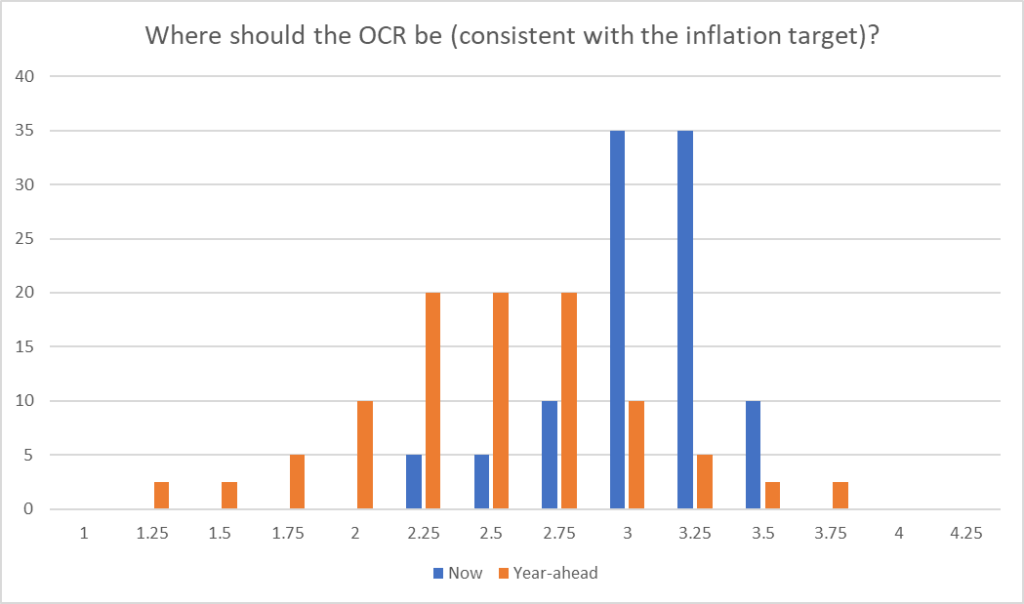
Michael Reddell writes – Procrastinating this morning, I asked Grok to write a post in my style on yesterday’s Monetary Policy Statement. Suffice to say, I think I’ll stick to thinking and writing for myself for the time being. Among the many oddities of Grok’s product was the conviction that Adrian Orr was still Governor. Mercifully […]
May Monetary Policy Statement
Prebble on Labour and TPM
30 May 2025 Leave a comment
in politics - New Zealand Tags: constitutional law
Richard Prebble writes: Claims standards of parliamentary behaviour have fallen are nonsense. Except for Te Pāti Māori, this is a well-behaved House. The Speaker’s referral of the floor protest to the Privileges Committee was not discretionary. It was required by Standing Orders. The Speaker was lenient. He could have ordered the Sergeant-at-Arms to end the Māori Party […]
Prebble on Labour and TPM
New medicine approvals plan an exercise in not solving the problem
28 May 2025 Leave a comment
in applied price theory, economics of bureaucracy, economics of regulation, health economics, politics - New Zealand, Public Choice Tags: drug lags
Eric Crampton writes – New medicines are slow to be authorised for the New Zealand market. Even if a medicine has already been approved by many other trustworthy overseas regulators like those in Canada, the UK, Australia, and the EU, Medsafe can take a very long time to evaluate a medicine.
New medicine approvals plan an exercise in not solving the problem
One last post on Investment Boost
27 May 2025 Leave a comment
in applied price theory, economic growth, fiscal policy, macroeconomics, politics - New Zealand, public economics Tags: taxation and investment

After the discussion in my post yesterday on the Investment Boost subsidy scheme announced in the Budget I thought a bit more about who was likely to benefit the most from it. The general answer of course is the purchasers of the longest-lived assets. Why? Because if you have an asset which IRD estimates to […]
One last post on Investment Boost
Some more post-Budget thoughts
27 May 2025 Leave a comment
in budget deficits, business cycles, economic growth, fiscal policy, macroeconomics, politics - New Zealand, Public Choice, public economics Tags: taxation and investment

On two separate themes; aggregate fiscal policy, and the Investment Boost initiative. Aggregate fiscal policy Over the weekend for some reason I was prompted to look up the Budget Responsibility Rules that Labour and the Greens committed to in early 2017 (my commentary on them here). At the time, the intention seemed to be to […]
Some more post-Budget thoughts
Deficits forever?
24 May 2025 Leave a comment
in budget deficits, fiscal policy, macroeconomics, politics - New Zealand, Public Choice, public economics
Eric Crampton writes – This week’s budget projected no return to balanced books. It is difficult to see how recent budgets from National and Labour comply with the Public Finance Act’s fiscal responsibility provisions. It is a problem.
Deficits forever?
 Utopia, you are standing in it!
Recent Comments