Opposition leader Chris Hipkins does a regular slot with host Nick Mills on the Wellington NewstalkZB morning show.On Wednesday, much of the half hour was consumed by the host trying to extract from Hipkins what Labour would be doing about the fuel ‘crisis’ if in government. This was fastidiously avoided with various excuses, one being that,…
Hipkins under-performing and underwhelming
Hipkins under-performing and underwhelming
29 Mar 2026 1 Comment
Labour’s fuel crisis policy is silence
27 Mar 2026 Leave a comment
in defence economics, energy economics, politics - New Zealand, transport economics, war and peace Tags: Iran
The Herald reports: Labour leader Chris Hipkins isn’t providing an alternative plan of action to help struggling New Zealanders facing pain at the pump and the threat of rising prices elsewhere. Asked repeatedly what alternatives Labour could suggest, Hipkins said the onus to present ideas was on the current Government. He gave some principles, such…
Labour’s fuel crisis policy is silence
Taking comfort from the 1970s
27 Mar 2026 Leave a comment
in defence economics, economics of regulation, energy economics, politics - New Zealand, war and peace Tags: Iran
When a story recently emerged about the government getting advice on carless days under the Petroleum Demand Restraint Act, older New Zealanders will have felt a warm flush of nostalgia. The 1979 restrictions brought coloured windscreen stickers announcing the weekday car owners had promised not to drive. Thursday proved the most popular choice. A thriving black market followed. Forty-three percent of vehicles secured exemptions.
Taking comfort from the 1970s
The truth about TOP
27 Mar 2026 Leave a comment
in environmentalism, politics - New Zealand

TOP isn’t above Left and Right. It’s just the Left in better packaging Every election cycle, like clockwork, Opportunity (TOP) reappears. It refreshes its branding, gets a new leader, rolls out a new slate of candidates, and the media, just as predictably, froths over them. Since Gareth Morgan founded the party in 2016, this has become a […]
The truth about TOP
A worthwhile trade off
25 Mar 2026 Leave a comment
in applied price theory, economics of regulation, human capital, labour economics, labour supply, law and economics, occupational choice, politics - New Zealand, property rights Tags: employment law, offsetting behavior, unintended consequences
Susan Hornsby-Geluk writes: Among the most controversial aspects of the recently enacted Employment Relations Amendment Act 2026 is the introduction of a high-income threshold for personal grievance claims. Under the new provisions, employees earning $200,000 or more in annual remuneration will lose the right to bring a personal grievance for unjustified dismissal, or an unjustified…
A worthwhile trade off
What power would allow Ministers to close down a community?
22 Mar 2026 Leave a comment
in economics of crime, economics of religion, law and economics, libertarianism, politics - New Zealand
The Herald reports: Senior Government minister Louise Upston visited Gloriavale in late January, months after refusing to rule out closing the religious community following allegations of child abuse in the community. Newstalk ZB has confirmed Upston visited the sect on January 30, alongside officials from the Ministry of Social Development. This story is puzzling. As…
What power would allow Ministers to close down a community?
An outrageous legal complaint decision overturned
19 Mar 2026 Leave a comment
in discrimination, gender, law and economics, liberalism, Marxist economics, politics - New Zealand Tags: free speech, political correctness, regressive left, sex discrimination
An Area Standards Committee of the Law Society fined Stephen Franks and Franks Ogilvy for, well being lawyers. They sent a letter on behalf of their client to health professionals involved in “gender affirming care”. The ASC found that they had “used a legal process for an improper purpose”, censured them and fined them. I…
An outrageous legal complaint decision overturned
The five voter tribes that will decide who governs New Zealand
19 Mar 2026 Leave a comment
in politics - New Zealand Tags: voter demographics
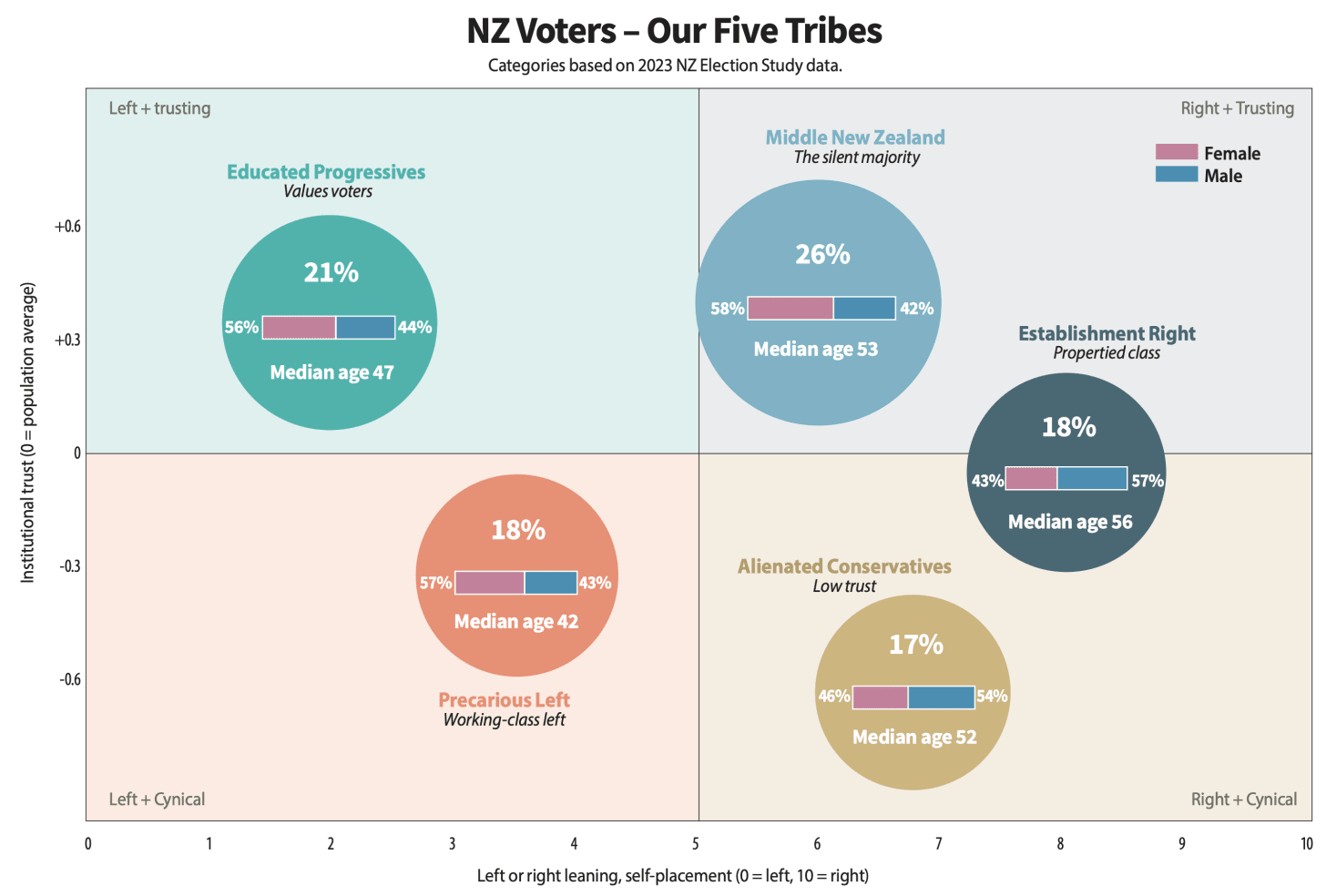
If you want to understand what will happen on 7 November, forget the polls for a moment. Forget the horse-race coverage, the personality contests, and the pundit predictions. Instead, read Danyl McLauchlan’s cover story in this week’s Listener magazine. It’s the sharpest piece of political analysis I’ve read this cycle – and probably the most […]
The five voter tribes that will decide who governs New Zealand
The Māori Seats – History, Not Myth
18 Mar 2026 Leave a comment
in constitutional political economy, economic history, politics - New Zealand, Public Choice
Professor Anaru Eketone claims the Māori electorates were a cynical device to suppress Māori political influence.(paywalled) The historical record suggests the opposite: the Māori seats were created to bring Māori into the parliamentary system and guarantee representation, rather than exclude them. By 1867, when the Māori Representation Act 1867(1) passed, Europeans outnumbered Māori roughly four to one. […]
The Māori Seats – History, Not Myth
103 ways for local government to save money
17 Mar 2026 Leave a comment
in economics of bureaucracy, politics - New Zealand, Public Choice, public economics
The Taxpayer’s Union has done a report listing 103 ways local government can save money. Some of the more significant ones which I support are: The post 103 ways for local government to save money first appeared on Kiwiblog.
103 ways for local government to save money
Medical Council proposes striking off doctors who disagree with their political views
17 Mar 2026 Leave a comment
in discrimination, economics of education, economics of regulation, human capital, labour economics, labour supply, liberalism, Marxist economics, occupational choice, occupational regulation, politics, politics - New Zealand
The Medical Council has proposed a statement on cultural competence that is basically a political litmus test. It is outrageous overreach, and an example of why Parliament needs to rein in all these regulatory bodies. No one would object to a statement that doctors must be respectful of all cultures and beliefs, while undertaking their…
Medical Council proposes striking off doctors who disagree with their political views
The great diversity of charter schools
14 Mar 2026 Leave a comment
in economics of education, liberalism, politics - New Zealand
I’ve just been looking at the 19 charter schools approved to date, and am impressed with how well they cater for all types of kids, They are not about replicating state schools, but providing alternatives for those who need or desire them. The focus of the schools are: And not a single student at these…
The great diversity of charter schools
The Covid inquiry’s verdict nobody quite wants
13 Mar 2026 Leave a comment
in economics of regulation, health economics, politics - New Zealand Tags: economics of pandemics
The final phase of the Covid inquiry is out, and almost nobody will be fully happy with what it says. The report says New Zealand got plenty right, but it also lays out a string of failures, blind spots and overreaches. It is neither the devastating indictment that opponents of the Labour government wanted, nor […]
The Covid inquiry’s verdict nobody quite wants
Greens draft list demotes several MPs
12 Mar 2026 Leave a comment

The Greens have published their draft list, voted on by delegates. It sees several MPs dropped to probably unwinnable places. Steve Abel has the biggest drop from 9 to 14. He is probably the most environmentally focused MP in their caucus, so I guess he hasn’t done enough campaigning on Gaza. Scott Willis drops from…
Greens draft list demotes several MPs
Te Pāti Māori get slaughtered by the High Court
10 Mar 2026 Leave a comment
in law and economics, politics - New Zealand
Justice Radich has just made the following rulings: It is very rare for the judiciary to make rulings such as this, but the way TPM went about their decision making was so flawed, that the Judge felt he had to. This is a humiliating loss for Tamihere and his deputy co-leaders, especially the explicit instruction…
Te Pāti Māori get slaughtered by the High Court


Recent Comments