
Was Aaron Sorkin right? Hollywood discriminates? Sacrifices profit to indulge sexism?
17 Dec 2014 1 Comment
The wisdom of Homer Simpson: peak oil, oil pollution and the price at the pump
09 Dec 2014 1 Comment

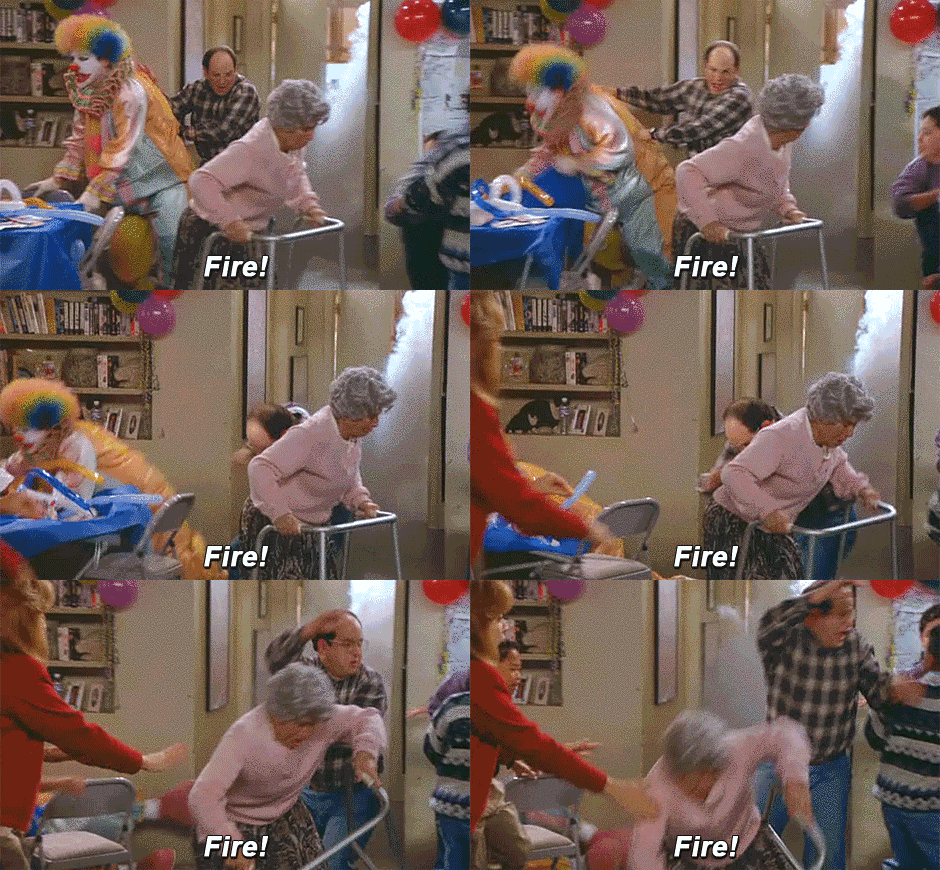
A favourite line from Seinfeld
03 Dec 2014 Leave a comment
in economics of love and marriage, gender, human capital, labour economics, TV shows, unemployment Tags: Seinfeld
Are you wearing a wire?
25 Nov 2014 Leave a comment
in economics of media and culture, movies, TV shows Tags: movies, TV shows all
One of the oldest dramatic devices in a TV show or movie drama is to have the hero or police spy go into a meeting with the criminal desperados wearing a wire.
There has been zero technological progress in the size of these listening devices ever since I started watching TV.
When undercover agents record conversations., they use a bulky tape recorder strapped around their waists, and wires — connected to a microphone — secured to their chests with an adhesive.

When the criminals look for the wire, they tear off the shirt of the suspected police spy to look for the wire. They never check his mobile phone.

Today, eavesdropping equipment is sophisticated enough to record high-definition video and sound, and stream it live to a remote computer. Devices no bigger than a pen cap can be slipped into a coat pocket and easily record through the person’s clothing.

Scriptwriters are really going to have to look for a substitute dramatic device. Pretty soon, a large part of the audience simply will not recognise an old-fashioned tape recorder.

Sinatra police mug-shot from 1938
23 Nov 2014 Leave a comment
in movies, Music, televison, TV shows Tags: Frank Sinatra

Air Crash investigations is running out of air crashes to investigate
17 Nov 2014 Leave a comment
in liberalism, technological progress, TV shows Tags: air crash investigations

My favourite programme on TV is Air Crash Investigations – drama, heroism, technology and a detective story all rolled into one. The show is in its 14th season now, so it is running out of decent crashes to investigate.

The planes are getting smaller; some even have propellers on them. The show is also investigating crashes in developing countries, where the causes of the crash are often too obvious before the show starts.
Surprisingly, some of the investigations about propeller driven aircraft were actually rather interesting.

One of these programs was set in 1955: a mid-air collision over the Grand Canyon, which turned out to be a rather interesting a crash investigation.
Back then, not only were there no black boxes, air traffic control consisted of the pilot radioing his airline who would then telephone the air traffic controller.
There are not that many planes in the air at that time, but enough to run into each other over the Grand Canyon. The causes of the crash were identified through brilliant detective work.
A surprisingly large number of crashes are caused by pilots forgetting to fly the plane. A malfunction warning distracts the entire crew in solving the problem, in part, because flying is so automated that they have nothing else to do. Hence the rise of crew resource management as a solution to this.

Very few air crashes actually have one cause. Usually, there can be two or three or even half a dozen factors. All had to be in play for there to be the disaster. This confluence of unusual factors can lead to a situation outside the experience of the pilots which can overwhelm them before they work out what is happening.

Many crashes are averted by the skill, initiative and improvisation of the pilots and their stout refusal to stop fighting to the last. More lives are saved by the calm ability of the cabin crew to evacuate the plane so quickly.

 Utopia, you are standing in it!
Recent Comments