


Situation Critical: Massive Wind Power Collapses Threaten Australia’s Entire Eastern Power Grid
20 May 2020 Leave a comment

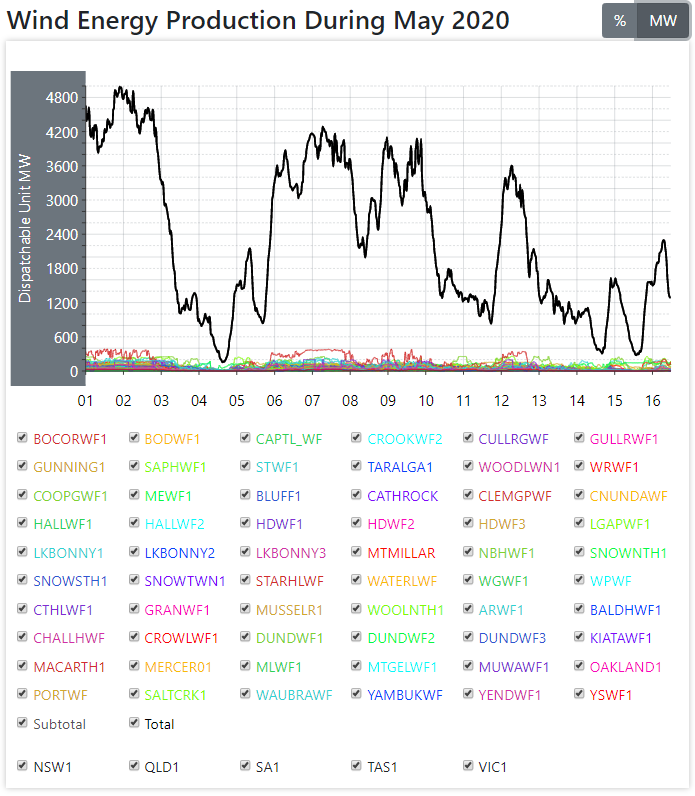
Wind power is the joke where the punchline is a mixture of rocketing power prices and a grid on the brink of collapse. None of which is particularly funny for those suffering from one and threatened by the other. As to the latter, this country’s maniacal obsession with heavily subsidised and chaotically intermittent wind and solar has Australia at ‘situation critical’.
Depicted above – courtesy of Aneroid Energy – is the output delivered by Australian wind power outfits to the Eastern Grid so far this month.
Spread from Far North Queensland, across the ranges of NSW, all over Victoria, Northern Tasmania and across South Australia its entire capacity routinely delivers just a trickle of its combined notional capacity of 7,295MW.
Collapses of over 3,000 MW or more that occur over the space of a couple of hours are routine, as are rapid surges of equal magnitude, which make the grid…
View original post 2,086 more words
Cabinet reshuffles and ministerial by-elections in the 19th century
20 May 2020 Leave a comment
Winston Churchill was famously rejected by the electors of North-West Manchester when he was appointed as President of the Board of Trade in 1908, before being found a suitable berth at Dundee. He was certainly not the first high profile casualty of a ministerial by-election.
Lord John Russell, the new Home Secretary (and future Prime Minister), was defeated at South Devon in May 1835. William Gladstone, appointed as Colonial Secretary, abandoned his candidature for Newark in irritation after a protectionist opponent came forward in January 1846, and although his name was subsequently linked with numerous other constituencies, he remained out of the Commons until the next general election in 1847.

Following last week’s Cabinet reshuffle, several ministers will be getting to grips with the challenges of their new departments. However, unlike the nineteenth century, they are at least spared the extra burden of seeking renewed endorsement from their constituents. Under a law passed in the reign of Queen Anne (1707), anyone accepting ‘an office of profit under the Crown’ – which included not only ministerial posts, but also a wide range of lesser positions – had to vacate his parliamentary seat and seek re-election. Those moving between offices also faced a by-election. In 1859 Thomas Milner Gibson had to stand twice in quick succession for Ashton-under-Lyne: on 27 June, after being appointed as president of the Poor Law Board, and then again on 9 July after being moved to the presidency of the Board of Trade. Ministerial by-elections made up more than a quarter of all by-elections taking place between…
View original post 467 more words
Unequal Pay: For Women Only – Part One.
20 May 2020 Leave a comment

American women who work for wages or a salary, on the average, earn 77 cents when American men earn one (1) dollar, also on the average.
You have to be careful of averages. They are not naturally vicious but they are often used to deceive. That is, people routinely overestimate themselves and don’t slow down enough to understand what they are seeing and hearing when an average is mentioned.
Here is a little practice exercise: Suppose all women who lack education beyond high school quit work completely. (They might go on welfare or they might find hard working husbands, maybe currently illegal immigrants – Not a bad idea actually, if I say so myself!) If this happened, what would become to the 77 cents on the dollar?
(The answer is several paragraphs below.)
Consider also that “on the average” means, of course, that there are many women who earn more…
View original post 1,737 more words
COVID-19 discussion thread VII
20 May 2020 Leave a comment

by Judith Curry
Some interesting papers that I’ve spotted over the past week.
View original post 849 more words
The fall of communism crashed the scripophily market
20 May 2020 Leave a comment
in economic history, international economic law, international economics, International law, law and economics, Marxist economics, property rights, Public Choice

#climateemergency #globalwarming #GreenNewDeal @AOC @GreenpeaceAP @Greens @NZGreens @oxfam @BernieSanders @SenWarren
20 May 2020 Leave a comment
in energy economics, environmental economics, global warming, politics - Australia, politics - New Zealand, politics - USA Tags: climate alarmists, nuclear energy, solar power, wind power

Which is Auckland? Lombardy? #COVID19 #OTD
20 May 2020 Leave a comment
in health economics, politics - New Zealand


Will We Ever Find and Understand Extraterrestrial Messages ?
20 May 2020 Leave a comment
in economics of education, economics of media and culture Tags: space
Spain seeks to pass new climate law to reach net zero by 2050
20 May 2020 Leave a comment


It looks as if most European countries intend to learn the hard way that industrial economies can’t run successfully on expensive and intermittent electricity supplies. If their governments are happy to de-industrialise they should say so, then voters working in power-hungry industries would know the score. The price of climate superstition could be high for a lot of people.
– – –
Spain has announced it is seeking to pass a new climate law to ensure it can cut its emissions to net zero by 2050, reports Energy Live News.
The draft law proposals would ban all new coal, oil and gas projects with immediate effect in order to rapidly reduce Spain’s greenhouse gas emissions by a fifth before 2030, relative to 1990 levels, as well as increase the renewable share of the country’s energy mix from around 50% to 70% by this time.
View original post 71 more words
Henry VIII Invades France 1544
20 May 2020 Leave a comment

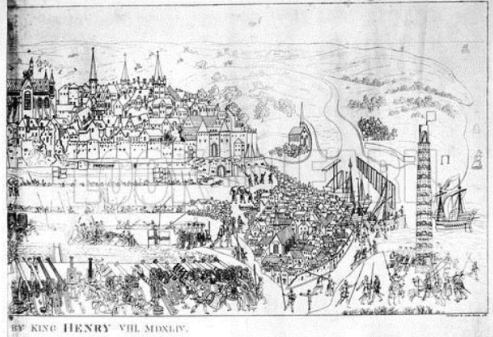
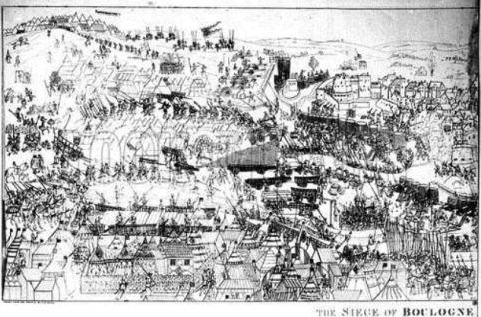
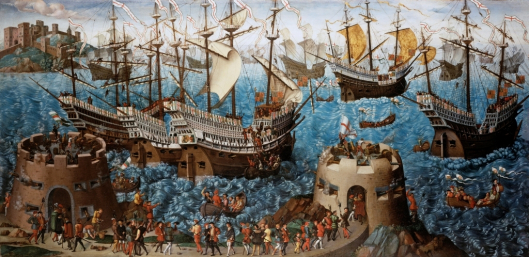
Henry VIII embarking in Dover.
Throughout this year, and the beginning of 1544, preparations were made for the great invasion of France under the combined leadership of Henry of England and Charles of Spain. The cost of the undertaking was so vast, however, that the general coinage of the realm was debased by introducing a larger amount of alloy into its gold and silver coins. By these means the king’s mint acquired large sums of money, since the face value of the currency was the same despite the smaller amount of precious metal. Prices naturally rose, at a rate of approximately 10 per cent each year, and the economy took twenty years to recover. These were the results of the king’s passion for war.
Other ways of making money were also found. It was decided to exact a ‘benevolence’ from the nation. Those who owned lands worth more than an…
View original post 1,382 more words


Recent Comments