We May Have a #COVID19 Vaccine in 2021, But Not Without Taking Risks @SciShow
09 May 2020 Leave a comment
in health economics Tags: economics of pandemics, vaccines
New Rule: Sex Monster | Real Time with @BillMaher
09 May 2020 Leave a comment
in discrimination, economics of crime, gender, law and economics, politics - USA Tags: 2020 presidential election, political correctness, regressive left, sex discrimination
Two anniversaries today, both marking the end of wars, one against people, the other against a virus
09 May 2020 Leave a comment

I missed this because I left out today’s anniversaries in the Hili dialogue. There are two big ones today, both pointed out by Fiona Fox, director of the Science Media Centre in Britain. Dr. Fox quotes remembrances from two of her experts (h/t Steve Jones):
FromProfessor Geoffrey L Smith FRS, Head, Department of Pathology, University of Cambridge
Today is VE-Day. [JAC: the 75th anniversary.] It is also the 40th anniversary of the WHO declaration of the eradication of smallpox, which in the 20th century alone killed an estimated 400 million people, many more people than in both world wars. Whilst in the midst of another viral pandemic, we should remember the magnificent role that WHO played in ridding the world of smallpox and the power of vaccination. WHO should be encouraged, supported and funded in its efforts to control and eliminate COVID-19.
View original post 477 more words
A Real-World Depiction of Life under Socialism
09 May 2020 Leave a comment

When making the case against socialism, I’ve pointed out how that coercive ideology is an evil and immoralfailure.
But maybe the best argument is contained in this very short video that was shared by a group of Tory activists in the United Kingdom.
Ms. Badenoch is now a member of the United Kingdom’s Parliament, and she was describing what it was like to grow up in Nigeria, a country where capitalism was not allowed to flourish.
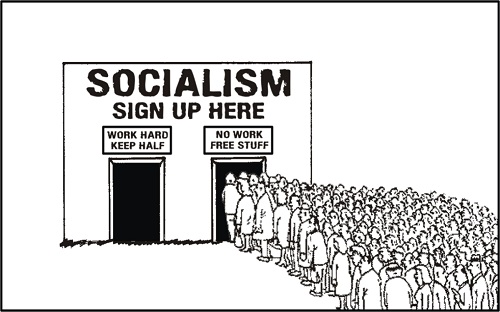 Given the upside-down incentive system created by socialism, it’s no surprise that she endured hardship.
And while her story is just an anecdote, there is overwhelming evidence that nations with more economic liberty generate much better outcomes for ordinary people.
If you’re interested in learning more Ms. Badenoch, the U.K.-based Daily Mailprofiled her back in 2017.
Kemi Badenoch is black; although British-born, she was raised in Nigeria by African parents…
View original post 468 more words
Stephen Williamson puzzles over quantitative easing
09 May 2020 Leave a comment
in business cycles, financial economics, global financial crisis (GFC), great recession, macroeconomics, monetary economics

The Government Response Stringency Index
09 May 2020 Leave a comment

Having mentioned yesterday the Oxford Covid-19 Government Response Stringency Index, I was playing around with variants of this chart, tracing the responses of various governments through time.
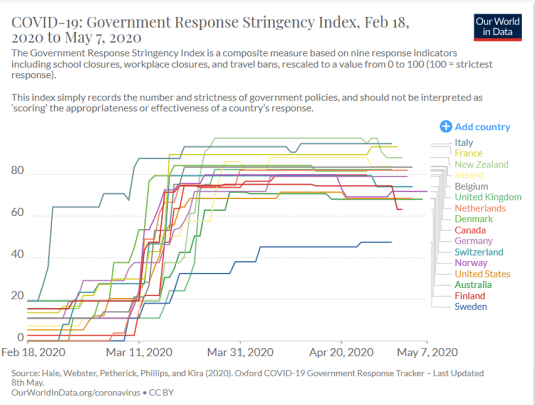
On this variant I’ve included the Anglo countries and most of the countries of western Europe.
It is only one index, and only as good as the presumptions about what mattered of those who put it together, but it is now quite widely used and cited.
In detail of course it is hard to read, but my main interest was in New Zealand relative to where the generality of other western countries were, and you can read the New Zealand line: throughout the “Level 4 lockdown” the compilers of the index judged our restrictions to be the most stringent of any of the countries, although as at the last updates – and they aren’t updating every country every day – we had…
View original post 649 more words
Maoists and Eysenck at LSE, May 1973: Disruptive protest and the prelude to ‘no platform’
09 May 2020 Leave a comment

On 8 May, 1973, the controversial psychologist Hans Eysenck attempted to deliver a lecture at the London School of Economics, but faced heavy protests from students. A group of Maoists stormed the stage and assaulted Eysenck. Alongside a sit-in the following month to protest a lecture by US academic Samuel Huntington at the University of Sussex, the shutting down of Eysenck was seen as an example of the grave danger free speech faced at British universities. Occurring less than a year before the ‘no platform’ policy was introduced by the National Union of Students, the Eysenck incident shows that claims that the freedom of speech was under threat at universities has existed for decades and that there has long been debate about the appropriate action to be taken against right-wing speakers who weren’t explicit fascists.
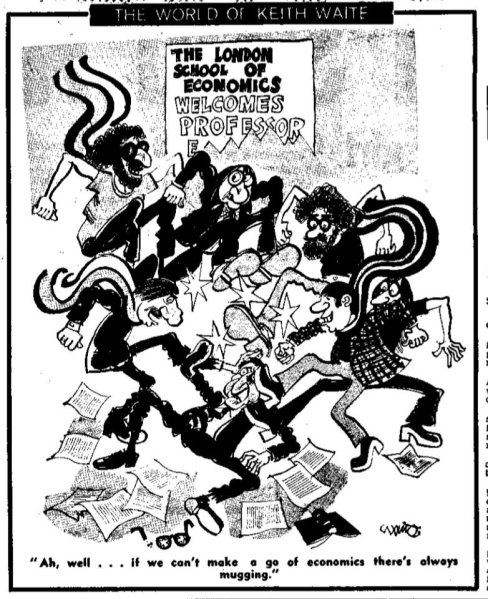 Cartoon from the Daily Mirror
Before the NUS formalised its ‘no platform’ policy and put…
View original post 2,347 more words
A Real-World Depiction of Life under Socialism
09 May 2020 Leave a comment
When making the case against socialism, I’ve pointed out how that coercive ideology is an evil and immoralfailure.
But maybe the best argument is contained in this very short video that was shared by a group of Tory activists in the United Kingdom.
Ms. Badenoch is now a member of the United Kingdom’s Parliament, and she was describing what it was like to grow up in Nigeria, a country where capitalism was not allowed to flourish.
Given the upside-down incentive system created by socialism, it’s no surprise that she endured hardship.
And while her story is just an anecdote, there is overwhelming evidence that nations with more economic liberty generate much better outcomes for ordinary people.
If you’re interested in learning more Ms. Badenoch, the U.K.-based Daily Mailprofiled her back in 2017.
Kemi Badenoch is black; although British-born, she was raised in Nigeria by African parents…
View original post 468 more words
The 1619 Project’s Pulitzer | Glenn Loury & John McWhorter [The Glenn Show]
09 May 2020 Leave a comment
in economic history, economics of crime, economics of education, labour supply, law and economics, politics - USA, property rights Tags: academic bias, media bias, political correctness, regressive left


Recent Comments