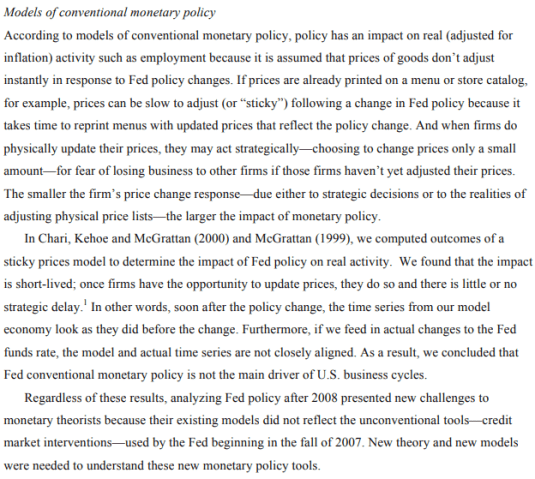
Ellen McGrattan on New Keynesian macroeconomic policy
02 May 2020 Leave a comment
in business cycles, great recession, job search and matching, labour economics, labour supply, macroeconomics, monetary economics
Climate confusion: worst carbon emissions scenario ‘misleading’
02 May 2020 Leave a comment


Maybe the climate alarmist leaders have finally grown tired of being panned for blatant exaggeration and dishonest fearmongering, based entirely on failing climate models. But of course much of the desired psychological damage has already been done.
Scientists should stop using the very worst predictions for carbon emissions, a study suggests – reporting by the BBC.
Referred to as “business as usual”, the scenario assumes a 500% increase in the use of coal, which is now considered unlikely.
View original post 294 more words
Some of the latest climate models provide unrealistically high projections of future warming
02 May 2020 Leave a comment
 Image credit: livescience.com
They might do well to remember that historic climate data always show carbon dioxide rises *following* temperature rises, often with quite a long time lag, never leading them, which raises awkward questions for ‘heat-trapping’ theories and climate models based on them.
– – –
A new study from University of Michigan climate researchers concludes that some of the latest-generation climate models may be overly sensitive to carbon dioxide increases and therefore project future warming that is unrealistically high, says Phys.org.
In a letter scheduled for publication April 30 in the journal Nature Climate Change, the researchers say that projections from one of the leading models, known as CESM2, are not supported by geological evidence from a previous warming period roughly 50 million years ago.
The researchers used the CESM2 model to simulate temperatures during the Early Eocene, a time when rainforests thrived in the tropics of…
View original post 497 more words
The race for a COVID-19 vaccine, explained
02 May 2020 Leave a comment
in health economics Tags: economics of pandemics, vaccines
One is as locked-down as Lombardy; the other is as locked-down as Sweden #COVID19
02 May 2020 Leave a comment

More money is on tap for minimising waste – but going online to learn about the scheme could be a time-waster
02 May 2020 Leave a comment

The government has replenished another trough and is calling the hogs to get their snouts into an $8 million swill.
No, this one is not under the control of Shane Jones, the Minister of Munificence whose announcements regularly trigger the Point of Order Trough Monitor.
The announcement this time was made by Associate Environment Minister Eugenie Sage, who emulated Jones by emphasising the employment prospects.
Her press statement begins:
Creating jobs in the vital waste reduction sector is the focus of the latest application round for the Waste Minimisation Fund, which opens today.
View original post 694 more words
How will we pay for all this?
02 May 2020 Leave a comment

The coronavirus pandemic is of course primarily a social crisis, but the fiscal costs are also important. A sharp and sustained deterioration in the public finances could have major implications for future government spending and taxation. Fortunately, there are also some good reasons to be sanguine.
Let’s begin with the bad news. A slump in economic activity is inevitable and even desirable; we actually want most people to stop doing what they would normally be doing, in order to save lives. However, this will also lead to a surge in government borrowing, reflecting both the direct costs of the fiscal measures being taken to protect businesses, jobs and incomes, and the knock-on effects of a steep fall in GDP on welfare spending and tax revenues.
The headline figures are scary. Given all the uncertainties, it makes sense to talk in terms of ‘plausible scenarios’ rather than ‘forecasts’, and any hard…
View original post 1,104 more words
May 1, 1707: The Acts of Union goes into effect.
02 May 2020 Leave a comment

The Acts of Union were two Acts of Parliament: the Union with Scotland Act 1706 passed by the Parliament of England, and the Union with England Act passed in 1707 by the Parliament of Scotland. They put into effect the terms of the Treaty of Union that had been agreed on July 22, 1706, following negotiation between commissioners representing the parliaments of the two countries. By the two Acts, the Kingdom of England and the Kingdom of Scotland—which at the time were separate states with separate legislatures, but with the same monarch—were, in the words of the Treaty, “United into One Kingdom by the Name of Great Britain”.

Elizabeth I, Queen of England and Ireland
Prior to 1603, England and Scotland were separate kingdoms; as Elizabeth I never married, after 1567, her heir became the Stuart king of Scotland, James VI, who was brought up as a Protestant. James was…
View original post 1,164 more words
Sullivan: According to his own standards, Biden’s guilty
02 May 2020 Leave a comment

Many of you have read about Tara Reade’s claim that Joe Biden assaulted her 27 years ago. Although her story has varied over time, her most serious claims do allege true sexual assault—digital penetration, which the Department of Justice considers rape. As far as I know about the evidence, it’s not sufficient to convict Biden in a court of law—evidence “beyond a reasonable doubt.” But Andrew Sullivan’s point in the first part of his latest column (the other two parts are about the pandemic death toll and a new documentary about Phylis Schlafly) is that according to Biden’s own standards as promulgated in Obama’s Title IX regulations, he’s guilty as hell, or would be found so in a college “trial.”
Click on the screenshot to read the article:


This is a little bit misleading, as Sullivan sees “Biden’s own standards”, as noted above, as those he promulgated in the…
View original post 1,232 more words
Which is South Australia? Auckland, New Zealand? Which hasn’t had a new #COVID19 case in 9 days?
02 May 2020 Leave a comment
in health economics, politics - Australia, politics - New Zealand

Why Pearl Harbor? Peaceful Portugal, and the poor Kriegsmarine – WW2 – OOTF 011
02 May 2020 Leave a comment
in defence economics, war and peace Tags: World War II
Myth of the Rational Voter
02 May 2020 Leave a comment
in applied price theory, economics of bureaucracy, economics of crime, economics of education, economics of information, economics of regulation, election campaigns, energy economics, environmental economics, history of economic thought, income redistribution, industrial organisation, international economics, labour economics, labour supply, law and economics, managerial economics, market efficiency, Marxist economics, minimum wage, organisational economics, personnel economics, politics - USA, population economics, property rights, Public Choice, public economics, rentseeking, resource economics, theory of the firm, transport economics, urban economics, welfare reform Tags: anti-foreign bias, anti-market bias, make-work bias, pessimism bias, rational ignorance, rational irrationality, regressive left
Alan Dershowitz: How to defeat ISIS? Ask Israel
02 May 2020 Leave a comment
in defence economics, laws of war, politics - USA, war and peace Tags: war against terror


Recent Comments