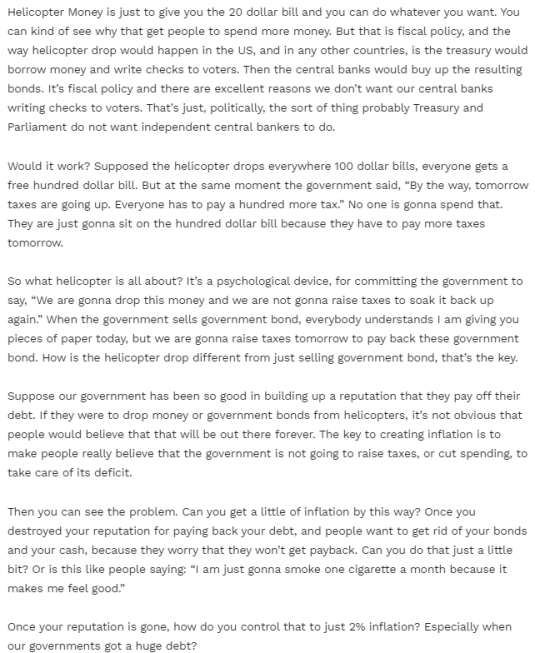
John Cochrane explains helicopter drops
01 May 2020 Leave a comment
in financial economics, fiscal policy, macroeconomics, Milton Friedman, monetarism, monetary economics, politics - New Zealand, public economics
The Life of Edward II, King of England and Lord of Ireland. Part VI.
30 Apr 2020 Leave a comment

Fall from power (1326–1327)
Isabella, with Edward’s envoys, carried out negotiations with the French in late March. The negotiations proved difficult, and they arrived at a settlement only after Isabella personally intervened with her brother, King Charles IV of France. The terms favoured the French Crown: in particular, Edward would give homage in person to Charles for Gascony. Concerned about the consequences of war breaking out once again, Edward agreed to the treaty but decided to give Gascony to his son, Edward, and sent the prince to give homage in Paris.
Edward now expected Isabella and their son to return to England, but instead she remained in France and showed no intention of making her way back. Until 1322, Edward and Isabella’s marriage appears to have been successful, but by the time Isabella left for France in 1325, it had deteriorated. Isabella appears to have disliked Hugh Despenser the Younger…
View original post 756 more words
The lack of any serious transparency
30 Apr 2020 Leave a comment
Spot on.

People can agree or disagree with the government and its official agencies on the various numerous specifics of the handling of the coronavirus, up to and including yesterday’s decisions. But whether you, or I, agree with individual choices that have been made – and I’m sceptical of more than a few of them – isn’t the point of this post, which is about the serious lack of transparency of official advice etc through this period of wrenching dislocation, in which lives were at risk, civil liberties shredded, the ability of people to earn their living badly disrupted, Parliament suspended and so on. Perhaps most or even all those decisions were the right ones – something that will probably be debated for the next 100 years, as aspects of the 1918 flu or much about the Great Depression still is- but no one can argue they were normal, routine or…
View original post 2,338 more words
The alert system was specifically designed to allow different districts to be on different alert levels
30 Apr 2020 Leave a comment
in health economics, politics - New Zealand Tags: economics of pandemics

New Paper Accepted: Normalised Insurance Losses from Australian Natural Disasters: 1966-2017
30 Apr 2020 Leave a comment

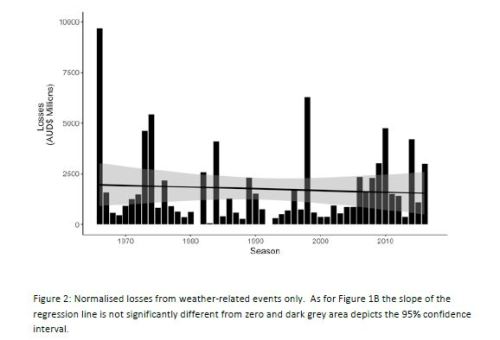
We have just had a new paper accepted for publication:
McAneney, J., B. Sandercock, R. Crompton, T. Mortlock, R. Musulin, R. Pielke, Jr., and A. Gissing. (2020, in press). Normalised Insurance Losses from Australian Natural Disasters: 1966-2017, Environmental Hazards.
Here is the bottom line: When aggregated by season, there is also no significant trend in normalised losses. This is also true if only weather-related event losses are considered; in other words, after we normalise weather-related losses for changes that we know to have taken place, no residual signal remains to be explained by changes in the occurrence of extreme weather events, regardless of cause. In sum, the rising cost of natural disasters is being driven by where and how we chose to live and with more people living in vulnerable locations with more to lose, natural disasters will remain an important problem irrespective of a warming climate.
Details after…
View original post 58 more words
“Flying Fortress” Boeing B-17 Part I
30 Apr 2020 Leave a comment





BIRTH OF THE B-17
In the early summer of 1934, the US Army Air Corps released a requirement for a multi-engined medium bomber intended primarily for the coast-defence role. The requirement called for the ability to deliver a 2000 lb (907 kg) bomb load over a range of at least 1020 miles (1641 km) but preferably 2200 miles (3540 km) at a speed of at least 200 mph (322 km/h) but preferably 250 mph (402 km/h). Boeing had already developed its Models 214, 215 and 246 series of closely related monoplanes for limited use as the B-9 series of twin-engined experimental and service test bombers, and fully appreciated that the monoplane layout of these aircraft offered little scope for improvement in its twin-engined form given the relative lack of power available from contemporary radial piston engines, or those foreseeable in the immediate future. The design team therefore chose to construe…
View original post 2,049 more words

Great depression unemployment rates
30 Apr 2020 Leave a comment
in business cycles, economic growth, economic history, fiscal policy, great depression, labour economics, labour supply, macroeconomics, monetary economics, public economics, unemployment Tags: Keynesian macroeconomics
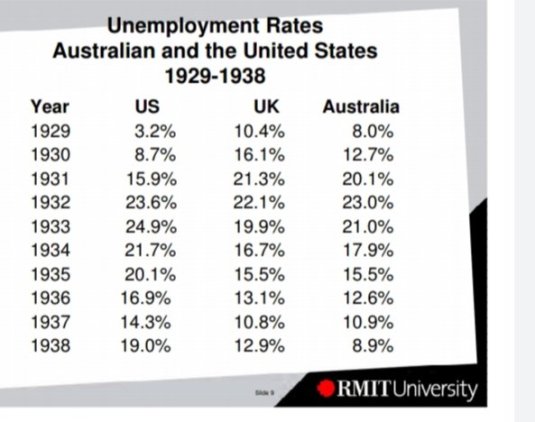
Source Sinclair Davidson
Hopeless Joke: Australia’s Wind Power Output Just Keeps On Collapsing, Time & Time Again
30 Apr 2020 Leave a comment


If you’re looking for a definition of ‘hopeless joke’, look no further than the daily contribution of Australia’s 6,960 MW industrial wind power fleet.
One hackneyed myth relied upon by the wind cult in this country (everywhere, really) is that the “wind is always blowing somewhere”. Which is complete and utter bollocks.
Spread from Far North Queensland, across the ranges of NSW, all over Victoria, Northern Tasmania and across South Australia its entire capacity routinely delivers just a trickle of its combined notional capacity.
Depicted above – courtesy of Aneroid Energy – is the output delivered by Australian wind power outfits to the Eastern Grid on 13 April.
Between Noon and 6pm output ranged between 110 and 170 MW, representing between 1.58% and 2.44% of the fleet’s combined notional capacity. That’s what we mean by “hopeless joke”.
Set out at the end of this post is the output, so far…
View original post 307 more words


Recent Comments