
By Paul Homewood The Telegraph is reporting that the National Grid boss, John Pettigrew, is advising Miliband to reject zonal pricing, because it is a unneeded distraction.
National Grid Boss Admits Electricity Prices Will Rise To Pay For Net Zero
Celebrating humanity's flourishing through the spread of capitalism and the rule of law
25 May 2025 1 Comment
in economics of climate change, energy economics, environmental economics, environmentalism, global warming Tags: British politics, wind power
By Paul Homewood The Telegraph is reporting that the National Grid boss, John Pettigrew, is advising Miliband to reject zonal pricing, because it is a unneeded distraction.
National Grid Boss Admits Electricity Prices Will Rise To Pay For Net Zero
25 May 2025 1 Comment
in applied price theory, economics of regulation, industrial organisation, international economics Tags: European Union
The IMF puts the hidden cost of trading goods inside the EU at the equivalent of a 45% tariff. For services the figure climbs to 110%, higher than Trump’s “Liberation day” tariffs on Chinese imports—measures many saw as a near-embargo. These barriers are not direct taxes. Instead, a construction company might find its building materials or plans, […]
Trade sentences to ponder
24 May 2025 Leave a comment
in defence economics, war and peace Tags: World War I
24 May 2025 Leave a comment
in budget deficits, fiscal policy, macroeconomics, politics - New Zealand, Public Choice, public economics
Eric Crampton writes – This week’s budget projected no return to balanced books. It is difficult to see how recent budgets from National and Labour comply with the Public Finance Act’s fiscal responsibility provisions. It is a problem.
Deficits forever?
24 May 2025 Leave a comment
in applied price theory, economics of bureaucracy, economics of natural disasters, health economics, Public Choice Tags: economics of pandemics
If you are like me, you spend a certain amount of time trying not to remember the pandemic experience. But COVID-19 pandemic did cause more than one million American deaths. In a world of sane and sensible prioritizing and policy-making, spending some time and effort focused on how to reduce the risks and costs of…
Prepping for the Next Pandemic
23 May 2025 Leave a comment
in applied price theory, budget deficits, economic growth, economics of regulation, entrepreneurship, fiscal policy, macroeconomics, politics - New Zealand, Public Choice, public economics

Michael Reddell writes – There were good things in the Budget. There may be few/no votes in better macroeconomic statistics and, specifically, a monthly CPI but – years late (for which the current government can’t really be blamed) – it is finally going to happen.
The (deeply underwhelming) Budget
23 May 2025 Leave a comment
in applied price theory, discrimination, econometerics, economic history, gender, health economics, labour economics, politics - USA, population economics Tags: abortion law reform

Regulations about abortion are often wildly controversial. But what effects to they actually have? Caitlin Myers addresses these issues in “From Roe to Dobbs: 50 Years of Cause and Effect of US State Abortion Regulations” (Annual Review of Public Health 2025, pp. 433-446). As a starting point, consider the years before and after the 1973 US Supreme Court…
US State-Level Abortion Regulations: Causes and Effects
23 May 2025 1 Comment
in discrimination, gender, human capital, labour economics, labour supply, occupational choice, politics - New Zealand, poverty and inequality Tags: gender wage gap, sex discrimination
The Herald reports: During her Budget presentation, Willis said that pay equity costs in 2020 were initially expected to reach $3.7b but there had since been a “blowout” with costs rising steeply, especially due to Labour’s 2022 decision to fund claims in the “funded sector”. The exact figure isn’t known, but as they have announced […]
The cost of Labour’s botched pay equity scheme
23 May 2025 1 Comment
in economics of education, history of economic thought
The first Nobel Prize in economics was awarded in 1969, to Ragnar Frisch and Jan Tinbergen. The fiftieth prize was awarded in 2018, to William Nordhaus and Paul Romer. In total up to that point, there had been 91 Nobel laureates in economics. This 2019 article by Allen Sanderson (University of Chicago) and John Siegfried (Vanderbilt…
An interesting paper about the first 50 years of Nobel Prize winners in economics
23 May 2025 Leave a comment
in economics of climate change, energy economics, environmental economics, environmentalism, global warming Tags: solar power, wind power

by Planning Engineer (Russ Schussler) Wind and solar power are often touted as the cheapest sources of electricity in many regions, capable of delivering low-cost energy for the vast majority of the time. At first glance, this might suggest that an energy mix heavily weighted toward renewables would be the most economical choice. However, this […]
Why “cheaper” wind and solar raise costs. Part I: The fat tail problem
22 May 2025 Leave a comment
in applied price theory, applied welfare economics, comparative institutional analysis, constitutional political economy, economics of bureaucracy, economics of regulation, history of economic thought, income redistribution, international economics, labour economics, law and economics, property rights, Public Choice, public economics, rentseeking, urban economics
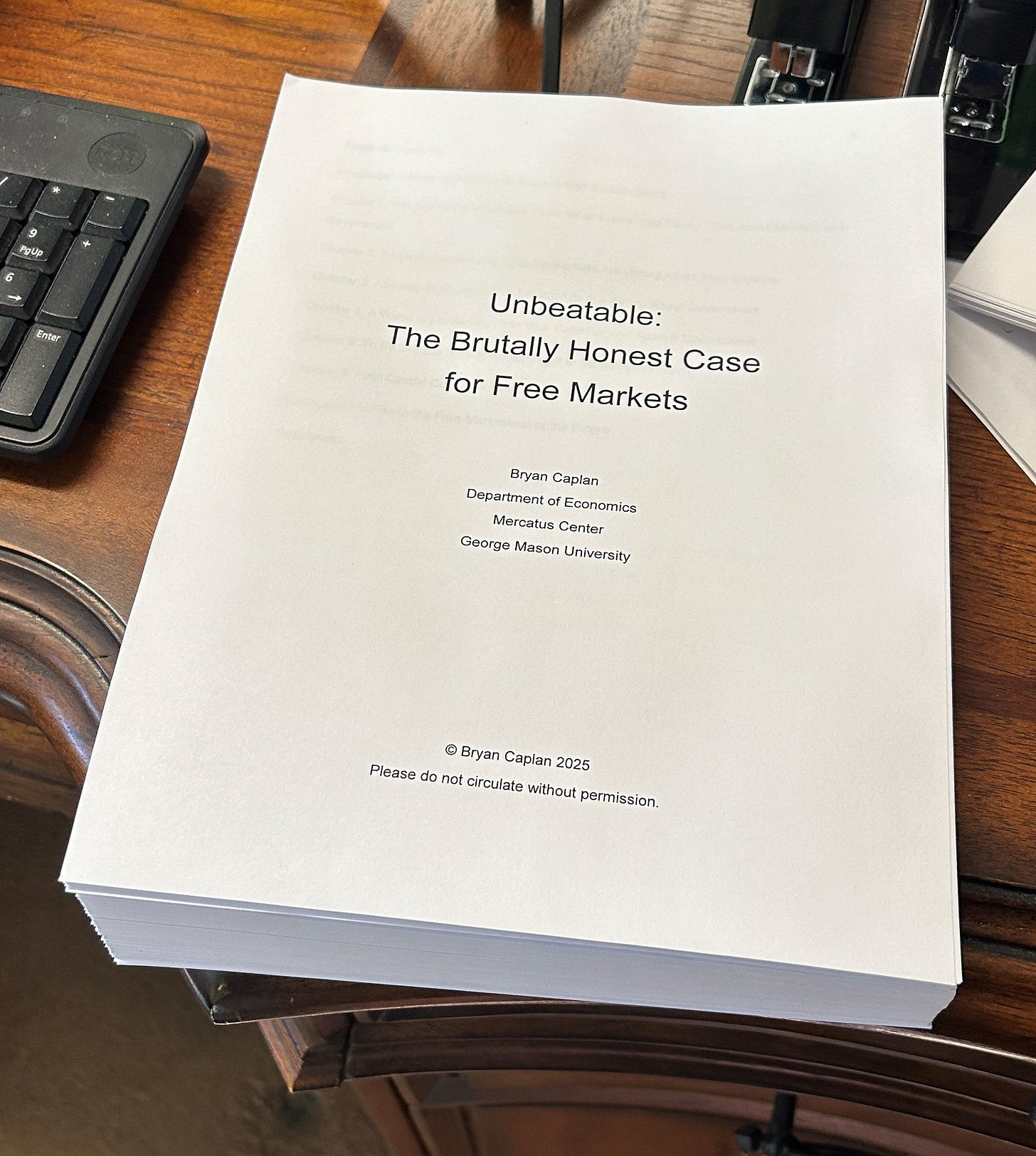
An excerpt from Chapter 3 of *Unbeatable*
Excusing the Government
22 May 2025 Leave a comment
in applied price theory, comparative institutional analysis, economics of information, economics of regulation, entrepreneurship, history of economic thought, industrial organisation, labour economics, law and economics, property rights
22 May 2025 Leave a comment
in applied price theory, development economics, economics of regulation, entrepreneurship, health economics, law and economics, politics - USA, property rights Tags: 2024 presidential election, patents and copyrights, price controls, price discrimination
Econ 101 is often dismissed as too simplistic. Yet recent events suggest that Econ 101 is underrated. Take the tariff debate: understanding that a tariff is a tax, that prices represent opportunity costs, that a bilateral trade deficit is largely meaningless, that a so-called trade “deficit” is equally a goods surplus or an investment surplus—these […]
Econ 101 is Underrated: Pharma Price Controls
21 May 2025 Leave a comment
in politics - New Zealand Tags: constitutional law
Ani O’Brien writes – I have written many times before about narratives and the role of constructing the binary of good and evil in politics. This week we again see how storytelling is shaping a prominent political conflict with the race to own the narrative as the Privileges Committee hands down its recommendations. On the […]
Racist or righteous? Privileges Committee versus Te Pāti Māori
21 May 2025 Leave a comment
in politics - New Zealand Tags: constitutional law
Don Brash writes – I don’t know about you, but I have had a gutsful of the disrespect and disdain Te Pāti Māori show for our Parliament and for all of us. With their hateful rhetoric and disruptive antics they have demonstrated that Māori seats have become the home of the most extreme race activists.
The Nail in the Coffin for Maori Seats
Celebrating humanity's flourishing through the spread of capitalism and the rule of law
Celebrating humanity's flourishing through the spread of capitalism and the rule of law
Celebrating humanity's flourishing through the spread of capitalism and the rule of law
A History of the Alt-Right
Econ Prof at George Mason University, Economic Historian, Québécois
Celebrating humanity's flourishing through the spread of capitalism and the rule of law
Scholarly commentary on law, economics, and more
Beatrice Cherrier's blog
Celebrating humanity's flourishing through the spread of capitalism and the rule of law
Celebrating humanity's flourishing through the spread of capitalism and the rule of law
Celebrating humanity's flourishing through the spread of capitalism and the rule of law
Why Evolution is True is a blog written by Jerry Coyne, centered on evolution and biology but also dealing with diverse topics like politics, culture, and cats.
Celebrating humanity's flourishing through the spread of capitalism and the rule of law
A rural perspective with a blue tint by Ele Ludemann
DPF's Kiwiblog - Fomenting Happy Mischief since 2003
Celebrating humanity's flourishing through the spread of capitalism and the rule of law
The world's most viewed site on global warming and climate change
Tim Harding's writings on rationality, informal logic and skepticism
A window into Doc Freiberger's library
Let's examine hard decisions!
Commentary on monetary policy in the spirit of R. G. Hawtrey
Thoughts on public policy and the media
Celebrating humanity's flourishing through the spread of capitalism and the rule of law
Politics and the economy
A blog (primarily) on Canadian and Commonwealth political history and institutions
Reading between the lines, and underneath the hype.
Economics, and such stuff as dreams are made on
"The British constitution has always been puzzling, and always will be." --Queen Elizabeth II
Celebrating humanity's flourishing through the spread of capitalism and the rule of law
Celebrating humanity's flourishing through the spread of capitalism and the rule of law
WORLD WAR II, MUSIC, HISTORY, HOLOCAUST
Undisciplined scholar, recovering academic
Celebrating humanity's flourishing through the spread of capitalism and the rule of law
Res ipsa loquitur - The thing itself speaks
In Hume’s spirit, I will attempt to serve as an ambassador from my world of economics, and help in “finding topics of conversation fit for the entertainment of rational creatures.”
Researching the House of Commons, 1832-1868
Articles and research from the History of Parliament Trust
Reflections on books and art
Posts on the History of Law, Crime, and Justice
Celebrating humanity's flourishing through the spread of capitalism and the rule of law
Exploring the Monarchs of Europe
Cutting edge science you can dice with
Small Steps Toward A Much Better World
“We do not believe any group of men adequate enough or wise enough to operate without scrutiny or without criticism. We know that the only way to avoid error is to detect it, that the only way to detect it is to be free to inquire. We know that in secrecy error undetected will flourish and subvert”. - J Robert Oppenheimer.
The truth about the great wind power fraud - we're not here to debate the wind industry, we're here to destroy it.
 Utopia, you are standing in it!
Recent Comments