Germany desperately needs to pray for a warm February miracle if the country is to avoid an energy disaster and a state of emergency.
Germany’s Natural Gas Crisis Escalates … One Storage Site Near Empty …Government Silent
Germany’s Natural Gas Crisis Escalates … One Storage Site Near Empty …Government Silent
27 Jan 2026 Leave a comment
in energy economics Tags: Germany
Some Links
26 Jan 2026 Leave a comment
in applied price theory, economic history, history of economic thought, international economics, liberalism, Marxist economics, politics - USA, Public Choice
TweetPhil Magness’s new essay on the origins of the vague and derogatory term “neoliberalism” is superb. A slice: While most versions of the neoliberal label still come from the academic left today, the term has come back into favor within a certain, curious strand of the right. Conservative writers such as Patrick Deneen, Adrian Vermeule,…
Some Links
Can Europe’s Downward Trajectory Be Reversed?
26 Jan 2026 Leave a comment
in economic growth, macroeconomics Tags: European Union
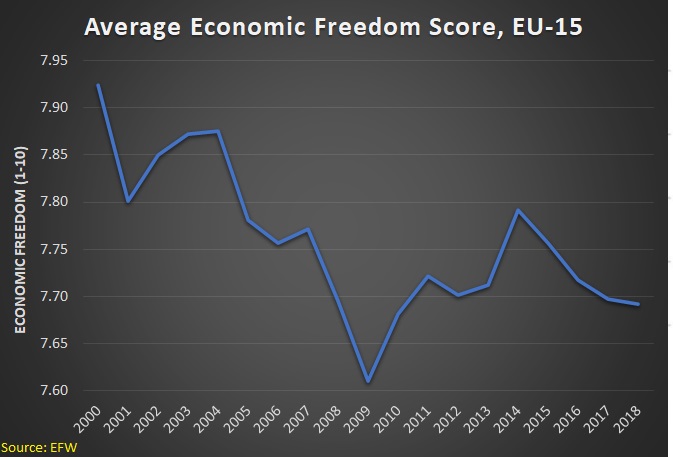
About five years ago, I fretted about the gradual erosion of economic liberty in Western Europe. And I followed up two years ago with similar analysis, grousing that the entire western world was joining Western Europe in the drift toward more statism. When you combine this grim trend with data about demographic decline, which is […]
Can Europe’s Downward Trajectory Be Reversed?
Ross McKitrick on Climate Models, Economic Impacts, and the DOE Report
26 Jan 2026 Leave a comment
in applied price theory, econometerics, economics of climate change, economics of regulation, energy economics, environmental economics, environmentalism, global warming
In this in-depth interview, economist and statistician Ross McKitrick discusses climate models, uncertainty, and whether the public climate debate is as scientifically balanced as often claimed. He also reflects on his role as a co-author of the recent U.S. Department of Energy report.
Ross McKitrick on Climate Models, Economic Impacts, and the DOE Report
The High Cost of Luxury Beliefs
26 Jan 2026 Leave a comment
in liberalism, Marxist economics, politics - New Zealand Tags: political correctness, regressive left
Roger Partridge writes – Some ideas cost nothing to believe but a great deal to implement. Political commentator Rob Henderson calls them “luxury beliefs” – convictions that signal virtue among the comfortable while imposing very real costs on those with much less room to manoeuvre. New Zealand, for reasons cultural as much as political, has […]
The High Cost of Luxury Beliefs
Sectoral shifts in supply, wartime agriculture edition
26 Jan 2026 Leave a comment
in defence economics, economic history, industrial organisation, war and peace Tags: British history, World War II
It is all the more remarkable, then, that within six years Britain’s agricultural output had transformed, more profoundly and at a faster pace than any time since the start of the Industrial Revolution. The most urgent need was to provide a substitute for all that previously imported foreign wheat. In 1939, Britain only had 11.8…
Sectoral shifts in supply, wartime agriculture edition
Female Nazi Guards: The Forgotten Perpetrators of the Holocaust
25 Jan 2026 Leave a comment
in defence economics, economics of crime, law and economics, war and peace Tags: Nazi Germany, The Holocaust

Female Nazi Guards: The Forgotten Perpetrators of the Holocaust When discussing the Holocaust and the atrocities of Nazi Germany, the image that often comes to mind is of male SS officers enforcing brutal policies. However, women also played significant roles in the Nazi regime’s machinery of oppression and genocide. Among these women were the female […]
Female Nazi Guards: The Forgotten Perpetrators of the Holocaust
The economics of currency values
25 Jan 2026 1 Comment
in applied price theory, economic history, financial economics, international economics, macroeconomics, monetary economics Tags: Japan
That is the topic of my latest Free Press column, here is one excerpt: What else are currency values telling us today? The Japanese yen continues a very weak run, now coming in at about 158 to the U.S. dollar. I can recall when it was common for the yen to stand at about 100…
The economics of currency values
AI and Jobs: Interview with David Autor
25 Jan 2026 1 Comment
in applied price theory, industrial organisation, labour economics, labour supply Tags: creative destruction
Sara Frueh interviews David Autor on the subject: “How Is AI Shaping the Future of Work?” (Issues in Science and Technology, January 6, 2026). Here are some snippets that caught my eye, but it’s worth reading the essay and even clicking on some of the suggested additional readings: How broadly are AI tools already being…
AI and Jobs: Interview with David Autor
Waking up to the reality of tobacco’s black market
25 Jan 2026 Leave a comment
in applied price theory, economics of regulation, health economics, politics - Australia Tags: economics of smoking
There’s a website called Tobacco in Australia: Facts and Issues which is written by a few anti-smoking activist-academics. It provides lots of tobacco-related statistics and a bit of editorialising. The website has a whole section devoted to criticising “industry estimates of the extent of illicit trade in tobacco”. It is an article of faith in tobakko…
Waking up to the reality of tobacco’s black market
Climate Change Economics, Skip the Hysteria (Lomborg)
25 Jan 2026 Leave a comment
in development economics, economic history, economics of climate change, economics of regulation, energy economics, environmental economics, environmentalism, global warming, resource economics Tags: climate activists, climate alarmism, pessimism bias

For those who prefer reading, below is an excerpted transcript lightly edited from the interview, including my bolds and added images. Hey everyone, it’s Andrew Klavan with this week’s interview with Bjorn Lomborg. I met Bjorn, he probably doesn’t remember this, but I met him many, many years ago at Andrew Breitbart’s house. Andrew brought […]
Climate Change Economics, Skip the Hysteria (Lomborg)
Poor whites used to vote for Democratic presidential candidates while rich whites voted Repulican. This has now reversed
24 Jan 2026 1 Comment
in politics - USA Tags: 2016 presidential elections, voter demographics
See Entertainment got too good by Eric Levitz of Vox. The article has some interesting ideas on why this happened along with some useful graphics. I have links to several related posts on the attitudes of Democrats & Repulicans, what shapes their views, how they differ, how they affect their daily lives and why they change…
Poor whites used to vote for Democratic presidential candidates while rich whites voted Repulican. This has now reversed
How the Labour Party will campaign in 2026
24 Jan 2026 Leave a comment
in politics - New Zealand Tags: 2026 general election
This week Chris Hipkins gave us the clearest picture yet of how Labour plans to fight the 2026 election. His speech at the party’s caucus retreat in West Auckland, and then a rally-style address to party activists, revealed a strategy that combines class-based attack lines, relentless positivity, and a narrowed focus on kitchen-table concerns. But […]
How the Labour Party will campaign in 2026
Americans Are Getting Richer, Part IV
24 Jan 2026 Leave a comment
in applied price theory, economic growth, economic history, income redistribution, labour economics, macroeconomics, politics - USA, poverty and inequality

In 2016, here’s some of what I wrote about the economic outlook in Illinois. And I shared the same observation when writing about California in 2018. There’s a somewhat famous quote from Adam Smith (“there is a great deal of ruin in a nation“) about the ability of a country to survive and withstand lots of […]
Americans Are Getting Richer, Part IV
When the Left and the Right start behaving in the same way, there’s nothing left of the Left
23 Jan 2026 Leave a comment
in defence economics, discrimination, economic history, economics of education, gender, International law, liberalism, Marxist economics, politics - New Zealand, war and peace Tags: regressive left
I HAVE BEEN RESISTING the conclusion that New Zealand no longer possesses a “left-wing” movement. What the news media persists in referring to as “the Left” or “progressives” are no such thing. By any reasonable definition, the movements identified – or identifying themselves – as left-wing fail to measure up. What they truly are we […]
When the Left and the Right start behaving in the same way, there’s nothing left of the Left
 Utopia, you are standing in it!
Recent Comments