Arab Gulf states vastly outspend Iran on military http://t.co/9Aq2RBpSJm—
ian bremmer (@ianbremmer) July 29, 2015
Arab Gulf states vastly outspend Iran on military
01 Aug 2015 Leave a comment
in defence economics, economic history, war and peace Tags: arms races, Gulf States, Iran, Middle-East politics, Saudi Arabia
Ronald Reagan, the biggest peacenik of them all!
06 Jun 2014 Leave a comment
in defence economics Tags: arms races, Cold War
President Ronald Reagan, ever the optimist, was distraught. He was pacing the living room at the U.S. ambassador’s residence in Reykjavik, Iceland, on Sunday, Oct. 12, 1986, just minutes after failing to reach an agreement with Soviet leader Mikhail Gorbachev. James Kuhn, the president’s aide, recalled that he had never seen Reagan look this way. The president was standing alone, his face forlorn.
Reagan later described the Reykjavik summit as a great success, and in some important ways it was. But in those first hours after it ended, Reagan seemed to have let slip from his grasp a chance to end the nuclear arms race. Everyone was grim. The failure seemed large.
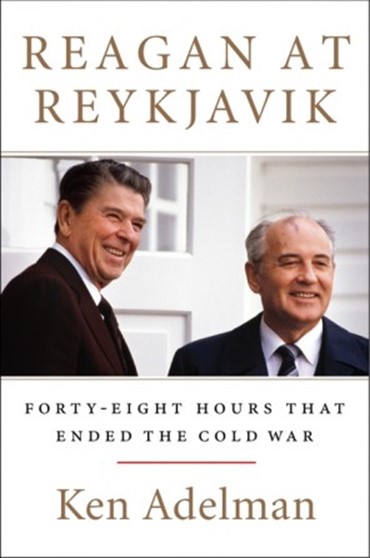
(HarperCollins Publishers/HarperCollins Publishers) – The front cover to “Reagan at Reykjavik: Forty-Eight Hours That Ended the Cold War” by Ken Adelman.
Bottom of Form
The summit was one of the most dramatic and spontaneous moments of the Cold War, and historians, memoirists, archivists and playwrights have since returned to the scene, peering through the curtains of Hofdi House in hopes of gaining a better understanding of how Reagan and Gorbachev came so close to eliminating nuclear weapons and then walked away. The allure of the story has been deepened in recent years by the release of official notes taken by each side.
Ken Adelman tackles this history with his views well established and on full display. This book is a paean to Reagan. “A mere blink of history after Reagan stood tall at Reykjavik,” Adelman writes, “the Soviet Union came down, thereby ending decades of danger. My contention is that these events were not merely coincidental.” At Reykjavik, he says of Reagan, “we see a man with surprising depth and dexterity on the critical issues of his day.” According to Adelman: “The Cold War thus ended just as Ronald Reagan had said it would. We won. They lost.” Describing a moment when Reagan appears in Reykjavik to talk with his staff, Adelman says: “I always felt awed to be in the presence of the president. . . . I felt a tingle in the back of my neck.”
Adelman, who was at the summit as director of the U.S. Arms Control and Disarmament Agency, recounts the weekend’s roller coaster of expectations and emotions. Reagan went to the summit clueless about what to expect. Gorbachev came prepared with tempting and detailed concessions on reducing strategic and intermediate-range nuclear weapons. Reagan jumped at the offers, having long harbored an aspiration to abolish nuclear weapons. At a key moment on the second day, he let loose with words that had never been spoken at such a summit, proposing to eliminate all nuclear weapons. Gorbachev said yes. “Then let’s do it,” declared Secretary of State George Shultz. But later that day, Gorbachev sprang a trap, saying all his proposals were a package deal and the package included a limit on research for Reagan’s cherished Strategic Defense Initiative (SDI), a proposed missile defense system that was just at the early research phase. Gorbachev wanted to restrict testing to the laboratory for a decade. Reagan refused, and they had no deal. It fell apart over one word, “laboratory.” But the summit paved the way for later arms-control agreements.
Adelman does not add much new, but his account, written in a breezy manner, contains interesting nuggets. He admits that Reagan’s repeated offer to share SDI with the Soviets was “splendidly naive” and “rather silly.” He also suggests that the U.S. Pershing II intermediate-range missile, deployed in Europe in 1983, was a “lemon.”
During the summit, Adelman wasn’t in the room with Reagan and Gorbachev, but upstairs with the U.S. and Soviet delegations, and he took part in the long, overnight, expert-level negotiations. He depicts confusion and uncertainty. Were they talking about eliminating ballistic missiles, or offensive missiles, or nuclear missiles? Reagan spoke interchangeably about all three. Gorbachev used “nuclear forces” and “offensive weapons” without distinction. Reykjavik was history being not only made, but improvised.
The weakness of Adelman’s account is that he doesn’t do justice to Gorbachev’s radical ambitions. This was a blind spot back in Reagan’s day, too. Soviet disarmament campaigns were considered just another blast of propaganda. “We in the Reagan administration remained skeptical,” Adelman writes, “never for a minute imagining that this time thisRussian leader might actually be serious about seeking fewer weapons.”
But Gorbachev was serious. In January 1986, he called for eliminating all nuclear weapons by the year 2000. When Shultz went to tell Reagan about the news from Moscow, Reagan replied, “Why wait until the end of the century for a world without nuclear weapons?” In April and May, the Chernobyl nuclear accident further deepened Gorbachev’s resolve. He had already faced down demands from his military-industrial complex to build a vast new Soviet missile defense system. He had put a moratorium on nuclear testing. He told aides preparing for the summit that his goal was “liquidation of nuclear weapons.” By the time he got to Reykjavik, Gorbachev was hell-bent on dramatic results. But by Adelman’s account, Gorbachev “merely wanted the standard-fare Nixon-Ford-Carter arms control to move along faster.” A better assessment is that of James Graham Wilson in “The Triumph of Improvisation,” published in February by Cornell University Press; he concludes that Gorbachev was “the indispensible agent of change.”
Reagan clung fiercely to SDI at Reykjavik, even though it was no more than a gauzy dream at that point. Adelman observes correctly, “Reagan wanted so badly to build it and Gorbachev wanted so badly to stop it, that it assumed for them, and practically only for them, a reality it actually lacked.”
But Adelman then resurrects the unpersuasive argument that SDI led the Soviet Union to collapse. “SDI became the straw that broke the Communist camel’s back,” he claims. This is an old chestnut that gives Reagan too much credit. The threat of SDI and superior American technology certainly worried the Kremlin. But the Soviet Union collapsed because of profound internal weaknesses — fault lines that were systemic and that Gorbachev widened in his valiant efforts at reform. That narrative does not console those who want to put Reagan on an ever-higher pedestal, but it is closer to the truth.
David E. Hoffman is a contributing editor to The Washington Post and the author of “The Dead Hand: The Untold Story of the Cold War Arms Race and Its Dangerous Legacy,” which won the Pulitzer Prize for general nonfiction in 2010.
REAGAN AT REYKJAVIK
Forty-Eight Hours That Ended
the Cold War
By Ken Adelman
Broadside. 375 pp. $29.99
In the old “Saturday Night Live” skit, Ronald Reagan is portrayed as friendly and obliging when the cameras are rolling, though not quite with-it. But as soon as he is behind closed doors in the Oval Office, the smiling, doddering senior citizen becomes a shrewd, manipulative dynamo in total command of events, revealing the “amiable dunce” to be nothing more than an act.
There are moments like this in Ken Adelman’s “Reagan at Reykjavik,” when the Soviets underestimate Reagan much as the Washington elite did, only to be bested by him later on. Yet Mr. Adelman’s chronicle avoids easy triumphalism, capturing larger-than-life moments at a dramatic mid-1980s summit while also showing the main participants to be all too human.
Reagan at Reykjavik
By Ken Adelman
Broadside, 375 pages, $29.99
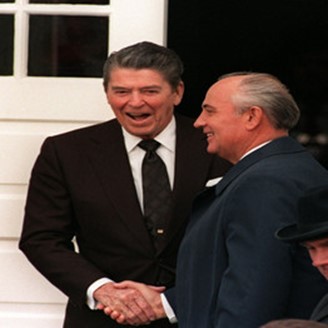
Reagan and Gorbachev in 1986. Associated Press
At the moment, tensions between Russia and the United States are at a post-Cold War high, in no small part because of a Russian leadership that came of age during the Soviet era and that now wishes to reclaim some of Moscow’s lost glory. For some, the current crisis—with its moves and countermoves and feints toward negotiation—may evoke memories of Reagan and his Soviet counterpart, Mikhail Gorbachev, sparring over missiles and mutually assured destruction and then agreeing to sit down and air their disagreements in Iceland’s capital. The meeting, held in mid-October 1986, was initially judged a failure. Everything from the body language of the two leaders to the snide press accounts radiated disappointment.
“The Reykjavik summit is something out of an Agatha Christie thriller,” Mr. Adelman writes. It is a story that he is well-suited to tell. He was in Reykjavik in his role as Reagan’s arms-control director. A gifted writer, Mr. Adelman offers a vivid account that reveals small details (Reagan ate meatloaf for lunch on the flight to Iceland) as well the essentials of the summit’s debating points and accomplishments. Along the way, he never loses track of the big picture: a breakthrough moment in Cold War history that did not look quite so promising at the time.
Reagan was in his second term, his economic program largely vindicated, although Republicans were soon to lose control of the Senate. He was ready to turn his focus to the world stage. Mr. Gorbachev had ascended to the leadership of the Soviet Communist Party the year before, at a time when his fellow commissars were geriatric and failing, a perfect emblem for the sclerotic Soviet economy. He was younger and more vigorous than his predecessors, a man who grasped the need for reform even as he hoped to mend rather than end communism.
It was Mr. Gorbachev who proposed the meeting in Reykjavik. It was supposed to be a prelude to a weightier Washington summit the following year. A cartoon reproduced in Mr. Adelman’s book shows the Soviet leader in a gown asking for a “pre-dance” to “get better acquainted before we really dance.” But before long, at Reykjavik, large reductions in nuclear weapons were on the table; so was Reagan’s desire to abolish nuclear weapons.
The two leaders came very close to a deal, one that would have achieved a 50% reduction in strategic nuclear arsenals and a total elimination of offensive ballistic missiles. A disagreement over confining the Strategic Defense Initiative—a proposed missile-defense program known as “Star Wars”—to the laboratory scuttled everything, and the summit ended with only terse laments for what might have been. The journalist Sam Donaldson described Reykjavik as a “very bad setback for the president,” the end of his “magic.”
Whereas Mr. Gorbachev saw SDI as a mortal threat pointed directly at Red Square, Reagan believed it to be, potentially at least, an almost impenetrable force field that would forever end the doctrine of mutually assured destruction, appropriately shorthanded as “MAD.” He called SDI “the greatest opportunity for peace in the twentieth century,” assuming, as he proposed, that the shield would be shared by the two superpowers.
In truth, Mr. Adelman admits, SDI was neither threat nor savior. Reagan’s “faith in SDI was heartfelt,” Mr. Adelman writes, but at that point in history “SDI wasn’t much more than a presidential aspiration.” Reagan nevertheless told Mr. Gorbachev: “Think of us two, you and me, standing there and telling the world we have SDI, and asking others to join us in getting rid of these terrible nuclear weapons.” Mr. Gorbachev responded icily, “My remarks in reply will be less philosophical.”
The two leaders nevertheless engaged in plenty of philosophical discussion. Mr. Gorbachev scolded Reagan for his earlier talk of an “evil empire.” Reagan pointedly said that Soviet citizens who disagree with their government wind up in jail. Mr. Adelman describes the testy dialogue as “exceeding the Nixon-Khrushchev ‘kitchen cabinet’ debate in the summer of 1959.”
From these exchanges, Mr. Adelman contends, sprang a personal breakthrough between Reagan and Mr. Gorbachev that made their later arms-control success possible—notably, their agreement, in 1987, to eliminate intermediate-range and shorter-range missiles. At Reykjavik, they grew to like and respect each other. “Evidence indicates,” Mr. Adelman dryly remarks, “that personal relations count a lot in international politics, as in life.”
Reagan’s position on SDI left the Soviets—who were already spending 30% of their GNP on the military—with few options. The eventual result, Mr. Adelman says, was a safer world. “Anyone who asserts that our current predicament is more precarious than that during the Cold War either didn’t live during the Cold War or wasn’t alert to its dangers.”
For someone who played a role in the story he is telling, Mr. Adelman is fair-minded and empathetic, even to former foes. He writes movingly of the suicide, in 1991, of military adviser Sergei Akhromeyev, who was present at Reykjavik and whose suicide note expressed despair at the U.S.S.R.’s disintegration. “A noble man serving an ignoble cause,” Mr. Adelman writes of his one-time adversary. Of the chimera that caused so much trouble at the summit, he observes: “SDI never worked as Reagan wished. It worked even better.”
—Mr. Antle is editor of the Daily Caller News Foundation and the a
The relative contributions of Thomas Schelling and the peace movement to the risks of war
26 May 2014 1 Comment
in Thomas Schelling, war and peace Tags: arms races, deterrence, disarmament, mutually assured destruction, peace movements, Robert Aumann
Thomas Schelling (and Robert Aumann) did terrible things such as work out how not to blunder into wars and how to deter wars rather than have to actually fight them.
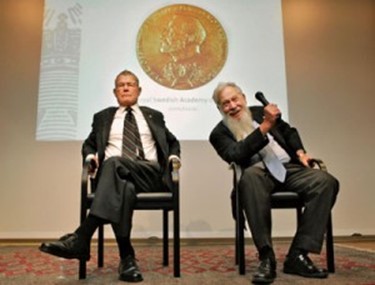
Schelling’s unique contribution at the Rand Corporation involved viewing strategic situations as bargaining processes.
Focusing on the stand-off between the United States and the Soviet Union, Schelling observed that the two superpowers had both shared and opposing interests.
Their shared interests involved avoiding a nuclear war, while their opposing interests concerned dominating the other. Conflict and cooperation became inseparable.
Iran and Israel are moving down that same path if both have nuclear weapons.
Schelling focused in particular on how the United States and Soviet Union could arrive at and stick to bargains by means of deterrence and compellence.
Deterrence involves dissuading the other from doing something, while compellence referred to persuading the other to do something.
- Deterrence and compellence are supported by threats and promises.
- Threats are costly when they fail and successful when they are not carried out.
- Promises are costly when they succeed and successful when they are carried out. A threat is cheaper than a promise because you do not have to carry it out if your threats work in intimidating others to do what you want.
Since the exploitation of potential force is better than the application of force, it is key to use threats and promises while avoiding having to act upon these.
The challenge is to communicate threats and promises in a credible manner.
The ability to hurt people is conducive to peace, while the ability to destroy weapons increases the risk of war. This is the paradox of deterrence. A country needs a credible second-strike capacity to deter a pre-emptive first strike. A country needs its missiles to survive such an attack.
Populations are better protected by protecting the missiles. By protecting the missiles rather than their cities, each side was offering their populations as a hostage to the other.
With each side holding the other’s cities as hostage, neither has an incentive to strike first. This is much safer than having each side worried about their weapons been destroyed and they therefore use them before they are destroyed in some minor crisis.
That is one of Schelling’s many contributions to peace.
What were the contributions of the peace movements?
Robert Aumann argued well that the way to peace is like bargaining in a medieval bazaar. Never look too keen, and bargain long and hard. Aumann argues that:
If you are ready for war, you will not need to fight. If you cry ‘peace, peace,’ you will end up fighting…
What brings war is that you signal weakness and concessions.
Countries are more likely to cooperate if they have frequent interactions and have a long time horizon. The chances of cooperation increase when it is backed by the threat of punishment.
Disarmament, Aumann argues, “would do exactly the opposite” and increase the chances of war. He gave the example of the Cold War as an example of how their stockpiles of nuclear weapons and fleets of bombers prevented a hot war from starting:
In the long years of the cold war between the US and the Soviet Union, what prevented “hot” war was that bombers carrying nuclear weapons were in the air 24 hours a day, 365 days a year? Disarming would have led to war.
Aumann has quoted the passage from the biblical Book of Isaiah:
Isaiah is saying that the nations can beat their swords into ploughshares when there is a central government – a Lord, recognized by all.
In the absence of that, one can perhaps have peace – no nation lifting up its sword against another.
But the swords must continue to be there – they cannot be beaten into ploughshares – and the nations must continue to learn war, in order not to fight!
Gun control as an arms race-updated
07 Apr 2014 1 Comment
in law and economics Tags: arms races, gun control
U.S. has 4.4% of world's population, but 42% of world's civilian-owned guns. bit.ly/1GlBQ68 via @voxdotcom https://t.co/MdCaKYvHEg—
The Intercept (@the_intercept) October 01, 2015
Gun control is not going to happen in the USA because of the poor incentives for law-abiding individuals to retreat from high levels of legal private gun ownership when criminals will keep their guns. Harry Clarke pointed out that:
The political popularity of guns is strengthened by Prisoner’s Dilemma disincentives for individuals to retreat from high levels of gun ownership.
Accepting a gun buyback would be unattractive to citizens who would recognize high levels of overall gun ownership in the community and, hence, their own personal increased vulnerability if those with criminal intent acted rationally and kept their weapons.
The U.S. Department of Justice’s National Crime Victimization Survey showed the risk of serious injury from a criminal attack is 2.5 times greater for women offering no resistance than for women resisting with a gun.
- The key to the success of Australian and New Zealand gun laws was low levels of gun crime and minimal use of guns for self-defence.
- There was no arms race as compared to the USA where criminals and civilians are both armed. It is easy to control an arms race that has not started.
- The New Zealand, Australian and even the British police rarely have to discharge their weapons.
The Police do not normally carry guns where I live. Economics explains why. There is no arms race.
- Self-defence is not a valid reason to possess firearms in New Zealand. The law does not permit the possession of firearms ‘in anticipation’ that a firearm may need to be used in self-defence.
- The last time of a gun was fired in self-defence by a civilian in New Zealand may have been in 2007.
John Lott was subject to a witch hunt for saying rather straight forward arguments as:
Criminals are deterred by higher penalties. Just as higher arrest and conviction rates deter crime, so does the risk that someone committing a crime will confront someone able to defend him or herself.
Ready access to guns in moments of despair increases suicide rates. Suicides in the Israeli Defence Force fell 40% when young soldiers were not allowed to take their guns home at the week-end. On the other hand, Palestinian terrorists switched from mass shootings to suicide bombings because too many Israelis carry guns.
Getting rid of gun free zones would be a good start because they attract spree killers. Spree killers overcome their delusions and the voices in their heads for just long enough to invest much time finding places filled with defenceless victims. (Virginia Tech was a gun free zone).
America hasn't gone more than 8 days without a mass shooting bit.ly/1MLiaNF (via @washingtonpost) https://t.co/lDZQzFvh5P—
Catherine Mulbrandon (@VisualEcon) October 01, 2015
The last thing spree killers want is to be quickly shot down like the dogs they are such as at that American church in 2007. The Church later fired the guard when they found out she was a lesbian.

Found this interesting report here
At Columbine High School, the attack coincided with the “school resource officer” (a sheriff’s deputy) being off-campus.
The officer returned during the start of the attacks, and fired some long-distance shots at the killers. Those shots drove the killers into the school building, and saved the lives of several students who had been wounded.
The officer failed to pursue the killers into the building.
Dozens of additional officers arrived within minutes, but none of them entered the building either, even though an open 911 line indicated that killings were taking place in the library, while police stood outside just a few feet away.
At least 11 of the 13 Columbine deaths could have been prevented if the police had acted promptly.
Since Columbine, police tactics have changed drastically, to emphasize that whoever is at the scene should immediately and aggressively counter-attack an active shooter.
Penn and Teller suggested that any gun controls should apply only to men and that all guns must be pink in colour.
I agree. Guns do not kill people, people do not kill people, men use guns to kill men and women. In the USA, why stop women from owing guns for protecting themselves from men.
in 1996, Texas repealed its 100-year old law prohibiting concealed weapons after a restaurant massacre. One of the survivors left her gun in her car parked outside because of this law. She lost her parents in the massacre. She was a good shot.
This story is an example of trade-offs. It shows that there is more than one side to gun control especially when trapped in an arms race with a high gun ownership equilibrium . The New Zealand, Australian and even British arms race are in low gun ownership equilibriums.
 Utopia, you are standing in it!
Recent Comments