23 Jun 2015
by Jim Rose
in fiscal policy, macroeconomics, politics - Australia, politics - New Zealand, politics - USA, population economics, public economics
Tags: Australia, British economy, New Zealand, taxation and the labour supply
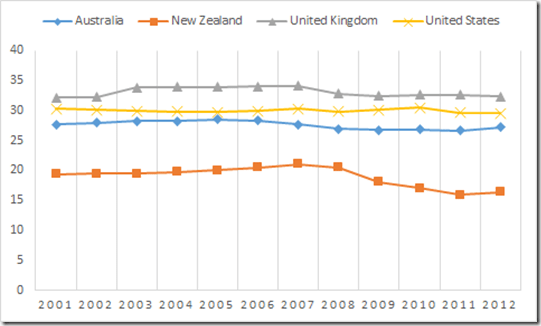
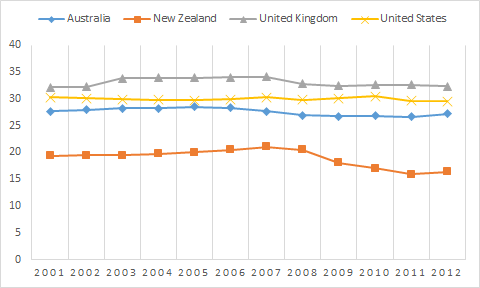
Figure 1: Direct taxes on the average worker in Australia, New Zealand, USA and UK, 2001 – 2012
Source: OECD Factbook 2014
Taxes on the average worker measure the ratio between the amount of taxes paid by the worker and the employer on the country average wage and the corresponding total labour cost for the employer. This tax wedge measures the extent to which the tax system on labour income discourages employment.
The taxes included in the measure are personal income taxes, employees’ social security contributions and employers’ social security contributions. For the few countries that have them, it also includes payroll taxes. The amount of these taxes paid in relation to the employment of one average worker is expressed as a percentage of their labour cost (gross wage plus employers’ social security contributions and payroll tax).
An average worker is defined as somebody who earns the average income of full-time workers of the country concerned in Sectors B-N of the International Standard Industrial Classification (ISIC Rev. 4). The average worker is considered single without children, meaning that he or she does not receive any tax relief in respect of a spouse, unmarried partner or child.
22 Jun 2015
by Jim Rose
in labour economics, politics - Australia, politics - New Zealand, politics - USA, population economics, poverty and inequality, welfare reform
Tags: Australia, British economy, Canada, child poverty, economics of the family, family poverty, Ireland, single mothers, single parents
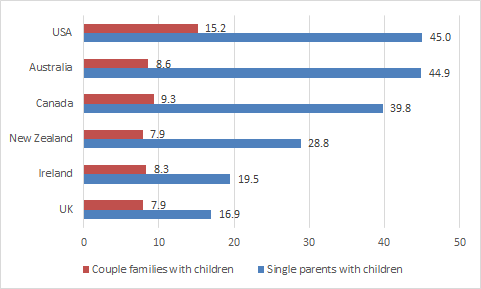
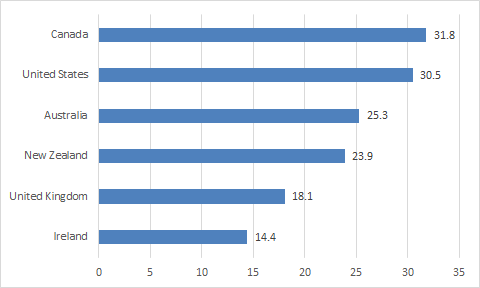
Figure 1: Child poverty rates by family type, Anglo-Saxon countries, 2010
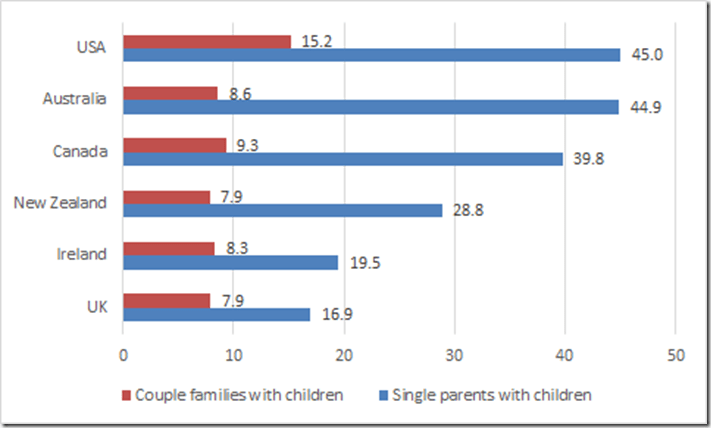
Source: OECD Family Database; Poverty thresholds are set at 50% of the median income of the entire population.
21 Jun 2015
by Jim Rose
in applied welfare economics, economic history, Gary Becker, politics - Australia, politics - New Zealand, politics - USA, population economics, technological progress
Tags: Australia, British economy, Canada, life expectancy, lost decades, New Zealand, The Great Enrichment
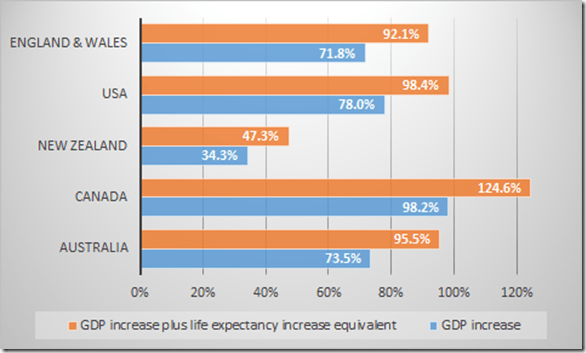
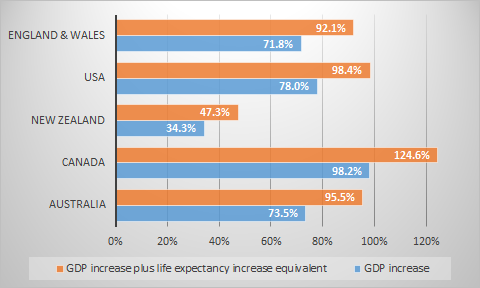
Figure 1: increase in real GDP and increase in real GDP plus life expectancy GDP increase equivalent, Australia, New Zealand, Canada, USA and England & Wales, 1965 to 1995
Source: Becker, Gary S., Tomas J. Philipson, and Rodrigo R. Soares. The Quantity and Quality of Life and the Evolution of World Inequality, NBER Working Paper No. 9765 (June 2003).
GDP per capita is usually used to proxy for the quality of life of individuals living in different countries. Becker and his co-authors computed a "full" growth rate that incorporates the gains in health and life expectancy.
Figure 1 shows that New Zealand was way behind the other countries in improvements in the quantity and quality of life between 1965 and 1995. This brings new meaning to the two decades of lost growth between 1973 and 1995. Canada should refer to 1965 to 1995 as its golden era.
21 Jun 2015
by Jim Rose
in economics of love and marriage, labour economics, labour supply, law and economics, politics - Australia, politics - New Zealand, politics - USA, population economics, poverty and inequality, welfare reform
Tags: Australia, British economy, Canada, child poverty, economics of families, family poverty, Ireland, labour force participation, single parents
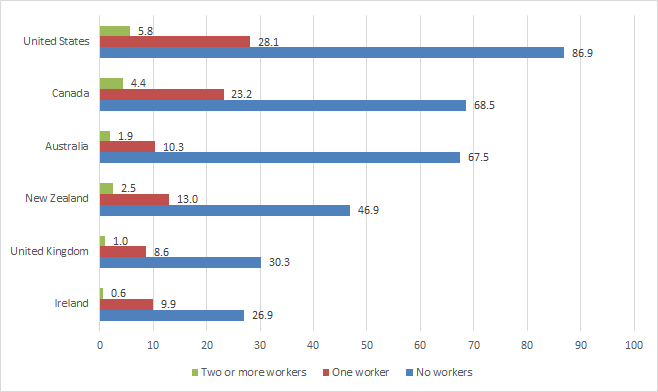
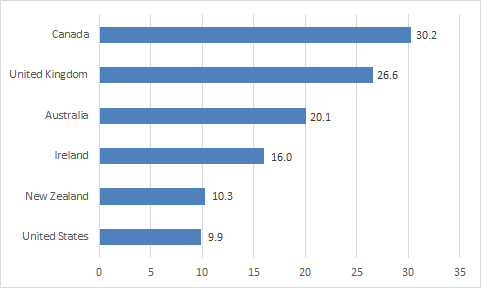
Figure 1: child poverty rates in couple families by employment status, Anglo-Saxon countries, 2010
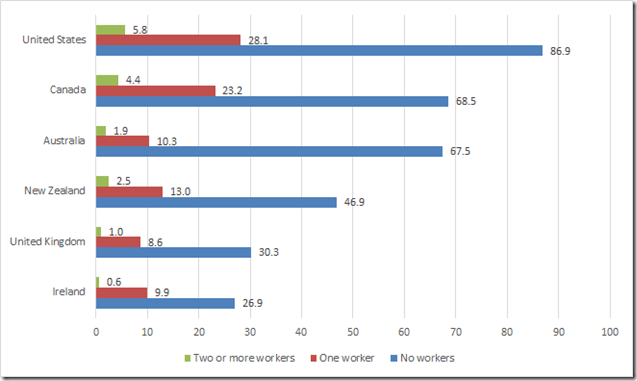
Source: OECD Family Database; Poverty thresholds are set at 50% of the median income of the entire population.
20 Jun 2015
by Jim Rose
in labour economics, politics - Australia, politics - New Zealand, politics - USA, poverty and inequality, welfare reform
Tags: Australia, British economy, Canada, child poverty, economics of the family, family poverty, female labour force participation rates, Ireland, maternal labour supply, single mothers, single parents
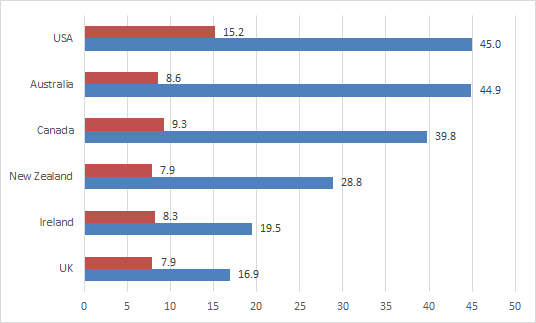
Figure 1: Child poverty rate by employment status of single parent, Anglo-Saxon countries, 2010
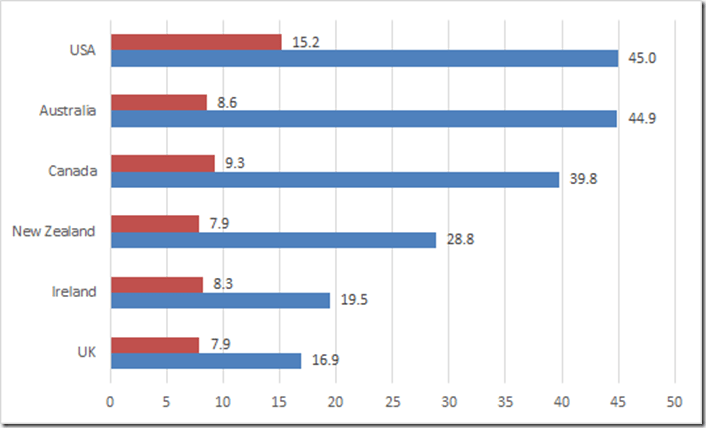
Source: OECD Family Database; Poverty thresholds are set at 50% of the median income of the entire population.
18 Jun 2015
by Jim Rose
in economic history, labour economics, minimum wage, politics - Australia, politics - New Zealand, politics - USA
Tags: Australia, British economy
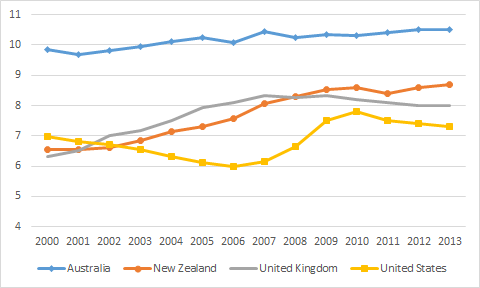
Figure 1: real minimum wage, 2013 constant prices, purchasing power parity, US$, Australia, New Zealand, USA and UK
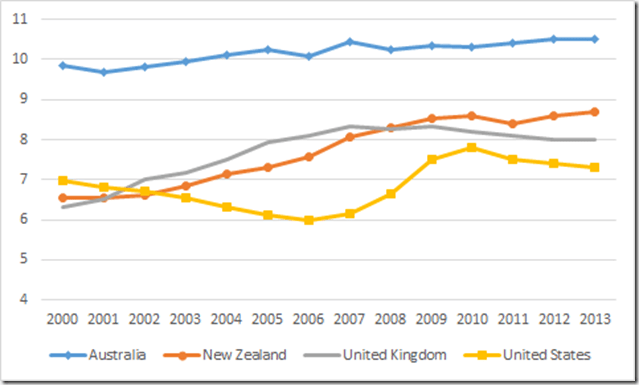
Source: OECD StatExtract.
14 Jun 2015
by Jim Rose
in discrimination, economics of education, gender, human capital, labour economics, labour supply, occupational choice, politics - Australia, politics - New Zealand, politics - USA
Tags: Australia, British economy, Canada, College premium, education premium, gender wage gap, Ireland
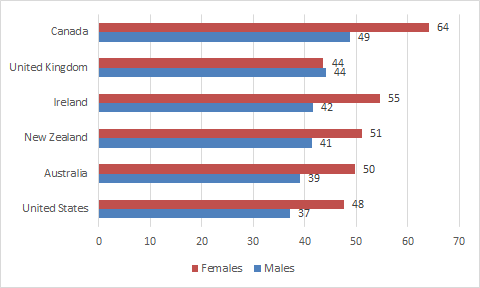
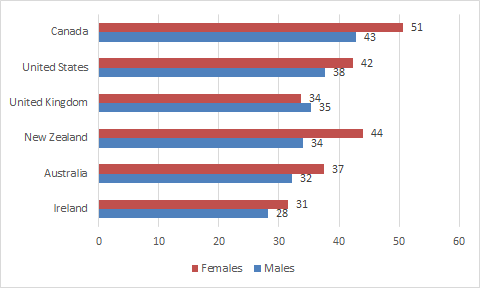
Figure 1: % population who have attained at least tertiary education, age 25 – 34 by gender (2012)
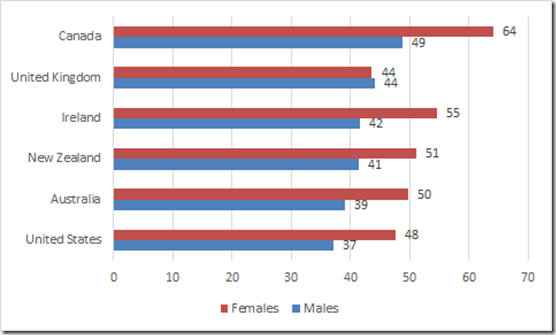
Source: OECD family database.
Figure 2 shows that the stark reversing of the gender gap in educational attainment shown in figure 1 was somewhat more recent in the US, UK and to a lesser extent in Ireland and Australia. In the UK and USA, educational attainment by gender was pretty equal for the earlier generation of graduates as compared to today’s 25 to 34-year-olds. The reversing of the gender gap in educational attainment dates back several decades in Canada and New Zealand.
Figure 2: % population who have attained at least tertiary education, age 45 – 54 by gender (2012)
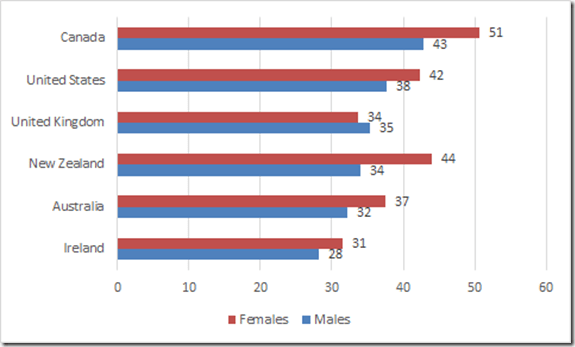
Source: OECD family database.
13 Jun 2015
by Jim Rose
in discrimination, gender, human capital, labour economics, labour supply, occupational choice, politics - Australia, politics - New Zealand, politics - USA, poverty and inequality
Tags: asymmetric marriage premium, Australia, British economy, Canada, gender wage gap, Ireland, labour demographics, maternal labour supply
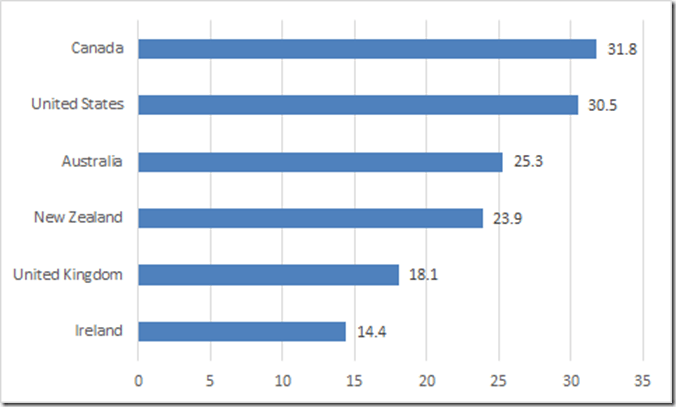
In another blow for the inherent inequality of bargaining power between workers and employers, and for the patriarchy, the wage gap is larger for tertiary educated female full-time workers aged 35-44 than it is for female full-time workers who just finished high school.
Figure 1: gender wage gap for mean full-time, full-year earnings for tertiary educated workers aged 35 – 44, 2012
Source: OECD family database.
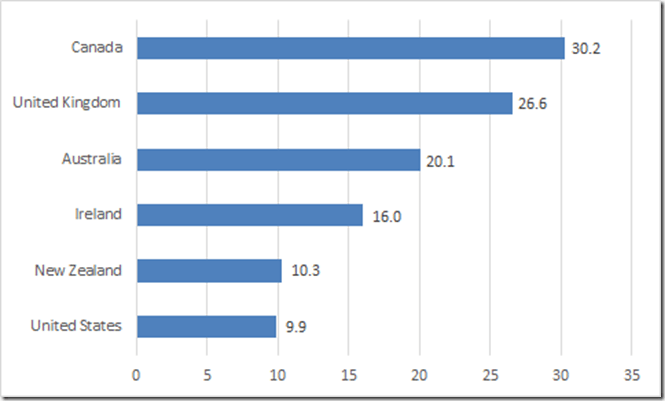
To add insult to injury, the gender wage gap further tertiary educated female workers is quite large in the USA but quite small for high school graduates.
Figure 2: gender wage gap for mean full-time, full-year earnings for below upper secondary educated workers aged 35 – 44, 2012
Source: OECD family database.
Canada seems to be a bit of a patriarchal hellhole while New Zealand does pretty well in gender wage gaps.
The gender gap in figure 1 and in figure 2 are unadjusted and calculated as the difference between mean average annual full-time, full-year earnings of men and of women as a percentage of men’s earnings.
12 Jun 2015
by Jim Rose
in discrimination, gender, human capital, labour economics, labour supply, occupational choice, politics - Australia, politics - New Zealand, politics - USA
Tags: Australia, British economy, Canada, gender wage gap, Ireland
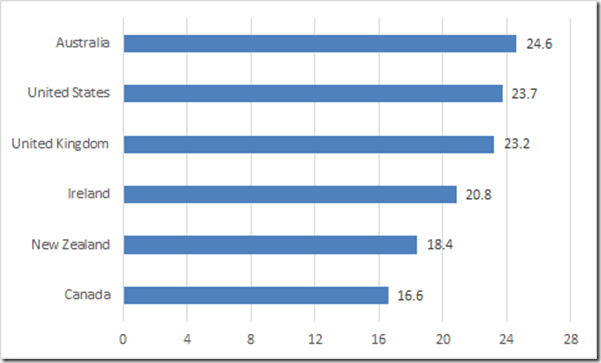
If there is an inherent inequality of bargaining power between workers and employers, as we are so frequently lectured by those in the self appointed know, why is the gender wage gap so small at the bottom of the earnings distribution?
Figure 1: % Gender gap in full-time earnings at the bottom decile of earnings distribution, 2012

Source: OECD family database
Figure 2: % Gender gap in full-time earnings at the median decile of earnings distribution, 2012

Source: OECD family database
Figure 3: % Gender gap in full-time earnings at the top decile of earnings distribution, 2012
Source: OECD family database
The gender gaps are unadjusted, and are calculated as the difference between the earnings of men and women for their respective earnings percentile.
11 Jun 2015
by Jim Rose
in discrimination, gender, human capital, labour economics, labour supply, occupational choice, politics - Australia, politics - New Zealand, politics - USA
Tags: Australia, British economy, Canada, gender wage gap, Ireland
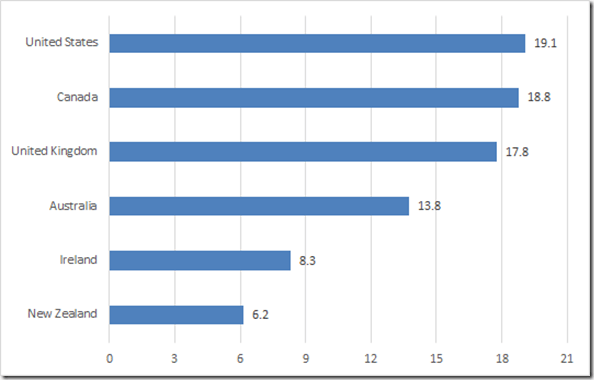
Figure 1: % gender gap in median earnings of full-time employees, 2012
Source: OECD family database
05 Jun 2015
by Jim Rose
in development economics, economics of crime, law and economics, politics - Australia
Tags: Australia, capital punishment, conspiracy theories, crime and punishment, expressive voting, Indonesia, left-wing condescension, Left-wing hypocrisy, Leftover Left, rational ignorance, rational irrationality
The Australian human rights commissioner has put forward a bizarre conspiracy theory linking the recent execution of two drug traffickers in Indonesia to the Australian policy of turning back refugee boats.

Ignorance and condescension of Indonesian domestic politics is prevalent among the left wing elite in Australia.
Indonesia started executions again under the new president after a long hiatus and in particular for death sentences for narcotics drug trafficking. Indonesia had an unofficial moratorium on the death penalty between 2008 and 2012 but resumed executions in 2013. Executions were infrequent.
The new president was recently elected on a platform of being tough on crime and in particular on drug trafficking and the 64 drug traffickers currently on death row:
[The clemency requests] are not on my table yet. But I guarantee that there will be no clemency for convicts who committed narcotics-related crimes
Secondly, making concessions to Australia does not win votes in Indonesia which is a democracy. Thirdly, a range of foreigners are on death row in Indonesia. The best way to have kept those two Australians alive was to say nothing so hopefully they are not moved up in the queue to spite Australia to win domestic political points.
Fourthly, someone of her legal training should be better at spinning conspiratorially yarns than this particularly weak work of imagination.
05 Jun 2015
by Jim Rose
in labour economics, minimum wage, public economics
Tags: Australia, British economy, Canada, Ireland, progressive taxation, taxation and the labour supply, welfare state
Figure 1: Minimum wage after income tax and social security contributions, US$ PPP, Anglo-Saxon countries, 2013
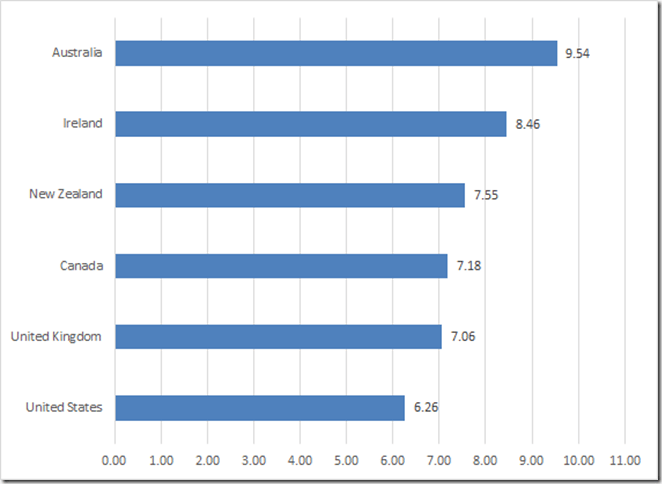
Source: OECD Focus on Minimum Wages after the crisis 2015
Previous Older Entries Next Newer Entries


 Utopia, you are standing in it!
Recent Comments