A mate suggested that I look into ecological economics. The self-appointed visionaries of ecological economics were so concerned about the population bomb that they proposed a “choice-based, marketable, birth license plan” or “birth credits” for population control. The Earth’s carrying capacity is a central issue in ecological economics.
Birth credits were promoted by urban designer and environmental activist Michael E. Arth since the 1990s and earlier by economist Kenneth Boulding (1964) and ecological economist Herman Daly (1991). I am not making this up.

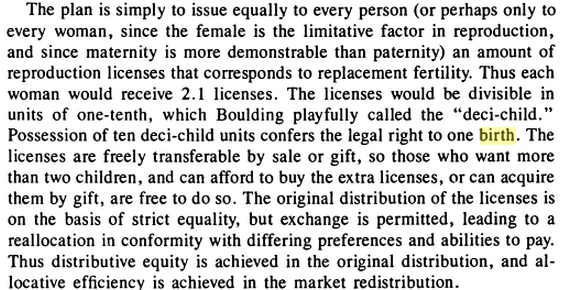
Birth credits would allow any woman to have as many children as she wants, as long as she buys a license for any children beyond an average allotment that would result in zero population growth (ZPG). Birth credits are similar to individual tradable quotas for fishing.
- If the allotment was determined to be 1.1 children, then the first child would be free, and the market would determine the cost of the license or birth credit for each additional child.
- The units could be sold in units of 1/10th of a credit with each of us getting 1.1 credits each for free, under some proposals.
Being nice members of the middle class, the penalty proposed for an illegal baby would be community service for the parents. I am sure most parents would welcome the time out of the house and the free child care. Obviously, these nice family unfriendly educated middle class ZPG types do not seem to appreciate the seas and oceans that some with cross to have a child.
Arth, Dally and his fellow prophets were smug enough to think they could see the future and a looming population bomb and food riots, but plainly they got the sign of the demographic crisis wrong.

Sub-replacement fertility is now the demographic crisis. Over half of the world’s population lives in countries with fertility rates at or below replacement level, and nearly all countries will reach low fertility levels in the next decade or two.
A larger population can, as Gary Becker has pointed out, increase the rate of technological progress by increasing the number of creative people working away at inventing new products and ideas. More people means more markets that will reach a critical mass for which people can then profitably invent new products, which further increase innovation and economic growth.
The price of these birth credits would be now lower than an EU carbon credit. You could not give them away.
HT: Steady-State Economics: Second Edition With New Essays – Herman E. Daly – Google Books.
 Utopia, you are standing in it!
Recent Comments