American voters who have bought tote bags decorated with pictures of Mrs Clinton or sweatshirts promoting abortion rights have inadvertently funded disruption in the UK.
Exposing the Financial Web: Clinton-Run Organizations Funding Climate Activists
Exposing the Financial Web: Clinton-Run Organizations Funding Climate Activists
04 Aug 2024 Leave a comment
in energy economics, environmental economics, environmentalism, global warming, politics - USA Tags: civil disobedience, climate activists, climate alarmism, crime and punishment, law and order
On new and old civil disobedience
29 Jan 2024 Leave a comment
in economic history, law and economics Tags: civil disobedience

According to my go-to source, the Oxford English Dictionary, “civil disobedience is defined this way: Rebellion of the populace against a governing power; (in later use) spec. refusal to obey the laws, commands, etc., of a government or authority as part of an organized, non-violent political protest or campaign. The three key aspects here involve deliberately breaking…
On new and old civil disobedience
Does @amnestynz under this distinction?
11 Apr 2018 Leave a comment
in defence economics, International law, laws of war, politics - New Zealand, Public Choice, war and peace Tags: civil disobedience, Gaza Strip, war against terror
Unexpected kind word for Parliament House protesters @GreenpeaceNZ @RusselNorman @NZGreens @greencatherine
15 Aug 2015 2 Comments
in constitutional political economy, economics of crime, environmental economics, global warming, law and economics, liberalism, politics - New Zealand, Public Choice, Rawls and Nozick, rentseeking Tags: civil disobedience, climate alarmism, expressive voting, Greenpeace, John Rawls, Justice Scalia, Leftover Left, rule of law
PRESS RELEASE: Greenpeace Parliament Climbers Convicted of Trespass bit.ly/1DRfKMG #realclimateaction http://t.co/sxRokpwRNk—
Greenpeace NZ (@GreenpeaceNZ) August 13, 2015
The Greenpeace vandals who trespassed at Parliament, climbing up to put signs down the front in flagrant disregard of the most ample possible options for peaceful protest right outside at least had the integrity to plead guilty. That shows some sort of fidelity to law and an acknowledgement that what they did was a criminal offence.
John Rawls makes the point that the purpose of civil disobedience is not to impose your will upon others but through your protest to implore them to reconsider their position and change the law or policy you are disputing.
Rawls argues that civil disobedience is never covert or secretive; it is only ever committed in public, openly, and with fair notice to legal authorities. Openness and publicity, even at the cost of having one’s protest frustrated, offers ways for the protesters to show their willingness to deal fairly with authorities. Rawls argues:
- for a public, non-violent, conscientious yet political act contrary to law being done (usually) with the aim of bringing about a change in the law or policies of the government;
- that appeals to the sense of justice of the majority;
- which may be direct or indirect;
- within the bounds of fidelity to the law; and
- whose protesters are willing to accept punishment. Although civil disobedience involves breaking the law, it is for moral rather than selfish reasons; the willingness to accept arrest is proof of the integrity of the act.
Rawls argues, and too many forget, that civil disobedience and dissent more generally contribute to the democratic exchange of ideas by forcing the champions of dominant opinion to defend their views.
Legitimate non-violent direct action are publicity stunts to gain attention and provoke debate within the democratic framework, where we resolve our differences by trying to persuade each other and convince the electorate.
Too many acts of non-violent direct action aim to impose their will on others rather than peaceful protests designed to bring about democratic change in the laws or policies of the incumbent government. That ‘might does not make right’ is fundamental to the rule of law. As United States Supreme Court Justice Antonin Scalia said
The virtue of a democratic system [with a constitutionally guaranteed right to free speech] is that it readily enables the people, over time, to be persuaded that what they took for granted is not so and to change their laws accordingly..
Both sides passionately but respectfully attempt to persuade their fellow citizens to accept their views. Win or lose, advocates for today’s losing causes can continued pressing their cases, secure in the knowledge that an electoral loss today can be negated by a later electoral win, which is democracy in action as Justice Kennedy explains:
…a democracy has the capacity—and the duty—to learn from its past mistakes; to discover and confront persisting biases; and by respectful, rationale deliberation to rise above those flaws and injustices…
It is demeaning to the democratic process to presume that the voters are not capable of deciding an issue of this sensitivity on decent and rational grounds.
The process of public discourse and political debate should not be foreclosed even if there is a risk that during a public campaign there will be those, on both sides, who seek to use racial division and discord to their own political advantage. An informed public can, and must, rise above this. The idea of democracy is that it can, and must, mature.
Freedom embraces the right, indeed the duty, to engage in a rational, civic discourse in order to determine how best to form a consensus to shape the destiny of the Nation and its people. These First Amendment dynamics would be disserved if this Court were to say that the question here at issue is beyond the capacity of the voters to debate and then to determine.
John Rawls’ view that fidelity to law and democratic change through trying to persuade each other is at the heart of civil disobedience reflects the difference between the liberal and the left-wing on democracy and social change as Jonathan Chait observed this week:
Liberals treat political rights as sacrosanct. The left treats social and economic justice as sacrosanct. The liberal vision of political rights requires being neutral about substance.
To the left, this neutrality is a mere guise for maintaining existing privilege; debates about “rights” can only be resolved by defining which side represents the privileged class and which side represents the oppressed…
Liberals believe that social justice can be advanced without giving up democratic rights and norms. The ends of social justice do not justify any and all means.
How the left-wing and liberal visions of democracy are different nymag.com/daily/intellig… http://t.co/Qk5vS9SaV4—
Jonathan Chait (@jonathanchait) August 13, 2015
Further evidence that street politics is counter-productive
14 May 2015 Leave a comment
in constitutional political economy, politics - Australia, politics - New Zealand, politics - USA, Public Choice Tags: activists, civil disobedience, Leftover Left, protesters, street politics
Public disorder and rioting by a large leads to a law and order response among the public and a hardening of social attitudes against whatever the desired social reform might be when it is tainted by civil disorder.
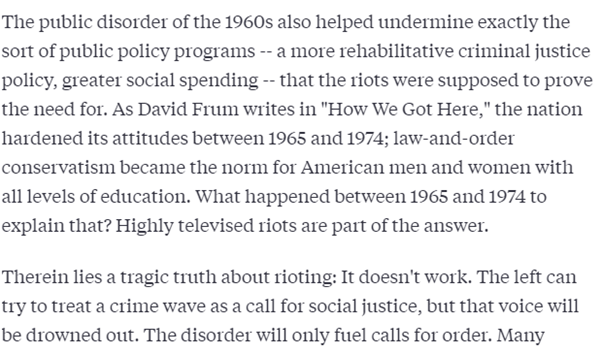
The Left, the Green Left and the watermelons in particular want to believe that street protests change things. They have to validate their youthful offences against public order.
Sadly, no; sadly for them but not for the law-abiding rest of us who resolve our differences by trying to persuade each other and elections.
The law-abiding rest of us believe in democratic equality. Your vote counts as much as mine in a democracy with free speech. The only way you can change my vote is by free speech, not by public disorder, threats and intimidation and taking the law into your own hands.
Do violent protests win votes for your cause?
12 May 2015 Leave a comment
in constitutional political economy, economic history, economics of crime, law and economics, politics - Australia, politics - New Zealand, politics - USA, Public Choice Tags: 1960s, activists, civil disobedience, Democratic Party, George Wallace, nonviolent protest, Richard Nixon, riots, Vietnam war, violent protests
Monkey Cage blogged on a very timely study on the impact of violent and nonviolent protests on voting behaviour. Non-violent protest in the 60s enticed sympathy and increased voter support for the Democratic Party in the 1964, 1968 to 1972 presidential elections:
Black-led nonviolent protests… exhibit a statistically significant positive relationship with county-level Democratic vote-share in the same period.
This is not surprising because nonviolent protest acknowledge fidelity to law and democratic equality. No one likes to be bullied and one of the purposes of the secret ballot is to prevent voters from being bullied because no one knows how you voted.
Indeed, there is a long history of anonymous pamphleteering, which has evolved into anonymous trolling as a way of people expressing their political views without facing backlash from both the majority and a vindictive minority.
In a democracy, it’s up to me to persuade you to change your mind – that what you took for granted for so long is not so. That’s how liberal democracies work: by trying to persuade each other and voting.
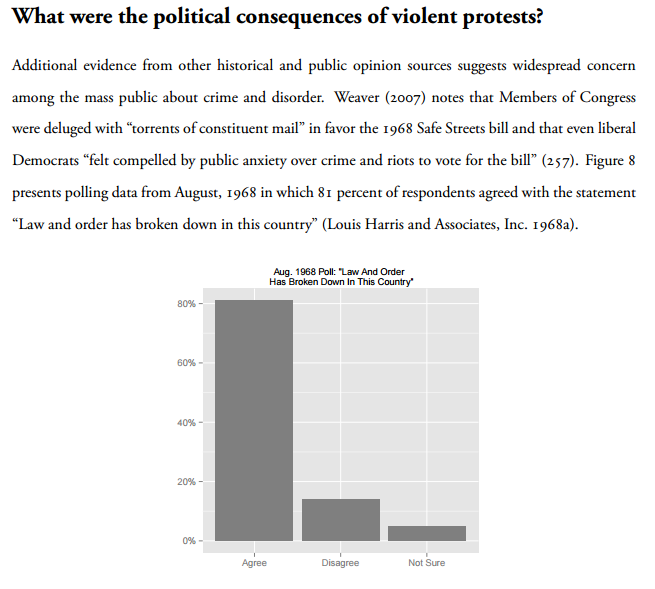
Violent protests had the exact opposite effect to peaceful protests on Democratic Party voting shares in the 1964, 1968 in 1972 presidential elections. There was a law and order backlash among voters against what were relatively widespread rioting and civil disorder:
…black-led protests in which some violence occurs are associated with a statistically significant decline in Democratic vote-share in the 1964, 1968 and 1972 presidential elections.
This is a roundabout way of saying that a Republican won the 1968 election on a law and order platform, not a Democrat on a peace platform. The country was convinced, including Liberal Democrats, that law and order had broken down and that the Democratic Party could not restore law and order.
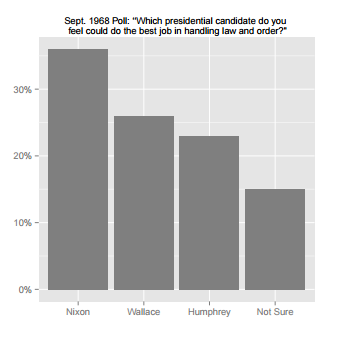
In the 1968 presidential election, there is a third party candidate, George Wallace, who won won almost ten million popular votes and 46 electoral votes, including in the electoral college on an even harsher law and order platform than Nixon.
Wallace was a racist Southern Democrat the Democratic Party would prefer us to forget and a nasty political opportunist to boot. His political rhetoric included the only words four letter words the protesters didn’t know was work and soap.
As I recall warmed over Marxism, the idea of violent protests is to provoke a law and order backlash, initially with popular support of the working class. The resulting police repression will overreach and cause the proletariat to breakthrough their false consciousness to see that capitalists for whom they are and rise up to overthrow them.

Rise up ye workers, rise up for you have nothing to lose but your chains. These days that call to the barricades would have to be rise up ye workers, rise up for you have nothing to lose what your smart phone and air points.
Civil disobedience and political activism are overrated
24 Mar 2014 Leave a comment
in politics - Australia, Rawls and Nozick Tags: Australian political parties, civil disobedience, John Rawls, non-violent direct action, political activism
Most activists take to the streets because if they ran openly for office, they would struggle to get 1% of the vote. Their best options are entryism and branch stacking.
The strength of democracy lies in the ability of small groups of concerned and thoughtful citizens to band together and change things by running for office and winning elections.
That is how new Australian parties such as the ALP, the country party, DLP, Australian democrats and Greens changed Australia. One Nation even had its 15 minutes of fame. Australian state upper houses even have Christian and shooters parties and many independents. Many started in someone’s living room.
Some find democracy frustrating because they cannot win openly at the ballot box even under proportional representation in federal and state upper houses.
When the “shooters” party and “no aircraft noise” party can win ahead of you, it is time to accept that your message of struggle and direct action simply does not resonate with the electorate.
John Rawls, discussing non-violent direct action, argues that in a nearly just society, those who resort to civil disobedience present themselves to the majority to show that, in their considered opinion, the principles of justice governing cooperation amongst free and equal persons have not been respected.

Rawls argues that civil disobedience is never covert or secretive; it is only ever committed in public, openly, and with fair notice to legal authorities. Openness and publicity, even at the cost of having one’s protest frustrated, offers ways for the protesters to show their willingness to deal fairly with authorities.
Rawls argues:
- for a public, non-violent, conscientious yet political act contrary to law being done (usually) with the aim of bringing about a change in the law or policies of the government;
- that appeals to the sense of justice of the majority;
- which may be direct or indirect;
- within the bounds of fidelity to the law; and
- whose protesters are willing to accept punishment. Although civil disobedience involves breaking the law, it is for moral rather than selfish reasons; the willingness to accept arrest is proof of the integrity of the act.
Rawls argues, and too many forget, that civil disobedience and dissent more generally contribute to the democratic exchange of ideas by forcing the champions of dominant opinion to defend their views.
Legitimate non-violent direct action are publicity stunts to gain attention and provoke debate within the democratic framework, where we resolve our differences by trying to persuade each other and convince the electorate.
Too many acts of non-violent direct action aim to impose their will on others rather than peaceful protests designed to bring about democratic change in the laws or policies of the incumbent government. That ‘might does not make right’ is fundamental to the rule of law.
 Utopia, you are standing in it!
Recent Comments