The relative political importance of climate change
01 Apr 2015 Leave a comment
in environmental economics, global warming, politics - Australia, politics - New Zealand, politics - USA Tags: 2014 congressional elections, climate alarmism, global warming, opinion polls, voter demographics
The alarmist predictions of global warming have proved to be exaggerated
31 Mar 2015 Leave a comment
The Campaign To Make You Care About Climate Change Is Failing Miserably
27 Mar 2015 Leave a comment
in economic history, economics of media and culture, environmental economics, global warming, politics - USA, Public Choice Tags: climate alarmism, expressive voting, global warming, rational ignorance, rational irrationality

Since 1989, there’s been no significant change in the public’s concern level over global warming. To put this in perspective, note that the most expensive public-relations campaign in history—one that includes most governmental agencies, a long list of welfare-sucking corporations, the public school system, the universities, an infinite parade of celebrities, think tanks, well-funded environmental groups and an entire major political party—has, over the past 25 years or so, increased the number of Democrats who “worry greatly” about global warming by a mere four percentage points.


via The Campaign To Make You Care About Climate Change Is Failing Miserably, Climate Change Not a Top Worry in U.S., In U.S., Concern About Environmental Threats Eases and The number of people worried about climate change hasn’t changed since 1989 – The Washington Post.
It’s the Trend, Stupid
25 Mar 2015 1 Comment
in econometerics, environmental economics Tags: climate alarmism, conjecture and refutation, double standards, green hypocrisy
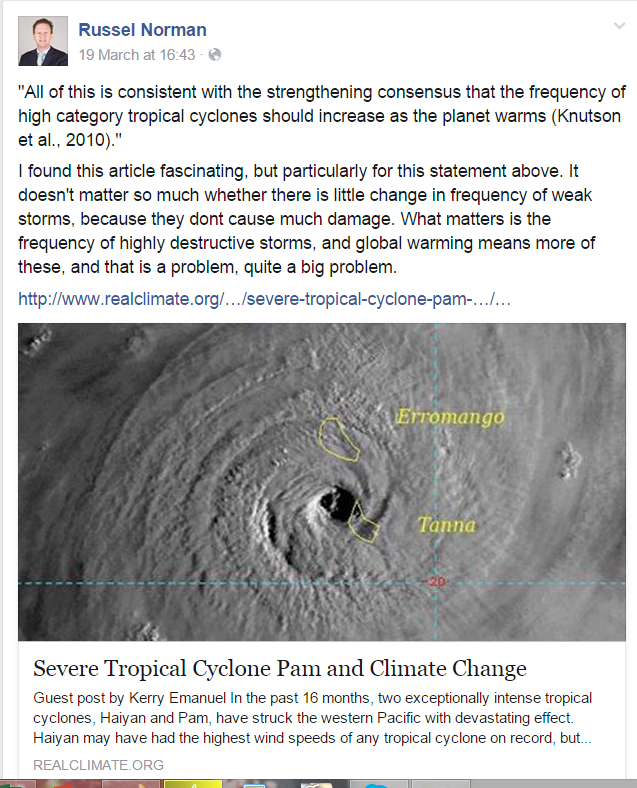
If I had a dollar for every time a climate alarmist talked about how hot this summer was or how strong that cyclone was is evidence of global warming, I’d be a rich man.
They can’t then go around saying a sample size of 17 years is too short to assess trends will show evidence of global warming when they routinely use a sample of one for their own global warming alarmism.
Naturally, such is the high stakes of the never admit you’re wrong, never concede anything public political discourse of these days, if a fellow traveller oversteps the mark, you gain nothing from calling him out as someone who overstepped the mark.

Both NASA and NOAA report 2014 as the hottest year on record. Despite the new #1, neither the news itself nor the response to it has surprised me.
View original post 632 more words
Another reason why that treaty with China over climate change won’t count much
25 Mar 2015 1 Comment
in environmental economics, global warming, politics - USA Tags: China, climate alarmism, global warming
The numbers behind any shift to a lower carbon economy simply don’t add up
24 Mar 2015 Leave a comment
in energy economics, environmental economics, global warming Tags: carbon trading, climate alarmism, expressive voting, global warming, Kyoto Protocol, power prices, rational ignorance, rational irrationality
The international success of Big Wind
24 Mar 2015 Leave a comment
in environmental economics, global warming, rentseeking Tags: Big Wind, climate alarmism, global warning, green rent seeking, renewable resources, wind power
On burden of proof
20 Mar 2015 Leave a comment
in environmental economics, environmentalism, global warming, liberalism, rentseeking Tags: climate alarmism, conjecture and refutation, green rent seeking, philosophy of science, precautionary principle
Global temperatures since 2500 BC
20 Mar 2015 2 Comments
in environmental economics, global warming Tags: climate alarmism, global cooling, global warming
Why masterly inactivity will be the American response to global warming
20 Mar 2015 1 Comment
in energy economics, environmental economics, environmentalism, global warming, Public Choice Tags: climate alarmism, global warming, green rent seeking, opinion polls, voting
The carbon footprint of the round the world solar flight should include its support planes
18 Mar 2015 Leave a comment
in environmental economics, global warming, technological progress, transport economics Tags: carbon footprint, climate alarmism, expressive voting, global warming, solar flight, solar power
Is fighting global warming a good investment?
17 Mar 2015 Leave a comment
in environmental economics, global warming Tags: climate alarmism, cost benefit analysis, global warming
Further evidence from the legacy media that climate alarmism is on the way out?
16 Mar 2015 Leave a comment
in economics of information, economics of media and culture, environmental economics, global warming Tags: climate alarmism, expressive voting, global warming, rational ignorance, rational irrationality
Many more birds to be incinerated as solar energy becomes cost competitive; climate alarmists face mass layoffs
13 Mar 2015 Leave a comment
in energy economics, environmental economics, global warming Tags: climate alarmism, creative destruction, global warming, killer green technologies, solar power

Unsubsidized rooftop solar electricity costs anywhere between $0.13 and $0.23/kWh today, well below retail price of electricity in many markets globally.
The economics of solar have improved significantly due to the reduction in solar panel costs, financing costs and balance of system costs. We expect solar system costs to decrease 5-15% annually over the next 3+ years which could result in grid parity within ~50% of the target markets.
If global electricity prices were to increase at 3% per year and cost reduction occurred at 5-15% CAGR, solar would achieve grid parity in an additional ~30% of target markets globally. We believe the cumulative incremental total available market for solar is currently around ~140GW/year and could potentially increase to ~260GW/year over the next 5 years as solar achieves grid parity in more markets globally and electric capacity needs increase…
solar system costs have declined at ~15% CAGR over the past 8 years and we expect 40% cost reduction over the next 4-5 years as a solar module costs continue to decline, panel efficiencies gradually improve, balance of system costs decline due to scale and competition, global financing costs decline due to development of new business models and customer acquisition costs decline as a result of increasing customer awareness and more seamless technology adoption enabled by storage solutions…
oil represents only about 5% of global electricity production and in some of the important solar markets such as US, China, oil based electricity generation is less than 5% of the total. Moreover, the cost of oil based electricity generation even at $50 oil prices is the 7-9c/kWh range and as shown in the note, the marginal cost is higher than solar in many regions worldwide. Bottom line is that oil prices do not have a material impact on solar demand.

About the only losers from this creative destruction in energy production, aside from the tens of thousands of public officials, academics and NGO employees who jobs and research grants depend up climate alarmism, are the birds that happen to fly past these solar power stations and are incinerated.

via Deutsche Bank’s 2015 solar outlook: accelerating investment and cost competitiveness – Deutsche Bank Responsibility and Deutsche Bank report: Solar grid parity in a low oil price era – Deutsche Bank Responsibility.

 Utopia, you are standing in it!
Recent Comments