Female superiors are more likely to be critical of female subordinates, high-ranking women are less likely to collaborate with same-sex subordinates, and female US workers tend to prefer a male boss. https://t.co/hj9lQ1oS1R pic.twitter.com/5T3oOpwv10
— Rolf Degen (@DegenRolf) April 20, 2018
Don’t do much for the value of diversity in management
20 Apr 2018 Leave a comment
in applied price theory, discrimination, gender, labour economics, managerial economics, organisational economics, personnel economics Tags: co-worker discrimination, sex discrimination
Sociologist documents what Gary Becker knew in 1957
12 May 2017 Leave a comment
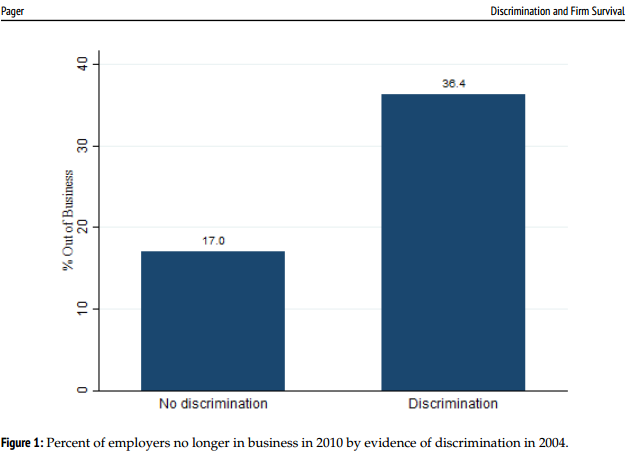
Source: Pager, Devah. 2016. “Are Firms that Discriminate More Likely to Go Out of Business?” Sociological Science (September):849-859. PDF
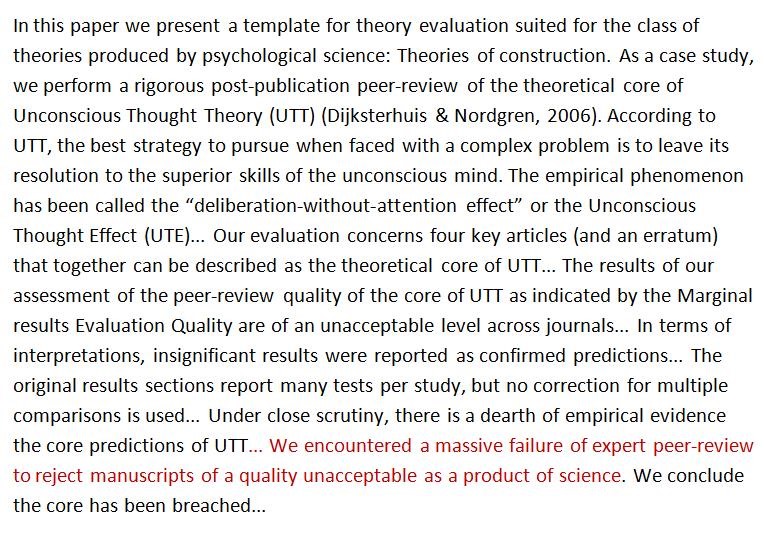
Unconscious mind studies should not have survived peer-review
21 Mar 2017 Leave a comment
in discrimination, labour economics Tags: co-worker discrimination, customer discrimination, employer discrimination, moral psychology, political psychology, social psychology
A long-standing anomaly about racial discrimination in the labour market
19 Apr 2015 Leave a comment
in discrimination, human capital, labour economics, labour supply, occupational choice Tags: co-worker discrimination, customer discrimination, employer discrimination, labour market discrimination, racial discrimination
CHART: Asians Make 15% More Than Whites, Is That Because of 'Asian Privilege' or Discrimination Against Whites? http://t.co/9YnkDDrcbO—
Mark J. Perry (@Mark_J_Perry) March 19, 2015
The Workplace Is Even More Sexist In Movies Than In Reality | FiveThirtyEight
12 Mar 2015 Leave a comment

The Bechdel Test: whether women are in a movie as fully human characters, or as plot devices for the male characters
27 Jan 2015 Leave a comment
in discrimination, economics of media and culture, gender, industrial organisation, movies, occupational choice, survivor principle Tags: co-worker discrimination, consumer sovereignty, customer discrimination, employer discrimination, Hollywood economics, sex discrimination, The meaning of competition
/cdn0.vox-cdn.com/uploads/chorus_asset/file/3332436/hickey-bechdel-11.0.png)
Hollywood is a slave to the box office on the most cutthroat industry there is. Film producers and screenwriters will portray men and women in whatever roles and whatever extent sells tickets.
How women are represented in the movies is determined solely by the preferences of the audiences willing to buy tickets. It’s a buyers market out there. Film producers would do whatever it takes to finance films that sell tickets, as even Five Thirty-Eight realised:
“Movies that are female-driven do not travel,” said Krista Smith, West Coast editor of Vanity Fair, describing the broader sentiment in Hollywood. There are almost no women who have sales value in multiple international territories, maybe with the exception of Sandra Bullock, she said.
Times change, and film producers change with the times. Consumers are both sovereign and change their minds, and in the case of movie audiences, constantly demand novelty and surprises, as even Five Thirty-Eight picked up on:
Hollywood is the business of making money. Since our data demonstrates that films containing meaningful interactions between women do better at the box office than movies that don’t, it may be only a matter of time before the data of dollars and cents overcomes the rumours and prejudices defining the budgeting process of films for, by and about women.
This moral panic over gender wage gaps between millionaire actresses and actresses dare not say that for want of offending the audience that is actually the main driver of any gender gap in movies.

Hollywood activists complaining about the gender wage are to business minded to dare insult the audiences that pay their wages.
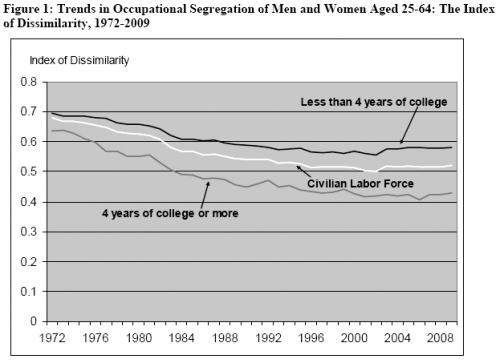
Claudia Goldin’s pollution theory of sex discrimination
10 Dec 2014 Leave a comment
in discrimination, gender, human capital, labour economics, labour supply, occupational choice Tags: Claudia Goldin, co-worker discrimination, credentialisation, employer discrimination, occupational segregation, sex discrimination, signalling
Claudia Goldin argues that it is difficult to rationalise sex segregation and wage discrimination on the basis of men’s taste for women in the same way as discrimination based on race or ethnicity. Goldin developed a pollution theory of discrimination in which new female hires may reduce the prestige of a previously all-male occupation.
When work took more brawn than brain, the distributions of skills and natural talents of men and women were further apart. Women were not as physically strong as men. This counted for more both before the Industrial Revolution and at the height of the Industrial Revolution when most factory work involved a considerable amount of brawn.
As machines substituted for strength, as brain replaced brawn and as educational attainment increased, the distributions of attributes, skills and natural talents narrowed by sex.
Because there is asymmetric information regarding the value of the characteristic of an individual woman, a new female hire may reduce the prestige of a previously all-male occupation.
Prestige is conferred by some portion of society and is based on the level of a productivity-related characteristic (e.g., strength, skill, education, ability) that originally defines the minimum needed to enter a particular occupation. People had to have a minimum amount of the socially prestigious strength or skill before they are hired.
Male fire fighters or police officers, to take two examples, may perceive their occupational status to depend on the sex composition of their police station or firehouse. These occupations are socially prestigious because of the strength and courage of police and fire-fighters. Men in an all-male occupation might be hostile to allowing a woman to enter their occupation even if the woman meets the qualifications for entry.
A reason for this hostility of the existing male members of the occupation is the rest of society may be slow to learn of the qualifications of these female newcomers. Their entry against this background of ignorance in the wider society may downgrade the occupation as still carrying prestigious characteristics such as physical strength. As Goldin explains:
Because they feel that the entry of women into their occupations would pollute their prestige or status in that occupation. Very simply, some external group is the arbiter of prestige and status.
Let’s take an example of firemen, and let’s say we begin not that long ago when there were no women who were firemen—which is why they’re called firemen.
And to become a fireman you have to take a test, lifting a very heavy hose and running up many flights of stairs. And every night, the firemen get off from work and go to the local bar.
Everyone slaps them on the back and says what great brawny guys they are and what a great occupation they are in, and everybody knows that to be a fireman requires certain brawny traits and lots of courage.
But nobody knows when there’s a technological shock to this occupation. And in this case it might be that fire hoses become really light or the local fire department changes the test. There are information asymmetries. But they do note that for this “brawny” characteristic, the median woman is much lower.
So if we observe a woman entering the occupation and we don’t know how to judge women, we’re going to assume that her skills are those of the median woman. Or it may be that we can observe something having to do with her muscles and that may up it a little bit.
But chances are we’re going to assume that some technological shock has happened to this occupation. And so her entry into the occupation is going to pollute it.
Then when they go to the bar, people will say, “oh you’ve got a woman in the firehouse; now fire fighting has become women’s work.” That’s where the pollution comes in.
Union rules also played a role in preventing the entry of women into some occupations
Many occupations have changed sex over time e.g., librarians, bank tellers, teachers, telephone operators, and sales positions. New occupations and industries are less like to be segregated on the basis of sex because they have not developed a social image regarding the prestige of workers.
Occupational segregation came to an end because credentialisation, which spreads information about individual women’s productivities and shatters old stereotypes, can help expunge this pollution of the prestige of specific occupations and jobs both within the industry and in wider society .
The visibility successful women today and in the past may help shatter old stereotypes and increase knowledge about the true distribution of female attributes in this prestigious occupation.

Goldin found that when typists were primarily men, it was claimed that typing required physical stamina so woman need not apply.
But later, when the occupational sex segregation reversed, when typing became a female occupation, it was said that typing required a woman’s dexterity, which men did not have! When I was at school, only women were taught to type.
 Utopia, you are standing in it!
Recent Comments