Despite all the hullabaloo, collective bargaining agreement coverage is not declined by that much outside of the English-speaking countries. Outside of the USA, the top 1% are very lazy so they have not benefited from this decline of union power. Within the USA, so few people are covered by collective bargaining agreements for so long that it would not figure in the rising top incomes over the last 30 or more years.
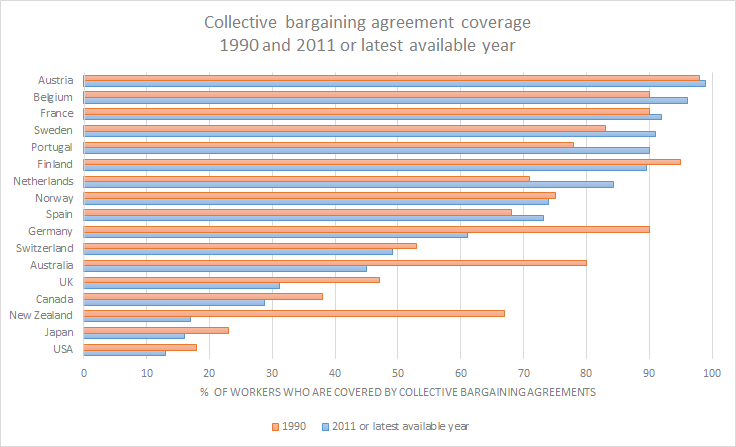
Source: Economic Policy Reforms 2015: Going for Growth – © OECD 2015 and OECD Employment Outlook 2002.
As for New Zealand, the main difference between 70% collective bargaining agreement coverage in 1990 and less than 20% collective bargaining coverage in 2011 is real wage growth returned to New Zealand in the early 1990s after 20 years of wage stagnation. The major economic event of the time was the passage of the Employment Contracts Act.
 Utopia, you are standing in it!
Recent Comments