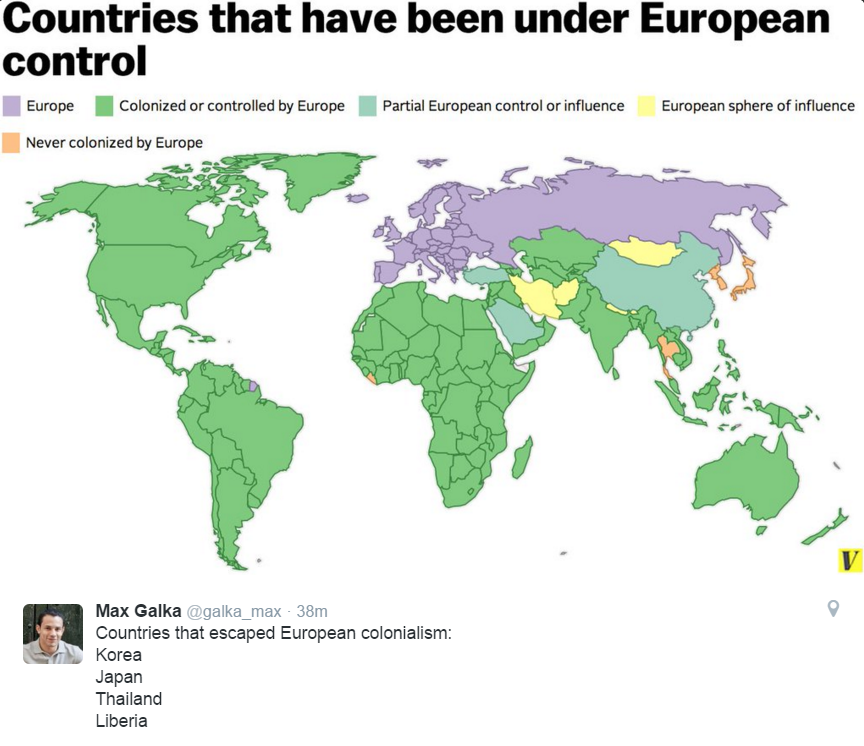
Russian Expansion, 1533-1894
06 Oct 2015 Leave a comment
in economic history Tags: age of empires, colonisation, Russia
Russian Expansion, 1533-1894. http://t.co/Y7I7RhD03R—
History Facts 247 (@historyfacts247) October 04, 2015
A map of countries Britain never invaded
29 Jul 2015 Leave a comment
in economic history, rentseeking, war and peace Tags: British empire, British imperialism, colonisation
A world map according to the countries Britain never invaded i100.io/8YNMkgK http://t.co/l5BO1hehEf—
i100 (@thei100) April 28, 2015
European imperialism in 1922
06 Jul 2015 Leave a comment
in economic history Tags: age of empires, British imperialism, colonisation, imperialism, maps
European imperialism in 1922 http://t.co/dxWEeXUcfr—
Charts and Maps (@ChartsandMaps) June 05, 2015
The Empire of Japan in 1939
03 Jul 2015 Leave a comment
in defence economics, economic history, war and peace Tags: China, colonisation, imperialism, Japan, World War II
The Empire of Japan in 1939, read how it got there brilliantmaps.com/russo-japanese… http://t.co/wop0insgnD—
Brilliant Maps (@BrilliantMaps) January 21, 2015
Colonizability of Africa (1899)
25 Jun 2015 Leave a comment
in economic history Tags: Africa, age of empires, British empire, colonisation, imperialism
Colonizability of Africa (1899) by Harry Johnston, a British explorer bit.ly/1uQjAPX http://t.co/2jiqQdCgeT—
Brilliant Maps (@BrilliantMaps) November 23, 2014
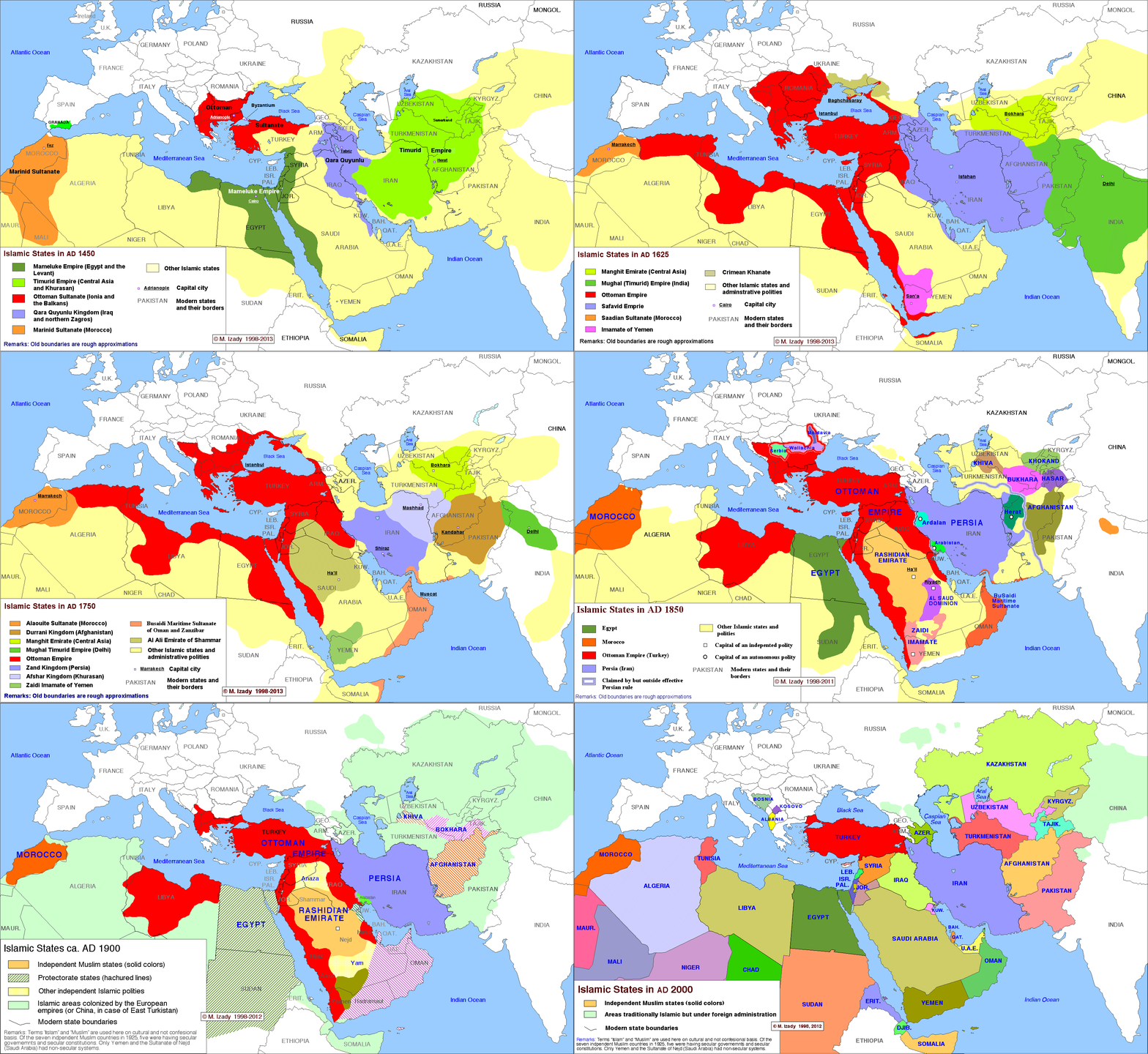
The Islamic states of the world, from 1450 to today
12 Jun 2015 Leave a comment
in economic history, war and peace Tags: colonisation, Eastern Europe, Islam, middle-east, Muslim empires
Who had the most colonies?
05 Jun 2015 Leave a comment
in development economics, economic history, Public Choice, rentseeking Tags: age of empires, British empire, colonisation
Land unknown to humans before the Age of Exploration
31 May 2015 Leave a comment
in economic history Tags: age of empires, Age of exploration, British empire, colonisation, maps

Who colonised Africa?
22 Apr 2015 Leave a comment
in economic history Tags: Africa, British empire, British imperialism, colonisation, imperialism
if colonizing Africa was the quiz Blockbusters, Britain would have been very good at it http://t.co/qeD1P0GgHU—
Laurence Chandy (@laurencechandy) February 03, 2014
The Rhino’s Horn and exactly why Australia was colonised-updated
12 Apr 2014 Leave a comment
in development economics, law and economics, property rights Tags: Australia, colonisation, property rights, rhino
Doug Allen in The Rhino’s Horn explains why owners sometimes reduce the value of certain attributes of their property because this reduces the incentives for others to steal it. These attributes may be of little value to you but of much greater value to those seeking to steal it.
The rhino’s horn is cut off to stop poaching. The horn is a mass of hair so removing it is painless. This is much cheaper than hiring bodyguards for every Rhino.

My garage door was tagged last year. I do not have this small tag cleaned-off because it would just invite another tagger to have a go.
Allen argued that it is cheaper to reduce the value of that part of the asset that others want to steal than spend a fortune defending it against potential theft. With regard to Australia, he said:
The country had, ironically, been discovered and claimed first by the Dutch, who at the time were a significant force in the region.
Starting in 1772, the French began their first claim to the territory. Although ignored by the British, the French sent expeditions in 1785 and 1792, making significant explorations of southern Australia and Tasmania. The French did not cease these efforts until the 1820s.
Australia was first colonised in 1788 as a penal colony. Very expensive to do, but it did fill-up the only valuable part – Sydney harbour – with 60,000 mainly riffraff and low life. This penal colony for a number of decades made the only valuable part of Australia more unattractive to other European powers to conquer. Allen explains:
In the case of Australia, the hypothesis might appear silly.
How much reduction in the first-best value to a continent can come from 60,000 convicts?
However, one must keep in mind that the only value of Australia at the end of the eighteenth century was from Sydney Harbour, Norfolk Island, and a few other strategic locations.
On these margins, the convicts could lower the value considerably
… After the War of 1812 Britain realized the strategic significance of Bermuda and subsequently established a penal colony there.
A prosperous colony is an attractive colony to conquer so imperial army and navy resources would have deployed to defending it. Prosperous locals and locally recruited troops can switch loyalties.
An empire full of prosperous colonies makes you an attractive target for other European powers to gang up on and divide the spoils. This may explain why some colonial powers had mixed feelings about developing their colonies. Robert Lucas observed that:
Stagnation at income levels slightly above subsistence is the state of traditional agricultural societies anywhere and any time. But neither did the modern imperialisms—the British included—alter or improve incomes for more than small elites and some European settlers and administrators.
France lost its once vast North American colonies through wars. Many colonies changed hands after the countless European wars as part of peace settlements.
 Utopia, you are standing in it!
Recent Comments