This link was sent to me by a despondent (and of course anonymous) New Zealander with the comment, “This is now unstoppable in NZ.” It’s from the Times Higher Education site, and the authors are Mahdis Azarmandi and Sara Tolbert, both on the Faculty of Education of New Zealand’s University of Canterbury. Click screenshot to […]
Last October I posted a critique of a new National Science Foundation (NSF) initiative designed to combine indigenous knowledge with modern science—in the U.S. this time, and to the tune of $30 million. The NSF was very optimistic, as you can see from the article below in Science (click to read; see also a similar […]
A comment by reader Chris Slater called my attention to this article from GeoNet, an organization described as providing “geological hazard information for Aotearoa New Zealand.” It’s also . . . . sponsored by the New Zealand Government through its agencies: Natural Hazards Commission Toka Tū Ake, GNS Science, Toitū Te Whenua Land Information New Zealand […]
Here we have a 55-minute (remote) conversation between Richard Dawkins and Kathleen Stock conducted during the “Dissident Dialogues” conference in NYC last May. Here’s a précis of Stock’s background from Wikipedia: Kathleen Mary Linn Stock OBE is a British philosopher and writer. She was a professor of philosophy at the University of Sussex until 2021. She has published academic […]
Grant Duncan writes: University management should take note of that, as there have been unrealistic efforts to force poorly defined “Treaty obligations” into teaching and research. For example, one university is now telling its academic staff that all curricula should, as a high priority, be “designed, developed and delivered in authentic partnerships with Māori [and] […]
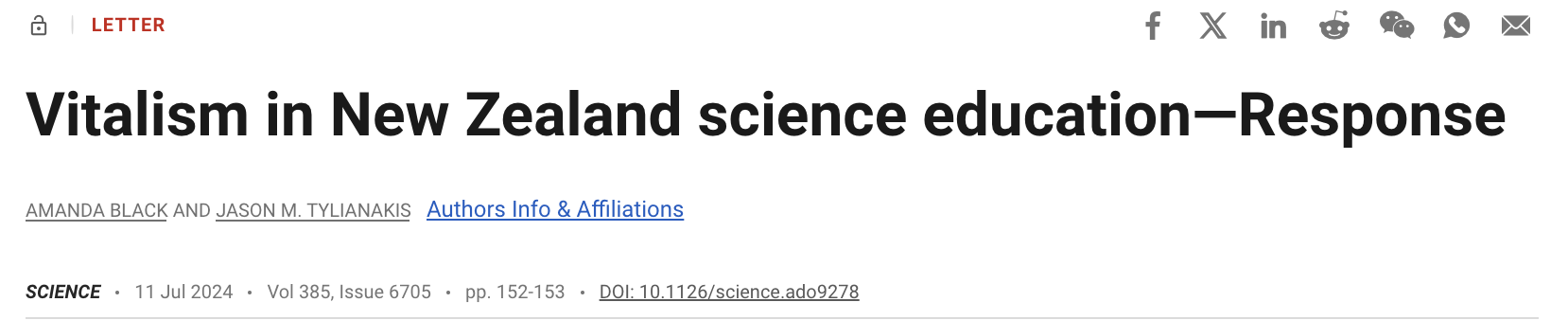
Two letters have just been published in Science signed by a total of 15 scientists, all criticizing the first article below (published in Science last February), a piece arguing for teaching indigenous knowledge (including N.Z.’s version, Mātauranga Māori) alongside science in the science classroom. (Click to read.) Now the authors, after being criticized, denied that […]
That is the title of the new Judith Butler book, focusing mostly on trans issues. To be clear, on most practical issues concerning trans, I side with the social conservatives. For instance, I don’t think trans women have a right to compete in women’s weightlifting contests. And I have not been happy with how many […]
Pielke Jr. argues like this: “The notion of consensus-as-truth has been operationalized in various forms: journalistic “fact checkers,” academic “misinformation” researchers, and content moderation on social media platforms. The practical effect is the creation of self-appointed arbiters of truth — journalists, academics, social media platforms, and even governments — who render judgments on acceptable and unacceptable speech according to conformance with an acceptable view.”
I’ve written a lot about New Zealand lately, in particular the schools’ and government’s attempt to force the teaching of “indigenous ways of knowing” (mātauranga Māori) into the science classroom as a system coequal in value with modern science. That means not only equal classroom time, but equal respect, treating indigenous ways of knowing as […]
The combination of Canadian wokeness and the migration across the Pacific of New Zealand’s “indigenous ways of knowing” trope has led to this ad by The University of Victoria. The U of V wants to hire three candidates in any branch of science with expertise “in either (a) working with Indigenous ways of knowing, or…
That this editorial appears in the premier journal Science, and is one of a growing number of pieces urging us to respect “indigenous ways of knowing”, suggests that the woke movement has sprouted a new branch. It’s one I’ve discussed many times with respect to Māori “ways of knowing” (Mātauranga Māori, or MM) in New […]
Written by me, here is a passage from GOAT: Who is the Greatest Economist of All Time, and Why Should We Care? A System of Logic covers many different topics, but for our purposes the most important discussion is Mill’s treatment “Of the Four Methods of Experimental Inquiry,” sometimes called “Mill’s Methods” and indeed receiving […]
Why Evolution is True is a blog written by Jerry Coyne, centered on evolution and biology but also dealing with diverse topics like politics, culture, and cats.
In Hume’s spirit, I will attempt to serve as an ambassador from my world of economics, and help in “finding topics of conversation fit for the entertainment of rational creatures.”




Recent Comments