

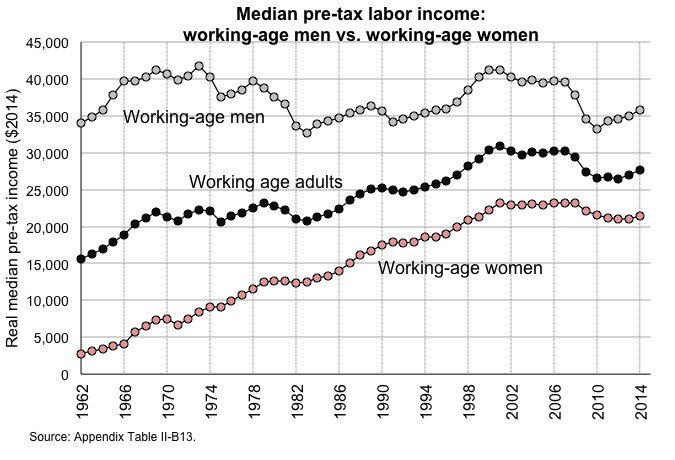
Does that mean they buy the same basket of goods as in 1962? Same quality? No new goods?
13 Jan 2017 Leave a comment
NZ inflation rate since 1991 with 1% CPI bias adjustment
13 Sep 2016 Leave a comment
in economic history, inflation targeting, macroeconomics, monetary economics, politics - New Zealand Tags: CPI bias, inflation rate
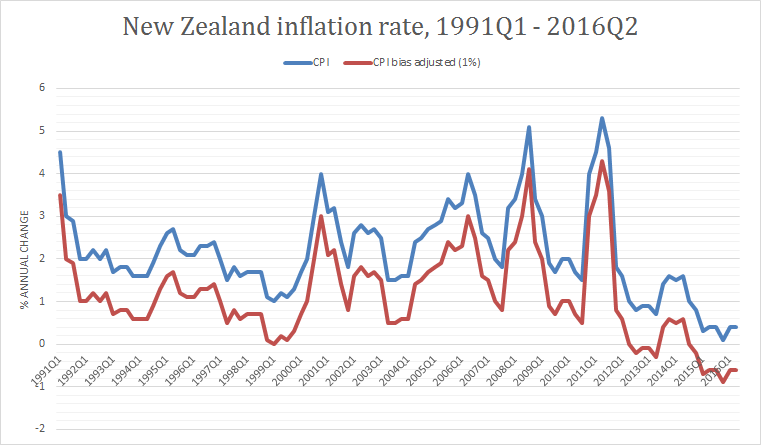
The inflation rate is overstated by about 1% each year because of difficulties in measuring new goods entering the consumer price index and improvements in the quality of existing goods in the consumer price index. With that adjustment of 1% in the chart below, a common measure of that bias, New Zealand has had zero to negative inflation for four years
Source: Reserve Bank of New Zealand Key Statistics.
One of the reasons for an inflation target band of 1 to 3% is an inflation rate of 1% is actually an inflation rate of 0%.
Cumulative Growth in Average Inflation-Adjusted After-Tax Income by Before-Tax Income Group, 1979 to 2011 with 1% annual adjustment for inflation measurement bias
01 Aug 2015 Leave a comment
in applied price theory, applied welfare economics, economic history, politics - USA Tags: CPI bias, living standards, measurement errors, The Great Enrichment
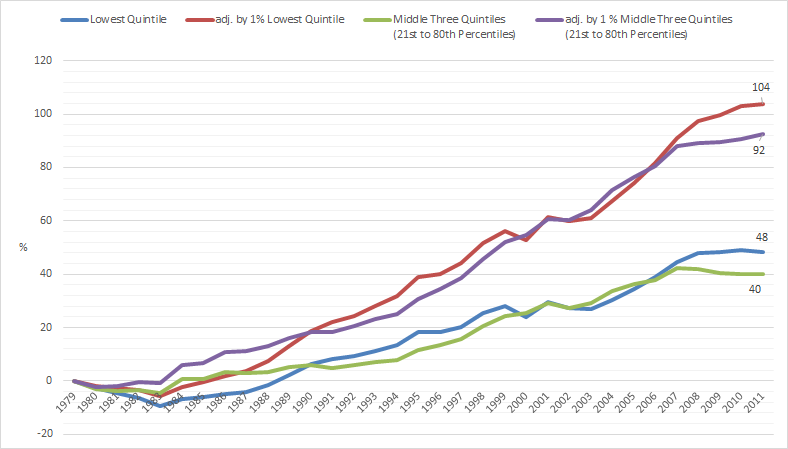
The Congressional Budget Office did its best to adjust after-tax incomes for inflation between 1979 in 2011. In figure 1, I added an extra 1% inflation adjustment in every year from 1979. 1% per annum is a common estimate of the inflation bias introduced by the inability of most measures of inflation to account for new goods and upgrades in the quality of existing goods to name but a few bias is in the measurement of consumer price inflation.
Figure 1: Cumulative Growth in Average Inflation-Adjusted After-Tax Income, by Before-Tax Income Group, USA, 1979 to 2011, 1% upward annual adjustment for inflation bias for new goods and quality upgrades
Source: derived from Congressional Budget Office, The Distribution of Household Income and Federal Taxes, 2011.
As can be seen from figure 1, with a 1% up left for measurement bias, instead of increases of 48% and 40% in the incomes of the lowest quartile in the middle three quartiles respectively, their after-tax, after inflation incomes about doubled since 1979.
"The rich got richer, true. But…" —@DeirdreMcClosk buff.ly/1Imdv4o http://t.co/M3ERx3JTIn—
HumanProgress.org (@humanprogress) June 28, 2015
Well done, capitalism. Everyone was on a working class income in the 1970s is now on a middle-class income. Such are the joys of compounding 1% per year over more than 30 years.
Source: Congressional Budget Office, The Distribution of Household Income and Federal Taxes, 2011.
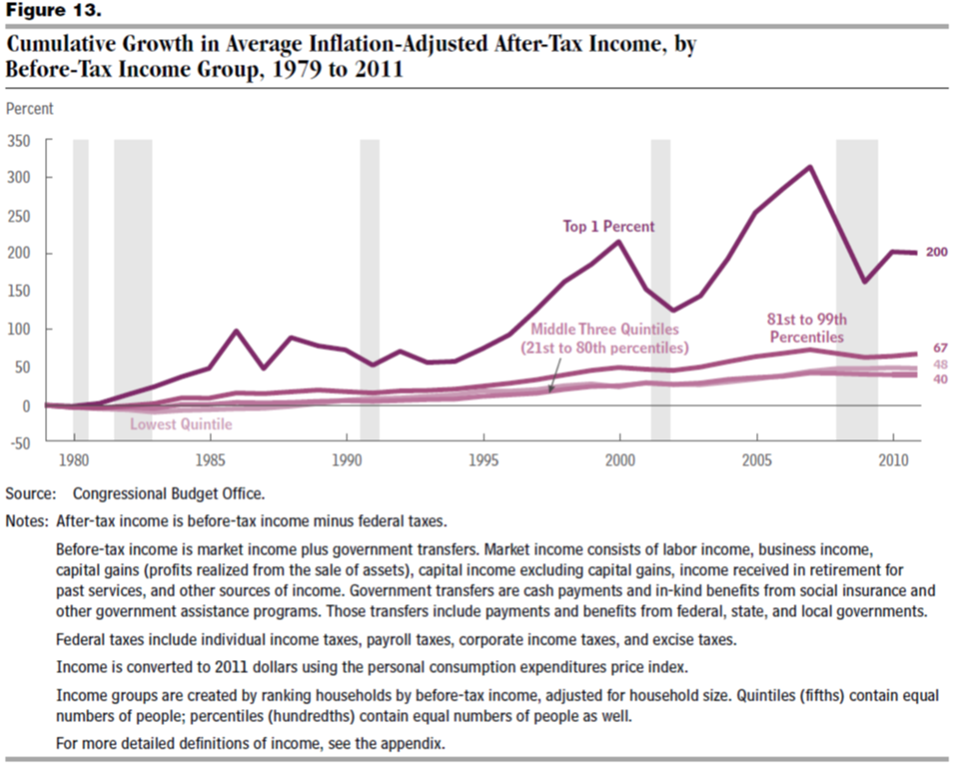
The original Congressional Budget Office diagram above with the higher income quartiles is presented for comparison. I didn’t present the top quartiles in figure 1 because it made it unreadable because of the dominant influence of the top 1%’s increase in income.
The lesson for the day is small inaccuracies in the measurement of prosperity can over several decades through compounding lead to massive misunderstandings of the increases in prosperity.
Australian and New Zealand inflation rates adjusted for new goods and quality bias of 1.5%
23 Apr 2015 Leave a comment
in inflation targeting, macroeconomics, politics - Australia, politics - New Zealand Tags: Australia, CPI bias, inflation, New Zealand
In praise of measurement error: good thing no one noticed the severe deflation in Australia and in New Zealand in the late 1990s for otherwise the do-gooders might have felt the need to do something about it. Good thing no one is panicking over the recent mild deflation in New Zealand as well.
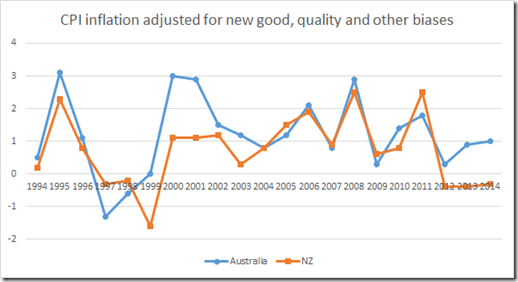
Source: OECD StatExtract
US, UK and Japanese inflation adjusted for new good and quality bias, 1994-2014
22 Apr 2015 Leave a comment
in econometerics, inflation targeting, macroeconomics, politics - USA Tags: CPI bias
All agree that the consumer price index (CPI) is biased and overstates inflation. In 1996, economists hired by the Senate Finance Committee estimated that the U.S. CPI overstates annual inflation by 1.1% (Boskin et al. 1996). That estimated CPI bias has not gotten smaller with time. It is now up to 1.5%, even 2%.
The main biases in the consumer price index everywhere come from how to handle changes in the quality of goods and services and how to deal with completely new goods and services.
I thought I might see what happened if I took account of this one and a half percentage point annual bias because of new goods, quality variation and other known biases in the CPI estimates for the USA, UK and Japan in the relevant OECD StatExtract database for annual CPI inflation.

Source: OECD StatExtract.
Taking into account new good and quality bias, Japan is been in serious deflation for quite some time now – at least 20 years. Japanese inflation went positive in the last year or two because I believe they increased their consumption tax.
The USA has a low inflation for about 20 years. The UK had no inflation for about seven years from 1997 then it started to rise again until 2012.
People get hot and bothered with deflation. Breathless journalism aside, fears of inflation are just a legacy of the great depression in the 1930s.
The only depression where deflation was accompanied by mass unemployment was the Great Depression. Mild deflation with good growth is a common phenomenon as Atkinson and Kehoe found:
Are deflation and depression empirically linked? No, concludes a broad historical study of inflation and real output growth rates. Deflation and depression do seem to have been linked during the 1930s. But in the rest of the data for 17 countries and more than 100 years, there is virtually no evidence of such a link.
Has New Zealand been in deflation since 2012?
21 Apr 2015 Leave a comment
in global financial crisis (GFC), great depression, inflation targeting, macroeconomics, monetary economics Tags: CPI bias, deflation, inflation, monetary policy
All agree that the consumer price index (CPI) is biased and overstates inflation. In 1996, economists hired by the Senate Finance Committee estimated that the U.S. CPI overstates annual inflation by 1.1% (Boskin et al. 1996). That estimated CPI bias has not gotten smaller with time. It is now up to 1.5%, even 2%.
One of the rationales for the inflation target of the Reserve Bank of New Zealand of 0-2% was the 2% was to account for the consumer price index was biased upwards. Targeting 0% would lead to mild deflation when inflation was properly measured.
The main biases in the consumer price index everywhere come from how to handle changes in the quality of goods and services and how to deal with completely new goods and services.
I thought I might see what happened if I took this one and a half percentage point annual bias in the CPI estimated for the USA and adjusted the New Zealand CPI inflation rates available at the Reserve Bank of New Zealand’s website over the last 20 years or so with this number.

If these consumer price index bias adjustments are correct, and they are roughly correct, inflation came to a dead stop in New Zealand after the global financial crisis in 2008, spiked again, and then moved into deflation in 2012. If anything, there’s been a mixture of price stability and the deflation since 2012.
People get quite hot and bothered with deflation. The New Zealand economy has been in a deflationary phase since the beginning of 2012 but it is recently grown so quickly that it is referred to in the media as the rock-star economy.
Breathless journalism aside , fears of inflation are just a legacy of the great depression in the 1930s. The only depression where deflation was accompanied by mass unemployment was the Great Depression. Mild deflation with good growth is a common phenomena as Atkinson and Kehoe found:
Are deflation and depression empirically linked? No, concludes a broad historical study of inflation and real output growth rates.
Deflation and depression do seem to have been linked during the 1930s. But in the rest of the data for 17 countries and more than 100 years, there is virtually no evidence of such a link.
 Utopia, you are standing in it!
Recent Comments