Creative destruction in advertising revenue
04 May 2015 Leave a comment
in economics of information, economics of media and culture, environmental economics, industrial organisation, survivor principle Tags: creative destruction, economics of advertising, entrepreneurial alertness, Google, legacy media, markets selection, The meaning of competition
Creative destruction in laptops
03 May 2015 Leave a comment
The difference that 25 years makes. http://t.co/rkoKm7BVMw—
Classic Pics (@classicepics) May 02, 2015
Creative destruction in tobacco
02 May 2015 Leave a comment
in entrepreneurship, health economics Tags: creative destruction, economics of smoking, entrepreneurial alertness
Per capita consumption of #tobacco in the United States via @USGA & @voxdotcom: plot.ly/~Dreamshot/1999 http://t.co/W5J1D2iJQN—
plotly (@plotlygraphs) April 21, 2015
New consumer good diffusion rates are rising rapidly
30 Apr 2015 Leave a comment
in economic history, entrepreneurship, technological progress Tags: creative destruction, entrepreneurial alertness, technology diffusion, The Great Enrichment


via The 100-Year March of Technology in 1 Graph – The Atlantic and Guess What’s the Fastest-Adopted Gadget of the Last 50 Years – The Atlantic..
The role of entrepreneurial alertness in sifting out quackery
30 Apr 2015 Leave a comment
in economics of information, economics of media and culture, entrepreneurship, health economics Tags: charlatans, creative destruction, entrepreneurial alertness, market selection, quackery
The robots are coming, the robots are coming, but is it for my current job?
29 Apr 2015 1 Comment
in entrepreneurship, labour economics, labour supply, occupational choice Tags: creative destruction, entrepreneurial alertness, innovation, skill biased technical change, technological unemployment

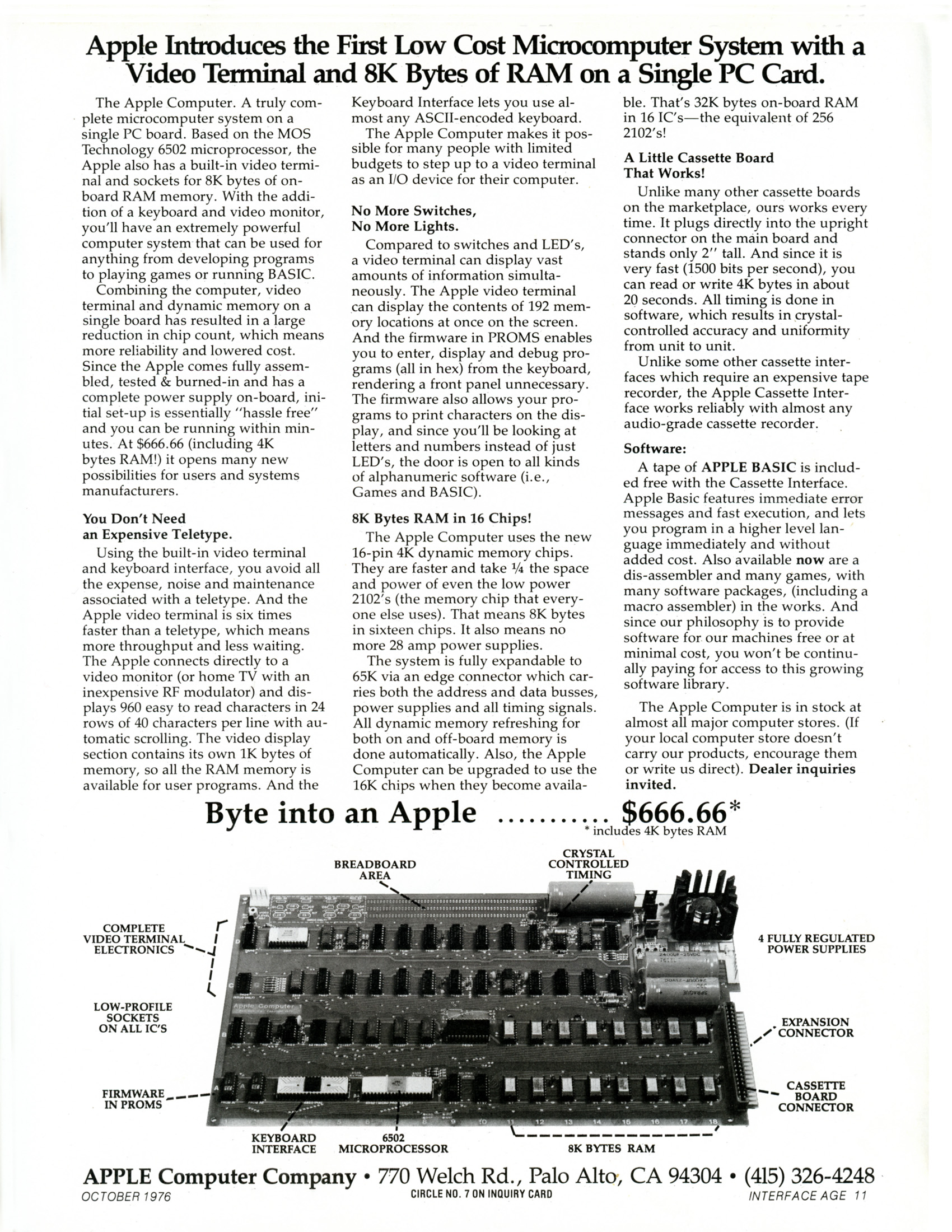
The Apple 1– Updated
28 Apr 2015 Leave a comment
in economic history, technological progress Tags: Apple, creative destruction, innovation, Steve Jobs
In 1976, high school friends Steve Wozniak and Steve Jobs built their first computer — the Apple 1. http://t.co/pl9US5FPBI—
ClassicPics (@History_Pics) April 27, 2015
Apparently, e-cigarettes are safer
27 Apr 2015 Leave a comment
in health economics Tags: creative destruction, economics of smoking, risk wrist trade-offs
Creative destruction in the S&P500 index
23 Apr 2015 Leave a comment
in economics of media and culture, industrial organisation, survivor principle Tags: creative destruction

ICT diffusion has been rapid in the last 15 years
21 Apr 2015 Leave a comment
in technological progress Tags: creative destruction, technology diffusion, The Great Enrichment

I read a Steve Jobs biography 15 years ago when you couldn’t find him on this chart
21 Apr 2015 Leave a comment
in economic history, entrepreneurship, financial economics, industrial organisation, survivor principle Tags: Apple, creative destruction, entrepreneurial alertness, Steve Jobs
People really forget how awesomely powerful IBM was in the 1980s: @evankirstel http://t.co/TkpuU5sAXg—
Marc Andreessen (@pmarca) April 04, 2015
If You’ve Got A Business, You Didn’t Build That
19 Apr 2015 Leave a comment
in entrepreneurship, industrial organisation, Public Choice, rentseeking, survivor principle Tags: creative destruction, entrepreneurial alertness, market selection, top 1%, working rich
The rich are working rich who earn their incomes through entrepreneurial alertness. They move assets from low value uses to higher value uses and profit through capital gains. Entrepreneurial alertness is not a skill that can be taught.
Where the rich make their income: Capital gains, writes @robtfrank urbn.is/1Gx6Eos (h/t @TaxPolicyCenter) http://t.co/LkErbQ25LW—
Urban Institute (@urbaninstitute) April 10, 2015
Creative destruction in the tablet market
19 Apr 2015 Leave a comment
in economic history, entrepreneurship, industrial organisation, survivor principle Tags: creative destruction, market selection, The meaning of competition
Apple is losing the tablet market it created with the iPad read.bi/17zuReH http://t.co/odPeM5iWyX—
BI Tech (@SAI) February 25, 2015
50% more R&D since the 60s, but still no growth dividend?
18 Apr 2015 1 Comment
in applied price theory, economic growth, economics of education, entrepreneurship, history of economic thought, human capital, industrial organisation, macroeconomics, occupational choice, survivor principle Tags: Ben Jones, Chad Jones, creative destruction, endogenous growth theory, innovation, R&D
Spending on intellectual property products has risen in the USA from 1% in 1950 to 5% now. Public R&D spending in the USA has been pretty static for 60 years. Intellectual property products in the chart below includes traditional research and development, spending on computer software, and spending on entertainment such as movies, TV shows, books, and music. Spending on software and entertainment was only recently measured in the US national accounts. This inclusion of intangible capital investments will radically change the story of economic growth and the business cycle in the 20th century.
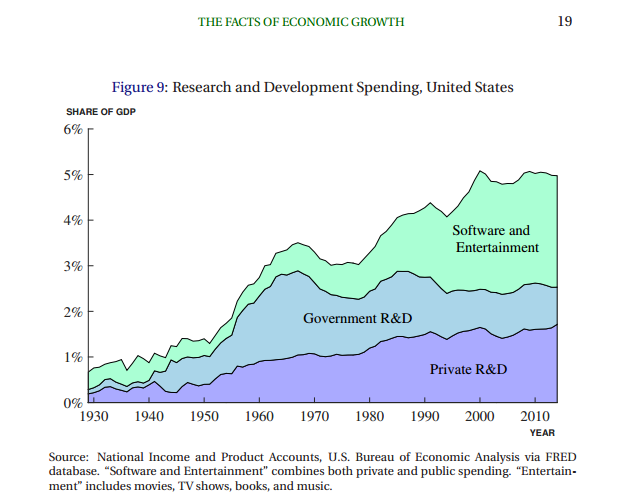
Source: Chad Jones (2015).
The growth rate in the USA hasn’t changed much despite this massive increase in intellectual property property product production. Is innovation getting harder? R&D is supposed to boost the growth rate, if you are to believe politicians bearing subsidies for it wherever they find it.
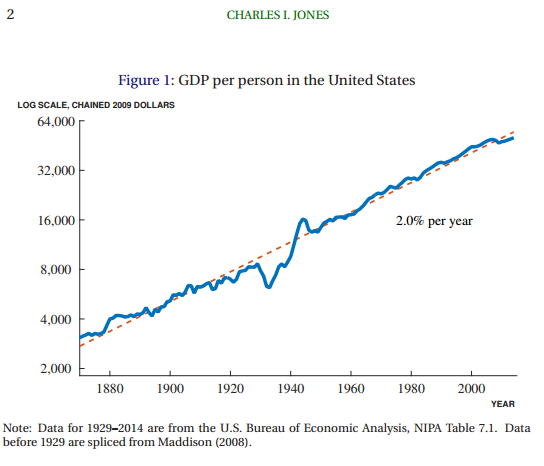
Source: Chad Jones (2015).
Ben Jones in The Burden of Knowledge and the Death of the Renaissance Man: Is Innovation Getting Harder? found that as knowledge accumulates as technology advances, successive generations of innovators may face an increasing educational burden. Innovators can compensate through lengthening their time in education and narrowing expertise, but these responses come at the cost of reducing individual innovative capacities. This has implications for the organization of innovative activity – a greater reliance on teamwork – and has negative implications for economic growth.
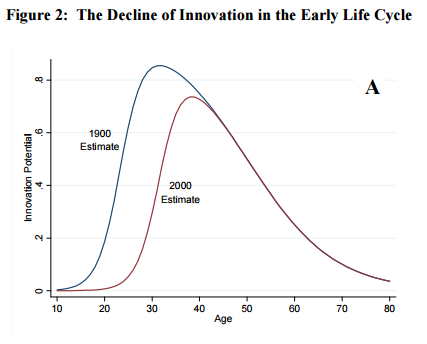
This longer period of education and initial study is not compensated by inventors innovating for longer spans of their lifestyle. This rising burden of knowledge is cutting into their best years of their lives. Jones found a broad and dramatic declines in early life-cycle productivity among great minds and ordinary inventors, and a close relationship of these trends with increased training duration.
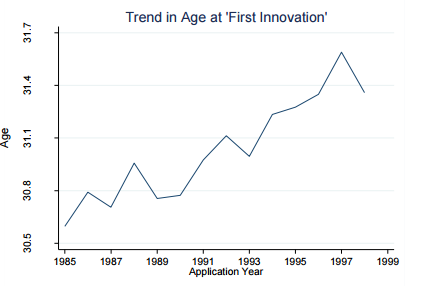
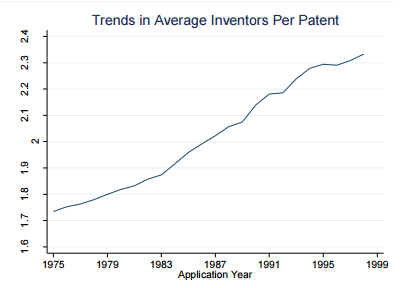
Jones found that the age at first invention, specialisation, and teamwork increased over time in a large micro-data set of inventors. Upward trends in academic collaboration and lengthening doctorates can also be explained in his framework of innovation getting harder because of a rising burden of knowledge. Co-authorship in academic literature has increased, including physics, biology, chemistry, mathematics, psychology, and economics. This measure of teamwork has increased 17% per decade.
Using data on Nobel Prize winners, Jones found that the mean age at which the innovations are produced to win the Prize has increased by 6 years over the 20th Century.
- Before 1901, two-thirds of the Nobel laureates did their prize-winning work before the age of 40 and 20 per cent did it before age of 30.
- By 2000, however, great achievements seldom occurred before the age of 40.
It’s now taking longer for scientists to get their basic training and start their careers. There is simply more to learn because knowledge in all fields has grown by quantum leaps in the past century. Nobels are being handed out for different types of work than a century ago.
- There has been a trend away from awarding prizes for abstract, theoretical ideas.
- Now more honours are being bestowed on people who have made discoveries through painstaking lab work and experimentation – which takes a lot of time to do.
Jones’ theory provides an explanation for why productivity growth rates did not accelerate through the 20th century despite an enormous expansion in collective research effort and levels of education and many more graduates. Innovation is getting harder?
What happened when the robots took all the agricultural jobs?
18 Apr 2015 Leave a comment
in entrepreneurship, industrial organisation, survivor principle Tags: agricultural economics, creative destruction, technological unemployment
around 1910, about a third of all US workers were in agriculture. It's now about 2%. conversableeconomist.blogspot.com/2015/03/snapsh… http://t.co/wUd8tbk0n6—
Catherine Rampell (@crampell) March 09, 2015
 Utopia, you are standing in it!
Recent Comments