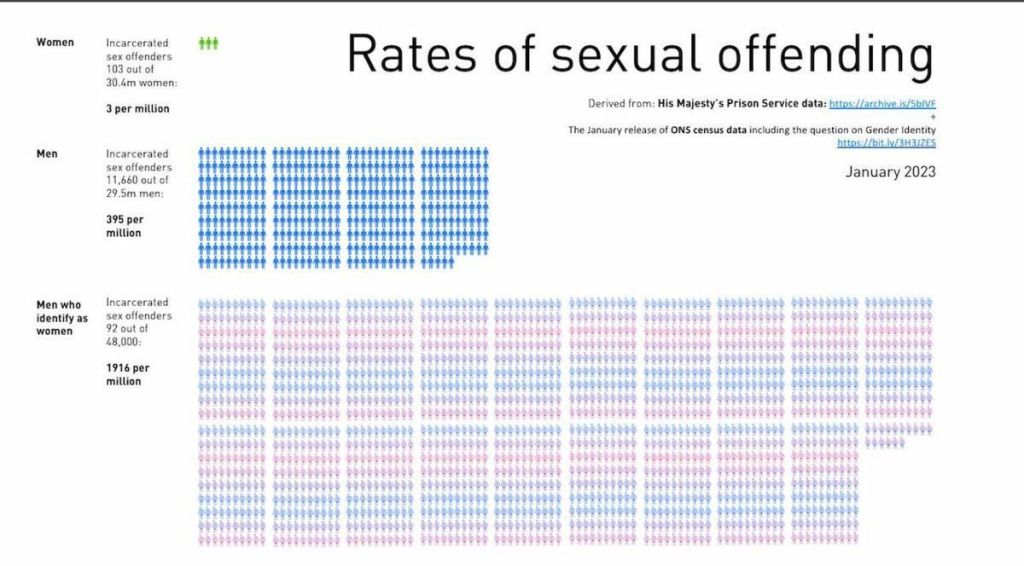
Sex offending rate of women: 3 per one million
— i/o (@eyeslasho) September 5, 2024
Sex offending rate of men: 395 per million
Sex offending rates of transwomen: 1,916 per million pic.twitter.com/VXVmztGZCV
Celebrating humanity's flourishing through the spread of capitalism and the rule of law
06 Sep 2024 Leave a comment
in economics of crime, gender, law and economics Tags: crime and punishment, free speech, law and order, political correctness, regressive left
04 Aug 2024 Leave a comment
in energy economics, environmental economics, environmentalism, global warming, politics - USA Tags: civil disobedience, climate activists, climate alarmism, crime and punishment, law and order
American voters who have bought tote bags decorated with pictures of Mrs Clinton or sweatshirts promoting abortion rights have inadvertently funded disruption in the UK.
Exposing the Financial Web: Clinton-Run Organizations Funding Climate Activists
26 Jul 2024 Leave a comment
in economics of bureaucracy, economics of crime, law and economics, politics - USA, Public Choice Tags: 2024 presidential election, crime and punishment, law and order

No sooner does this blog write about shitty government bureaucrats refusing to do the right thing, and even doubling down on the wrong things, than one of them does the right thing. Cheatle Resigns and for Good Cause. That’s Kimberly Cheatle, head of the United States Secret Service (USSS), finally taking responsibility for her outfit […]
Cheatling Responsibility
24 Jul 2024 Leave a comment
in economics of crime, economics of education, law and economics, politics - USA Tags: 2024 presidential election, crime and punishment, free speech, law and order, political correctness, regressive left

We have been following the controversies surrounding professors commenting on the attempted assassination of former President Donald Trump. Some of those responses have ranged from celebrations to spreading bizarre conspiracy theories. The latest controversy concerns Rutgers University Writing Program Assistant Teaching Professor Tracy Budd, who posted a Facebook message saying ”Let’s hope today’s events inspire […]
“Let’s Hope Today’s Events Inspire Others”: Rutgers Professor Under Fire for Posting on Trump Assassination Attempt
19 Jul 2024 Leave a comment
in economics of crime, energy economics, environmental economics, environmentalism, global warming, law and economics Tags: climate activists, crime and punishment, criminal deterrence, free speech, law and order, regressive left
Five Just Stop Oil protesters, including one of its co-founders, have been jailed for conspiring to organise protests that blocked the M25 motorway.
Roger Hallam Receives Five Year Sentence, other Just Stop Oil Co-Conspirators Receive Four Years
18 Jul 2024 Leave a comment
in economics of crime, law and economics, politics - New Zealand Tags: crime and punishment, criminal deterrence, law and order
The Sensible Sentencing Trust has announced: Before Labour repealed it in 2022, the Three Strikes law operated for 12 years from 2010. In that time, there were: Every one of the 25 Third Strikers was a recidivist serious violent or sexual offender, by definition, having committed at least three “strike” offences. However, the Government’s proposed […]
Sensible Sentencing Trust launches Stop the Three Strikes Sellout website
18 Jul 2024 Leave a comment
in economics of bureaucracy, economics of crime, economics of education, law and economics, politics - New Zealand, Public Choice Tags: crime and punishment, law and order
There is media fuss today around the resistance of schools in terms of excluding students excluded from other schools. The NZ Herald highlights statistics that 100s of schools appear to be reluctant and three remain outright resistant. The article highlights the legal obligation for schools to accept students in their zone. This can be ordered […]
The Genuine Legal Conflict for School Boards
06 Jul 2024 Leave a comment
in economics of crime, law and economics, politics - New Zealand Tags: crime and punishment
The 60 paragraph decision by Judge Jelas is an interesting read. Some extracts:
The Ghahraman judgment
12 Jun 2024 Leave a comment
in applied price theory, economics of crime, law and economics, politics - New Zealand Tags: crime and punishment, criminal deterrence, law and order
The Herald reports: A recidivist offender who shot a small-time Auckland drug dealer while robbing him of his stash and recent gaming machine jackpot had been on electronically monitored post-prison release conditions at the time of the murder – but had cut off his tracking device. That factor of Benjamin “Dekoy” Mcintosh’s murder in June 2022 was highlighted for the […]
Three Strikes might have kept this victim alive
09 Jun 2024 Leave a comment
in applied price theory, econometerics, economics of crime, economics of education, labour economics, law and economics, occupational choice Tags: cognitive psychology, crime and punishment, criminal deterrence, law and order
Gary Becker’s famous model of rational crime suggests that criminals weigh up the costs and benefits of crime (and engage in a criminal act if the benefits outweigh the costs). Time preferences matter in this model, because the benefits of a criminal act are usually realised immediately, whereas the greatest costs (including the penalties of…
More impatient people are more likely to commit crime
03 Jun 2024 Leave a comment
in applied price theory, econometerics, economics of crime, law and economics Tags: crime and punishment, criminal deterrence, law and order
Back in January, I posted about an article that was getting some attention in my world. Megan T. Stevenson is an active researcher in the criminal-justice-and-economics literature. She argues that when you look at the published studies that use randomized control trial methods to evaluate ways of reducing crime, most of the studies don’t show a…
Pushback on Pessimism About Randomized Controlled Trials
31 May 2024 Leave a comment
in economic history, economics of crime, economics of education, income redistribution, labour economics, law and economics, liberalism, Marxist economics, politics - New Zealand, poverty and inequality, property rights, Public Choice, public economics Tags: child abuse, child poverty, crime and punishment, family poverty, law and order

Article is by Chris Lynch and I have pinched this one from The BFD Blog. `ĀCT MP Karen Chhour has responded to the Maori Party’s “divisive outbursts.” Co-leader Rawiri Waititi said yesterday, ‘It’s now time for us to step comfortably into our rangatiratanga and to not give too much to this Pakeha Government with their […]
Karen Chhour Skewers The Maori Party
11 May 2024 Leave a comment
in economics of crime, law and economics, politics - New Zealand Tags: crime and punishment, criminal deterrence, law and order
1st strikers 2nd strikers This data comes from someone who has OIAd this data. The Government’s proposed new law will see 55% of violent or sexual offenders not get a first strike and 31% of what would have been second strikers not get a second strike. Arguably it could even see 75% of first strikers and 53% […]
Some three strikes data
05 May 2024 Leave a comment
in economics of crime, law and economics, politics - New Zealand Tags: child abuse, crime and punishment, law and order
The Children’s Minister, Karen Chhour, intends to repeal Section 7AA from the Oranga Tamariki Act 1989 because it creates conflict between claimed Crown Treaty obligations and the child’s best interests. In her words, “Oranga Tamariki’s governing principles and its act should be colour blind, utterly child centric and open to whatever solution will ensure a child’s…
Meanwhile “… the disturbing trend of increasing violence towards children continues to worsen.”
26 Apr 2024 Leave a comment
in discrimination, economics of bureaucracy, economics of crime, law and economics, politics - New Zealand, Public Choice Tags: crime and punishment, law and order

One of reasons Oranga Tamariki exists is to prevent child neglect. But could the organisation itself be guilty of the same? Oranga Tamariki’s statistics show a decrease in the number and age of children in care. “There are less children in care now than as at 30 June 2019 when there were 6450 children and…
LINDSAY MITCHELL: Is Oranga Tamariki guilty of neglect?
Celebrating humanity's flourishing through the spread of capitalism and the rule of law
Scholarly commentary on law, economics, and more
Beatrice Cherrier's blog
Celebrating humanity's flourishing through the spread of capitalism and the rule of law
Celebrating humanity's flourishing through the spread of capitalism and the rule of law
Celebrating humanity's flourishing through the spread of capitalism and the rule of law
Why Evolution is True is a blog written by Jerry Coyne, centered on evolution and biology but also dealing with diverse topics like politics, culture, and cats.
Celebrating humanity's flourishing through the spread of capitalism and the rule of law
Celebrating humanity's flourishing through the spread of capitalism and the rule of law
A rural perspective with a blue tint by Ele Ludemann
DPF's Kiwiblog - Fomenting Happy Mischief since 2003
Celebrating humanity's flourishing through the spread of capitalism and the rule of law
The world's most viewed site on global warming and climate change
Tim Harding's writings on rationality, informal logic and skepticism
A window into Doc Freiberger's library
Let's examine hard decisions!
Commentary on monetary policy in the spirit of R. G. Hawtrey
Thoughts on public policy and the media
Celebrating humanity's flourishing through the spread of capitalism and the rule of law
Politics and the economy
A blog (primarily) on Canadian and Commonwealth political history and institutions
Reading between the lines, and underneath the hype.
Economics, and such stuff as dreams are made on
"The British constitution has always been puzzling, and always will be." --Queen Elizabeth II
Celebrating humanity's flourishing through the spread of capitalism and the rule of law
Celebrating humanity's flourishing through the spread of capitalism and the rule of law
WORLD WAR II, MUSIC, HISTORY, HOLOCAUST
Undisciplined scholar, recovering academic
Celebrating humanity's flourishing through the spread of capitalism and the rule of law
Res ipsa loquitur - The thing itself speaks
Celebrating humanity's flourishing through the spread of capitalism and the rule of law
Researching the House of Commons, 1832-1868
Articles and research from the History of Parliament Trust
Reflections on books and art
Posts on the History of Law, Crime, and Justice
Celebrating humanity's flourishing through the spread of capitalism and the rule of law
Exploring the Monarchs of Europe
Cutting edge science you can dice with
Small Steps Toward A Much Better World
“We do not believe any group of men adequate enough or wise enough to operate without scrutiny or without criticism. We know that the only way to avoid error is to detect it, that the only way to detect it is to be free to inquire. We know that in secrecy error undetected will flourish and subvert”. - J Robert Oppenheimer.
The truth about the great wind power fraud - we're not here to debate the wind industry, we're here to destroy it.
Celebrating humanity's flourishing through the spread of capitalism and the rule of law
Celebrating humanity's flourishing through the spread of capitalism and the rule of law
Economics, public policy, monetary policy, financial regulation, with a New Zealand perspective
Celebrating humanity's flourishing through the spread of capitalism and the rule of law
Restraining Government in America and Around the World
 Utopia, you are standing in it!
Recent Comments