Fair summary
14 Feb 2019 Leave a comment
in discrimination, labour economics Tags: customer discrimination, employer discrimination, racial discrimination, sex discrimination
Is this the solution to implicit bias?
13 Mar 2018 Leave a comment
in discrimination, gender, labour economics, managerial economics, organisational economics, personnel economics Tags: customer discrimination, employee discrimination, employer discrimination, sex discrimination

Sociologist documents what Gary Becker knew in 1957
12 May 2017 Leave a comment
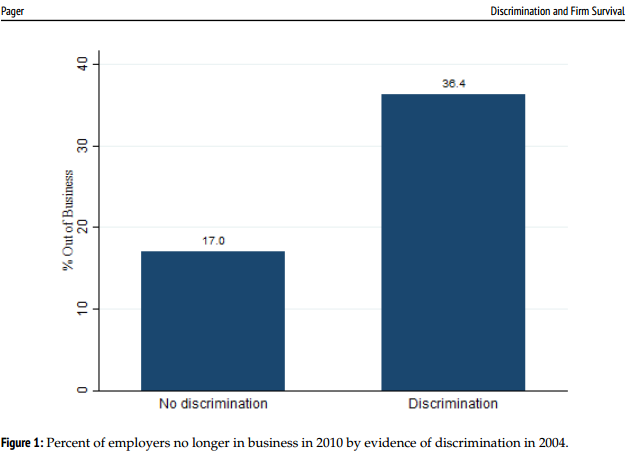
Source: Pager, Devah. 2016. “Are Firms that Discriminate More Likely to Go Out of Business?” Sociological Science (September):849-859. PDF
Unconscious mind studies should not have survived peer-review
21 Mar 2017 Leave a comment
in discrimination, labour economics Tags: co-worker discrimination, customer discrimination, employer discrimination, moral psychology, political psychology, social psychology

Voltaire on the 1734 London Stock Exchange:
31 Oct 2016 Leave a comment
in discrimination, economic history, entrepreneurship, financial economics, labour economics Tags: customer discrimination, market process, The meaning of competition

Is women’s soccer unusually profitable?
01 Apr 2016 Leave a comment
in discrimination, gender, labour economics, sports economics Tags: customer discrimination, employer discrimination, gender wage gap, television ratings, women's sports
If women soccer players are discriminated against, their employers must be making a lot of extra profits of their toil. If women soccer players are paid less than their marginal revenue product, the organisers of their tournaments and those that broadcasted them must be doing very well indeed.
The reality is pay in sports these days is determined by revenue from television rights. Players can top that up with sponsorship deals.
Do television commercials for men’s and women’s soccer tournaments sell for the same price? If so, do women receive a smaller percentage of that revenue stream? That is a good test of the hypothesis that they are discriminated against.
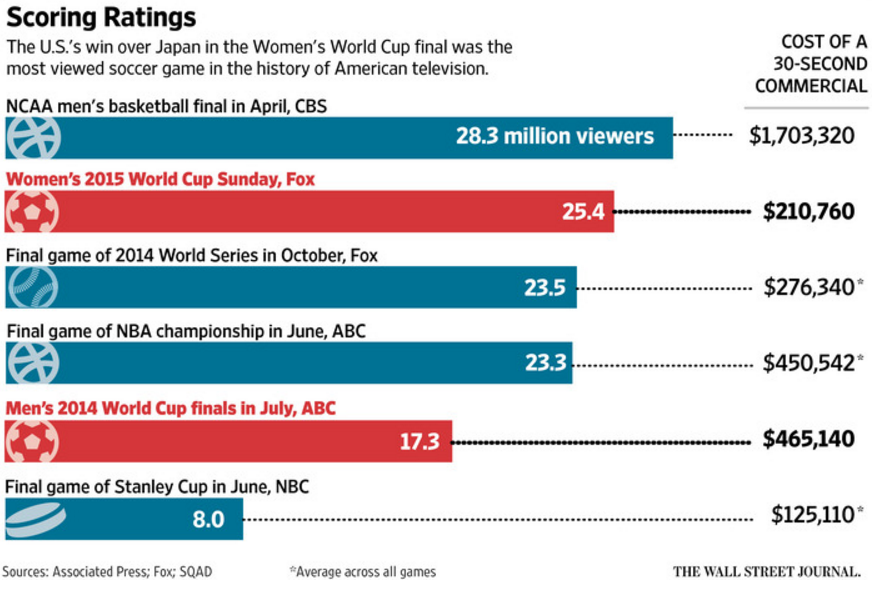
Despite the novelty of the US getting into the women’s World Cup, a 30 second commercial was sold for much much less. There may have been a ratings bonanza, but there was no accompanying revenue bonanza that could feed through to the pay of players from more generous television rights for future tournaments.
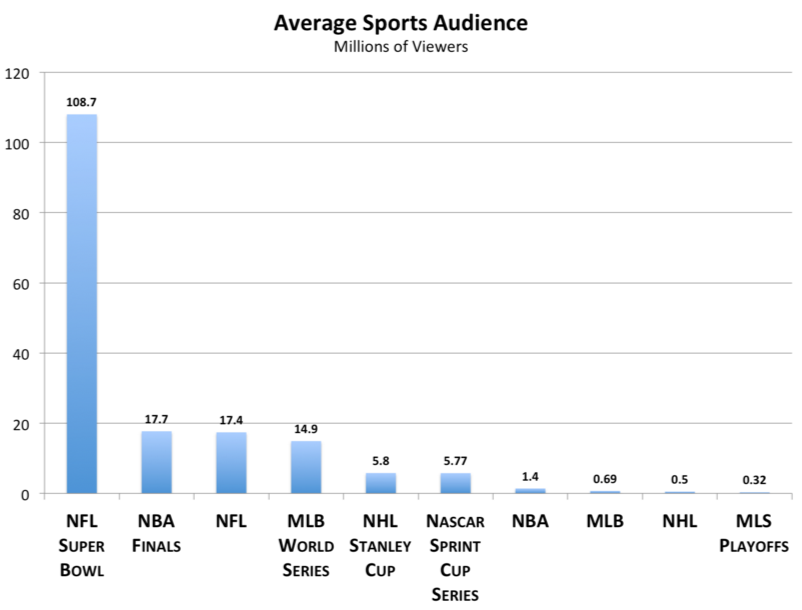
Women’s soccer is paid less because of the viewing preferences of audiences. Any sport that attracts high ratings will attract generous television rights. The money feeds through to the players.

This is a classic case of customer discrimination. Markets are very good at implementing customer discrimination, in this case giving viewers the sports they want to see.
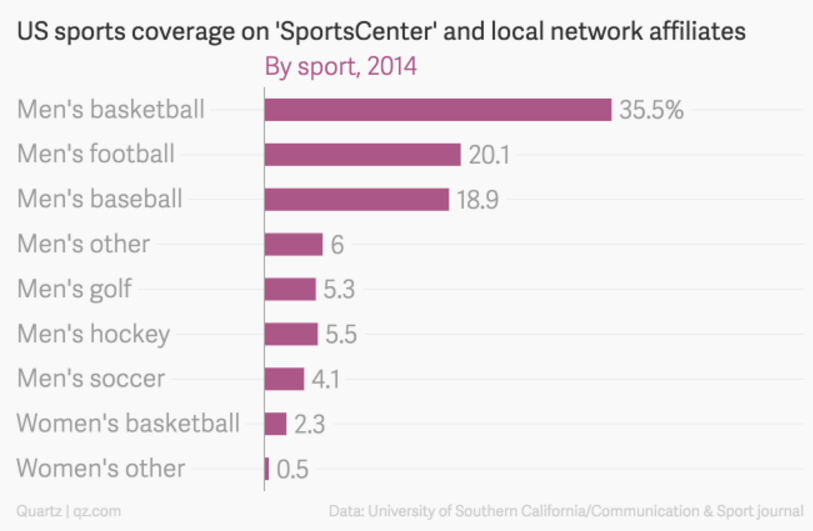
A classic early example of that was the introduction of foreign and minority players. Part of sport is that could be me out there kicking the goal. In consequence, viewers had a lot of trouble identifying with people who are not like them. Mankiw explains:
Studies of sports teams suggest that racial discrimination is, in fact, common and that much of the blame lies with customers.
One study, published in the Journal of Labor Economics in 1988, examined the salaries of basketball players. It found that black players earned 20 percent less than white players of comparable ability. The study also found that attendance at basketball games was larger for teams with a greater proportion of white players.
One interpretation of these facts is that, at least at the time of the study, customer discrimination made black players less profitable than white players for team owners. In the presence of such customer discrimination, a discriminatory wage gap can persist, even if team owners care only about profit.
That barrier was quickly overcome when viewers discovered that these foreign players and minorities players were very good and helped the team win more. The preference for their team winning overcame the preference for the team winning with people who look like them.
The current successive US women’s soccer should not be overrated in terms of its implications for higher pay. The Women’s United Soccer Association (WUSA) was formed in 2000 after success in the 1999 FIFA Women’s World Cup. It lasted just three seasons before folding with losses of $100 million.
Women’s soccer in the USA did have one year broadcast deals with Fox sport and ESPN in 2014 and 2013. Although no TV deal is set for the 2015 season, the NWSL recently announced that all games will be broadcast on YouTube Live for free.
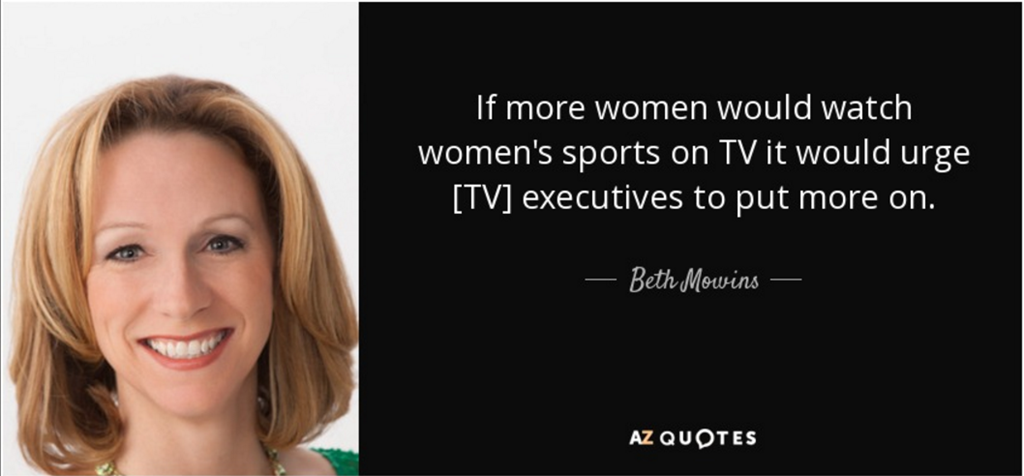
The women’s sports that are best paid without exception are the women’s sports with the most valuable television rights. Closing the gap between men’s and women’s sport is exclusively in the hands of viewer.
The sponsors of women’s sports are not hiding bags of money out the back which they could have paid for women out of secret television deals worth as the same as for men’s sports.
Screen actor demographics
07 Feb 2016 Leave a comment
in discrimination, gender, labour economics Tags: customer discrimination, employer discrimination, Hollywood economics, racial discrimination, sex discrimination
A long-standing anomaly about racial discrimination in the labour market
19 Apr 2015 Leave a comment
in discrimination, human capital, labour economics, labour supply, occupational choice Tags: co-worker discrimination, customer discrimination, employer discrimination, labour market discrimination, racial discrimination
CHART: Asians Make 15% More Than Whites, Is That Because of 'Asian Privilege' or Discrimination Against Whites? http://t.co/9YnkDDrcbO—
Mark J. Perry (@Mark_J_Perry) March 19, 2015
The Workplace Is Even More Sexist In Movies Than In Reality | FiveThirtyEight
12 Mar 2015 Leave a comment

The Bechdel Test: whether women are in a movie as fully human characters, or as plot devices for the male characters
27 Jan 2015 Leave a comment
in discrimination, economics of media and culture, gender, industrial organisation, movies, occupational choice, survivor principle Tags: co-worker discrimination, consumer sovereignty, customer discrimination, employer discrimination, Hollywood economics, sex discrimination, The meaning of competition
/cdn0.vox-cdn.com/uploads/chorus_asset/file/3332436/hickey-bechdel-11.0.png)
Hollywood is a slave to the box office on the most cutthroat industry there is. Film producers and screenwriters will portray men and women in whatever roles and whatever extent sells tickets.
How women are represented in the movies is determined solely by the preferences of the audiences willing to buy tickets. It’s a buyers market out there. Film producers would do whatever it takes to finance films that sell tickets, as even Five Thirty-Eight realised:
“Movies that are female-driven do not travel,” said Krista Smith, West Coast editor of Vanity Fair, describing the broader sentiment in Hollywood. There are almost no women who have sales value in multiple international territories, maybe with the exception of Sandra Bullock, she said.
Times change, and film producers change with the times. Consumers are both sovereign and change their minds, and in the case of movie audiences, constantly demand novelty and surprises, as even Five Thirty-Eight picked up on:
Hollywood is the business of making money. Since our data demonstrates that films containing meaningful interactions between women do better at the box office than movies that don’t, it may be only a matter of time before the data of dollars and cents overcomes the rumours and prejudices defining the budgeting process of films for, by and about women.
This moral panic over gender wage gaps between millionaire actresses and actresses dare not say that for want of offending the audience that is actually the main driver of any gender gap in movies.

Hollywood activists complaining about the gender wage are to business minded to dare insult the audiences that pay their wages.

 Utopia, you are standing in it!
Recent Comments