Here's where Republicans and Democrats differ on the role of government https://t.co/QPt9xhgFeF pic.twitter.com/zD3mF64wuM
— Pew Research Center (@pewresearch) January 31, 2016
Here’s where Republicans and Democrats differ on the role of government
08 Feb 2016 Leave a comment
in defence economics, economics of bureaucracy, economics of education, economics of information, economics of media and culture, economics of regulation, energy economics, entrepreneurship, environmental economics, income redistribution, politics - USA, Public Choice, rentseeking Tags: 2016 presidential election Republican Party, Democratic Party, votor demographics
Republicans and Democrats have different priorities which is why they are Republican or Democrat primary voters
02 Feb 2016 Leave a comment
in politics - USA, population economics, Public Choice Tags: 2016 presidential election, Democratic Party, rational irrationality, Republican Party, votor demographics
Political realignments in America in the 20th century
18 Nov 2015 Leave a comment
in economic history, politics - USA Tags: Democratic Party, fifth party system, fourth party system, political polarisation, political realignments, Republican Party, third-party system
How liberal are the Democratic candidates?
17 Nov 2015 Leave a comment
in politics - USA Tags: 2016 presidential election, Democratic Party, Leftover Left, Twitter left
Has Obama ‘elected more Republicans than any human being in history’?
08 Nov 2015 Leave a comment
in politics - USA Tags: 2016 presidential election, congressional elections, Democratic Party, Republican Party
Has the Democratic Party lost the white working class
29 Sep 2015 Leave a comment
in economic history, income redistribution, politics - USA, Public Choice, rentseeking Tags: American politics, Democratic Party, rational ignorance, rational rationality, suppressive voting, Withering away of the proletariat
Again, the decline in white working class support for Democrats is vastly overstated. I bid you a good night. http://t.co/bUNpME5o3B—
The Monkey Cage (@monkeycageblog) September 13, 2015
Presidential election turnout by race
09 Sep 2015 Leave a comment
in constitutional political economy, politics - USA, Public Choice, rentseeking Tags: 2016 presidential election, civil rights, Democratic Party, racial discrimination, southern States, voting rights

Do violent protests win votes for your cause?
12 May 2015 Leave a comment
in constitutional political economy, economic history, economics of crime, law and economics, politics - Australia, politics - New Zealand, politics - USA, Public Choice Tags: 1960s, activists, civil disobedience, Democratic Party, George Wallace, nonviolent protest, Richard Nixon, riots, Vietnam war, violent protests
Monkey Cage blogged on a very timely study on the impact of violent and nonviolent protests on voting behaviour. Non-violent protest in the 60s enticed sympathy and increased voter support for the Democratic Party in the 1964, 1968 to 1972 presidential elections:
Black-led nonviolent protests… exhibit a statistically significant positive relationship with county-level Democratic vote-share in the same period.
This is not surprising because nonviolent protest acknowledge fidelity to law and democratic equality. No one likes to be bullied and one of the purposes of the secret ballot is to prevent voters from being bullied because no one knows how you voted.
Indeed, there is a long history of anonymous pamphleteering, which has evolved into anonymous trolling as a way of people expressing their political views without facing backlash from both the majority and a vindictive minority.
In a democracy, it’s up to me to persuade you to change your mind – that what you took for granted for so long is not so. That’s how liberal democracies work: by trying to persuade each other and voting.
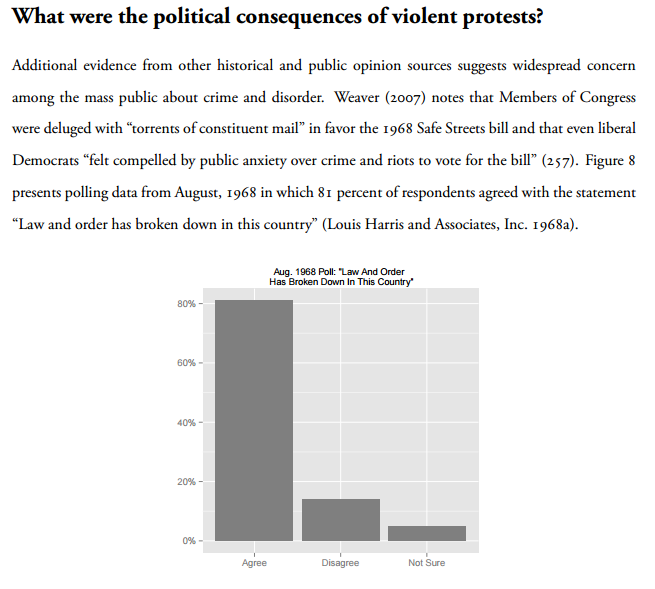
Violent protests had the exact opposite effect to peaceful protests on Democratic Party voting shares in the 1964, 1968 in 1972 presidential elections. There was a law and order backlash among voters against what were relatively widespread rioting and civil disorder:
…black-led protests in which some violence occurs are associated with a statistically significant decline in Democratic vote-share in the 1964, 1968 and 1972 presidential elections.
This is a roundabout way of saying that a Republican won the 1968 election on a law and order platform, not a Democrat on a peace platform. The country was convinced, including Liberal Democrats, that law and order had broken down and that the Democratic Party could not restore law and order.
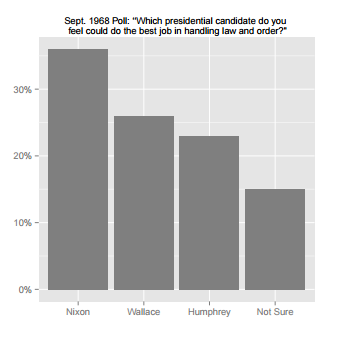
In the 1968 presidential election, there is a third party candidate, George Wallace, who won won almost ten million popular votes and 46 electoral votes, including in the electoral college on an even harsher law and order platform than Nixon.
Wallace was a racist Southern Democrat the Democratic Party would prefer us to forget and a nasty political opportunist to boot. His political rhetoric included the only words four letter words the protesters didn’t know was work and soap.
As I recall warmed over Marxism, the idea of violent protests is to provoke a law and order backlash, initially with popular support of the working class. The resulting police repression will overreach and cause the proletariat to breakthrough their false consciousness to see that capitalists for whom they are and rise up to overthrow them.

Rise up ye workers, rise up for you have nothing to lose but your chains. These days that call to the barricades would have to be rise up ye workers, rise up for you have nothing to lose what your smart phone and air points.
 Utopia, you are standing in it!
Recent Comments