From 1950, Japan doubled their standard of living every 8 years
02 Feb 2016 Leave a comment
in development economics, economic history, growth miracles Tags: East Asian Tigers, Japan
He who is first is now last: real GDP per capita of the East Asian Tigers since 1950
05 Nov 2015 1 Comment
in development economics, economic history, growth miracles Tags: East Asian Tigers, Hong Kong, Japan, Singapore, South Korea, Taiwan
Japan has gone first to be last having been just overtaken in the last year or two by South Korea on a per capita real GDP basis, PPP. The Lost Decade certainly has taken its toll on Japanese relative prosperity. Singapore overtook Japan in the 1970s – a testament to the Singapore miracle. Hong Kong too overtook Japan on a purchasing power basis in the mid-1990s followed not long after by Taiwan. Singapore is seriously rich.
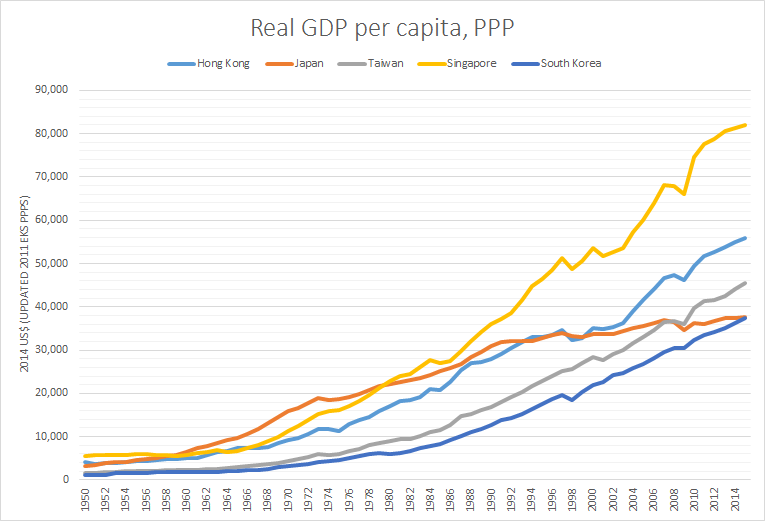
Source: The Conference Board. 2015. The Conference Board Total Economy Database™, May 2015, http://www.conference-board.org/data/economydatabase/
Capitalism and Pope Francis
22 Jul 2015 1 Comment
in development economics, economic history, economics of religion, growth disasters, growth miracles Tags: capitalism and freedom, East Asian Tigers, Latin American popularism, Pope Francis, The Great Escape, The Great Fact
https://twitter.com/Mark_J_Perry/status/620591953290375169/photo/1
Pope's plan to curtail use of fossil fuels will hurt the poor, see chart and @FurchtgottRoth tinyurl.com/oy5w5o3 http://t.co/YWEloL04MK—
Mark J. Perry (@Mark_J_Perry) June 21, 2015
Latin American populism versus the East Asian Tigers
17 Jul 2015 Leave a comment
in comparative institutional analysis, constitutional political economy, development economics, economics of bureaucracy, growth disasters, growth miracles, income redistribution, Public Choice, rentseeking Tags: East Asian Tigers, Latin American populism
Growth paths of #LatAm & the Caribbean the South East Tigers: wrld.bg/NCtLt #RiseoftheSouth http://t.co/IFuUOWldox—
World Bank Pubs (@WBPubs) May 31, 2015
On independence, Jamaica was rated a better prospect for economic development than Singapore!
24 Jun 2014 Leave a comment
in development economics, growth disasters, growth miracles Tags: East Asian Tigers, Jamaica, Singapore

Upon Singapore’s independence in 1965—three years after Jamaica’s own establishment as a nation—the two nations were about equal in wealth: the gross domestic product (in 2006 U.S. dollars) was $2,850 per person in Jamaica, slightly higher than Singapore’s $2,650.
Both nations had a centrally located port, a tradition of British colonial rule, and governments with a strong capitalist orientation. (Jamaica, in addition, had plentiful natural resources and a robust tourist industry.)
But four decades later, their standing was dramatically different: Singapore had climbed to a per capita GDP of $31,400 (2006 data, in current dollars), while Jamaica’s figure was only $4,800.
Both countries were ruled by political parties that were members of Socialist International.
Both countries had a Prime Minister who held office for a long time in the period after independence. Both countries had a father and son follow each other in short order as Prime Minister.
Bill Easterly at the Asian Development Bank
20 Jun 2014 Leave a comment
in Bill Easterly, development economics, growth miracles Tags: Bill Easterly, East Asian Tigers

— United Nations Conference on Trade and Development, a body that has long distinguished itself by promoting all the bad ideas that stifle both trade and development.
— But any Asian leader who hasn’t already figured out that trade should be mainstream after Asia’s world-historical trade explosion is past the point of rescue anyway.
— Successful trade booms (and the accompanying infrastructure demand) come about through letting free market entrepreneurs run wild to find things foreigners want rather than consulting ADB bureaucrats on designing a “national development strategy.”
— All of which goes to show that the ADB’s fundamental problem is that it needs advice from successful Asian countries more than they need advice from it.
The World Bank wrote South Korea off in the 1960s
20 Jun 2014 3 Comments
in development economics, growth miracles Tags: East Asian Tigers, South Korea
The World Bank (2002) mentions South Korea and Botswana as long term success stories. The first World Bank mission to Korea in the early 1960s described Korea’s development program as ludicrously optimistic:
There can be no doubt that this development program GDP growth of 7.1 per cent exceeds the potential of the Korean economy. . .
It is inconceivable that exports will rise as much as projected.
Korean economic growth turned out to be 7.3 per cent in the forecasted period. In 1960, South Korea was one of the poorest countries in the world, with an income per head on a par with the poorest parts of Africa.
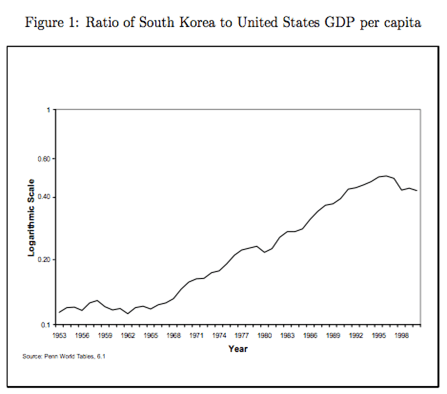
Unfortunately, a study for the World Bank’s Operations Evaluation Department found that Korea’s growth accelerated only after the decline in US aid, and did so by following policies contrary to the advice of US aid officials; hence, the consensus of most studies of Korea is that aid contributed little to Korea’s take-off (Fox 2000).
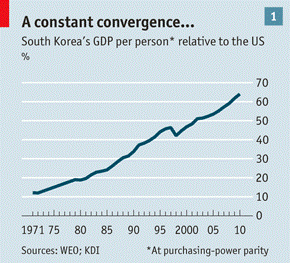
Chenery and Strout forecast in the early 1960s that growth in India and Pakistan over 1962-76 would exceed that of Korea. Rosenstein-Rodan at the same time predicted that Sri Lanka would have a higher per capita income than Taiwan or Korea by 1976. Hong Kong and Singapore, according to the same predictions, were to be left in the dust by Argentina and Colombia.
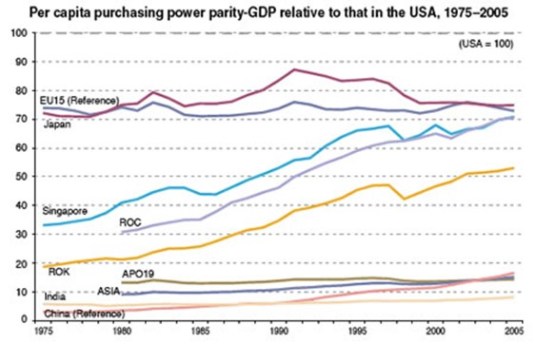
A key feature of this development miracle was an enormous increase in Korea’s international trade. In the early 1960s, Korea eliminated tariffs on imported production inputs and capital goods as long as these imports were used to produce goods for export. Beginning in the 1970s, Korea engaged in a broader, gradual reduction of tariff from about 40 per cent to 13 per cent.
Gordon Tullock is an interesting writer on South Korea saying that:
• Syngman Rhee was a socialist who knew nothing of capitalism.
• To make his country look capitalist to please the Americans, Rhee gave previously Japanese owned industries to his friends as monopolies.
• When General Park overthrew Syngman Rhee, he knew no economics, but he knew the bureaucracy was filled with Rhee’s cronies so he fired them all.
Tullock considers that South Korea became an open economy as a by-product of this political purge.
 Utopia, you are standing in it!
Recent Comments