In most public health campaigns, “zero” doesn’t mean zero. But to eradicate Ebola in a big city; “zero” means “zero”
20 Jul 2016 Leave a comment
in defence economics, economics, growth disasters, health economics Tags: Ebola
How Ebola compares to other infectious diseases
22 Dec 2015 Leave a comment
in health economics Tags: Ebola, infectious diseases
How infectious and deadly are the infectious diseases?
20 Jun 2015 Leave a comment
in health economics Tags: AIDS, Ebola, HIV, infectious diseases, measles
Visualised: how Ebola compares to other infectious diseases bit.ly/1sH3dDR http://t.co/vNadhO5NB6—
Guardian Data (@GuardianData) October 15, 2014
How Ebola compares to other infectious diseases
13 Apr 2015 Leave a comment
in health economics Tags: Ebola
Visualised: how Ebola compares to other infectious diseases bit.ly/1sH3dDR http://t.co/vNadhO5NB6—
Guardian Data (@GuardianData) October 15, 2014
Homeopaths offer services ‘to help fight’ Ebola epidemic in west Africa | The Guardian
31 Oct 2014 Leave a comment
in health economics, politics - New Zealand Tags: Ebola, Quacks
On their website, Van der Zee now urges supporters of homeopathy to sign the Change.org petition started in Australia, calling on WHO “to test and distribute homeopathy as quickly as possible to contain the outbreaks”.
Among the signatories is Steffan Browning, a Green Party MP in New Zealand.
He was publicly dismissed by the prime minister John Key as “barking mad”.
“Let’s be honest, this is a serious global issue, and if he really thinks that’s the answer I’d love to see the medical research,” said Key.
Browning admitted “it was probably a bit unwise” to sign the petition, which he also shared on his Facebook page encouraging other people to sign it. He said he had signed it “pretty late at night”, although he hoped WHO would keep an open mind on potential treatment options, since there was currently no cure.
New Zealand’s health minister, Jonathan Coleman, however, said treating Ebola patients with homeopathic remedies was “a wacko idea”, adding: “I don’t know what he’s thinking, it’s very, very dangerous. I think he really needs to engage his brain, it’s a really and stupid dangerous idea.”
via Homeopaths offer services ‘to help fight’ Ebola epidemic in west Africa | World news | The Guardian.
Ebola protocols in action – The clipboard man
16 Oct 2014 Leave a comment
in health economics, politics - USA Tags: Ebola


Ebola Infection rate as compared to other diseases
07 Oct 2014 Leave a comment
in health economics Tags: Ebola


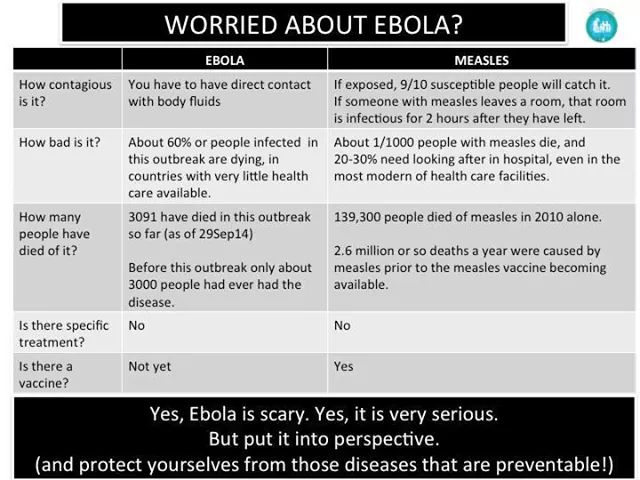


Concerned about Ebola? You’re worrying about the wrong disease
07 Aug 2014 Leave a comment
in health economics Tags: Ebola
Since the Ebola outbreak began in February, around 300,000 people have died from malaria, while tuberculosis has likely claimed over 600,000 lives.
Ebola might have our attention, but it’s not even close to being the biggest problem in Africa right now.
Even Lassa fever, which shares many of the terrifying symptoms of Ebola (including bleeding from the eyelids), kills many more than Ebola – and frequently finds its way to the US.
Ebola and you
01 Aug 2014 Leave a comment
in development economics, growth disasters, health economics Tags: Ebola, media panic, The Great Escape
How do people become infected with the virus?
Ebola is transmitted through close contact with the blood, secretions, organs or other bodily fluids of infected animals. In Africa infection in humans has happened as a result of contact with chimpanzees, gorillas, fruit bats, monkeys, forest antelope and porcupines found ill or dead in the rainforest.

The Ebola virus is fatal in 90 per cent of cases and there is no vaccine and no known cure.
Who is most at risk?
Those at risk during an outbreak include:
- health workers
- family members or others in close contact with infected people
- mourners with direct contact with the bodies of deceased victims
- hunters in contact with dead animals
What are the typical signs and symptoms?
Sudden onset of fever, intense weakness, muscle pain, headache and sore throat. That is followed by vomiting, diarrhoea, rash, impaired kidney and liver function and internal and external bleeding.
The incubation period is between two and 21 days.
A person will become contagious once they start to show symptoms. Once a person becomes infected, the virus can spread through contact with a sufferer’s blood, urine, saliva, stools and semen.
When should you seek medical care?
If a person is in an area affected by the outbreak, or has been in contact with a person known or suspected to have Ebola, they should seek medical help immediately.
What is the treatment?
Severely ill patients require intensive supportive care. They need intravenous fluids to rehydrate them. There is currently no specific treatment for the disease. Some patients will recover with the appropriate care.
Can Ebola be prevented?
Currently there is no licensed vaccine for Ebola. Several are being tested but are not available for clinical use.
Source: World Health Organisation via dailymail
Ebola is not a major public health risk in a developed country
30 Jul 2014 Leave a comment
in health economics Tags: Ebola
- People need to be in intimate contact to spread the virus.
- Ebola is much harder to spread than respiratory infections, such as influenza or measles.
- Ebola also can only be spread by people with active symptoms.

People in developed countries seek treatment when they feel ill and submit to quarantine if diagnosed with a contagious disease.
HT: reason.com
 Utopia, you are standing in it!
Recent Comments