
New Zealand does go on about how remote it is
13 Jun 2015 Leave a comment
in development economics, population economics Tags: economic geography, geography, lost decades, maps
If the world’s population had to live in one city
06 Jun 2015 Leave a comment
in population economics, urban economics Tags: economic geography, maps, population bomb
The world's population, concentrated http://t.co/Eq5jq1xn3x—
Amazing Maps (@Amazing_Maps) April 06, 2015
Is Canada diverging from Australia in labour productivity to become like New Zealand?
31 May 2015 1 Comment
in economic growth, economic history, macroeconomics, politics - Australia, politics - New Zealand Tags: Australia, Canada, economic geography, endogenous growth theory, lost decades
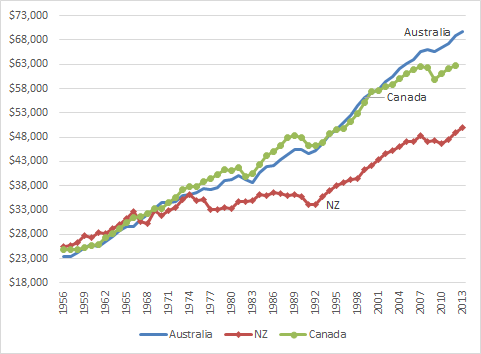
Figure 1 shows that Canada has been diverging from Australia in real GDP per working age person since the mid-1990s particularly since the global financial crisis.
Figure 1: Real GDP per New Zealander, Canadian and Australian aged 15-64, converted to 2013 price level with updated 2005 EKS purchasing power parities, 1956-2013
Source: Computed from OECD StatExtract and The Conference Board, Total Database, January 2014, http://www.conference-board.org/economics
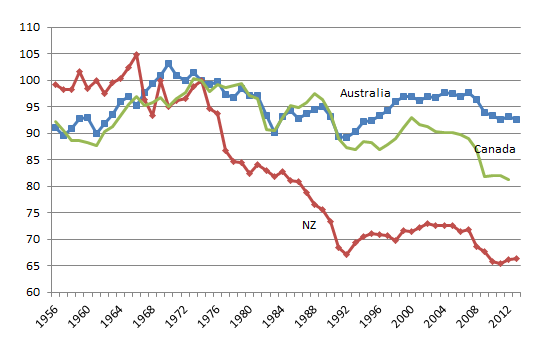
In common with New Zealand, Figure 2 shows that Canadian productivity has been in a pretty much along declines is about 1974, rarely catching up with any lost ground. Figure 1 shows that Canada used to be richer than Australia but is now poorer than Australia. Figure 2 is real GDP growth data detrended by the growth rate of the USA in the 20th century. A flat line in figure 2 is annual real GDP growth at 1.9%; a rising line is growth above 1.9%; a falling line is annual growth below 1.9% a year.
Figure 2: Real GDP per New Zealander, Canadian and Australian aged 15-64, converted to 2013 price level with updated 2005 EKS purchasing power parities, 1.9 per cent detrended, 1956-2013
Source: Computed from OECD StatExtract and The Conference Board, Total Database, January 2014, http://www.conference-board.org/economics
Figure 2 shows that Canadian productivity has been below trend for perhaps 30 years. There has been the occasional recovery but followed by a further decline. If Canadian labour productivity had grown at the same rate as the USA since 1974, labour productivity in Canada is something like 18% better.
Australia, as shown in figure 2, has neither caught up nor falling behind the USA in labour productivity for the entire post-war period since 1956. Canada has been falling behind its neighbour most markedly since the mid-1970s.
- Canada fell 10 percentage points further behind the USA in relative labour productivity between the mid-1970s and the mid-1990s.
- Canada stopped falling further behind the USA after 1995 to 2005 but, in common with New Zealand, Canadian labour productivity did not rebound to recover the prior lost ground.
The proximate causes of the Canadian productivity gap with the USA have a familiar echo to New Zealand ears. Relative to the USA, Rao et al. (2006) and Sharp (2003) attributed the gap to less capital per worker, an innovation gap as shown by lower R&D expenditure, a smaller and less dynamic high technology sector, less developed human capital at the top end of the labour market, and more limited scale and scope economies.
These factors have been put forward, at one time or another, as the proximate causes of the New Zealand productivity gap with the USA. Identifying the barriers to higher Canadian productivity may offer fresh insights into removing similar productivity barriers in New Zealand.
Canada, New Zealand and Australia should be catching-up with the USA in productivity per capita because copying the global leader is cheaper than innovation. Canada, New Zealand and Australia all have the basics to do this: a market economy, the rule of law and openness to foreign technology and international trade.
Instead of asking why New Zealand is not catching-up with Australian productivity, further study of the lack of productivity catch-up of Australia and Canada with the USA may uncover subtle barriers to productivity growth with similarities in New Zealand.
The productivity decline in Canada is of interest in New Zealand because Canada certainly cannot blame remoteness because it borders the USA. Canada cannot blame lack of size because it is noticeably larger than Australia and certainly New Zealand.
Time zones of the world
30 May 2015 Leave a comment
in economics of media and culture Tags: economic geography, time zones
 Utopia, you are standing in it!
Recent Comments