Gary Becker – The Challenge of Immigration: A Radical Solution
17 Feb 2017 Leave a comment
in Gary Becker, human capital, labour economics, labour supply Tags: economics of immigration
Bryan Caplan on “The Economics of Immigration”
11 Feb 2017 Leave a comment
in applied price theory, applied welfare economics, economic history, human capital, labour economics, labour supply Tags: economics of immigration
Here is Everyone Who Has Emigrated to the United States Since 1820
18 Jan 2017 Leave a comment
in economic history Tags: economics of immigration
Manus Island queue jumper admits he successfully jumped queue @AmnestyNZ cries torture
15 Jan 2017 Leave a comment
in Economics of international refugee law, politics - Australia Tags: do gooders, economics of immigration
Amnesty NZ thinks it is torture to go from being a faceless family in a UN refugee camp with little hope to being in the Manus Island immigration detention camp with Australia doing everything it can to get you accepted as a refugee in another country. How many refugees in UN camps have all the resources of the Australian government trying to resettle them? Burma is such a dump the resettlement anywhere in the world is an economic improvement as well.
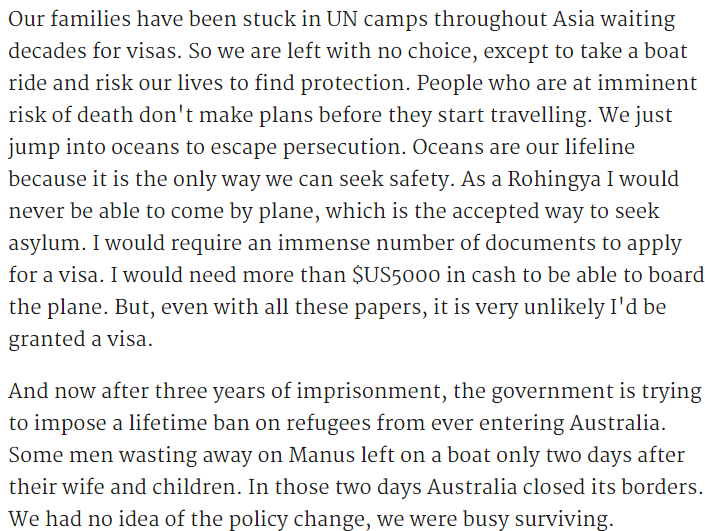
Source: ‘The torture in my country is transparent, in Australia it is not obvious’.
Another question that must be asked is whether the refugees on Manus Island displace refugees with better claims from within another country’s refugee quota because the Australian government is lobbying for them to be accepted as a refugee.
Boat arrivals do not increase the Australian refugee quota so someone with a better claim is displaced. As arrivals by boat are no longer ever eligible to settle in Australia, this displacement dilemma is moved onto the consciences of 3rd countries.
The purpose of the UN processing of refugees is to ensure those with the most pressing claims for asylum receive refugee status first. Those pushed back in the queue may be at a greater risk of imprisonment, torture and execution than those that arrived in Australia by boat.
Mapping the World’s Immigration Flows, Country-by-Country
29 Dec 2016 Leave a comment
in development economics, labour economics, labour supply, population economics Tags: economics of immigration
.@4corners @amnestynz evidence standards hit new low on #Nauru refugee reporting
18 Oct 2016 Leave a comment
in Economics of international refugee law, international economics, politics - Australia Tags: economics of immigration, Nauru, refugees
The ABCs journalistic standards have dropped so low that they continued to regard as credible a witness who compared Nauru with Syria. Neistat wrote the report for Amnesty which Four Corners then built on.

Syria is a war zone. Nauru is not. This is the Australian Government’s travel advice for Syria
We strongly advise Australians not to travel to Syria because of the extremely dangerous security situation, highlighted by ongoing military conflict including aerial bombardment, kidnappings and terrorist attacks…
Australians are also warned not to travel to the northern Caucasus included Chechnya for any reason because of the threat of terrorism and kidnappings.
The Department of Foreign Affairs and Trade does not issue travel advice for Nauru at this time.
I doubt that the state of law and order in Syria or Chechnya in peacetime is any different from Nauru at its worst. Refugees seek asylum from persecution. That does not guarantee them asylum in a country that is materially wealthier than the one they fled.
Many people engage in considerable hubris to avoid making difficult decisions about immigration and refugees. Tullock talked about how people avoid difficult decisions. They do not want to face up to the fact resources are scarce and they face limits on their powers.
To reduce the personal distress of making these tragic choices, Tullock observed that people often allocate and distribute resources in a different way so as to better conceal from themselves the unhappy choices they had to make. This even if this means the recipients of these choices are worse off and more lives are lost than if more open and honest choices were made up about there only being so much that can be done.
The Australian Greens, for example, call for a doubling of the refugee quota. A drop in the ocean when there is 59 million refugees out there. This allows them to feel righteous when they go to sleep at night
When it is pointed out that their policies will encourage more people to get on a boat, some of whom will drown, the Greens suggest people should be free to fly to Australia without documentation and then be released after a short security check.
#LetThemStay https://t.co/n1hA7W3q3Q—
Sarah Hanson-Young (@sarahinthesen8) February 04, 2016
Naturally, no government will ever adopt this suggestion. It shows that the Greens are not serious participants in managing refugee flows across borders. They prefer to feel righteous rather than actually systematically help people to the maximum available.
Arriving by boat in Australia does not increase the size of the refugee quota. It just changes who gets to the head of the queue and how many died trying to get to the head of the queue.
A.J.P. Taylor said something similar
15 Oct 2016 Leave a comment
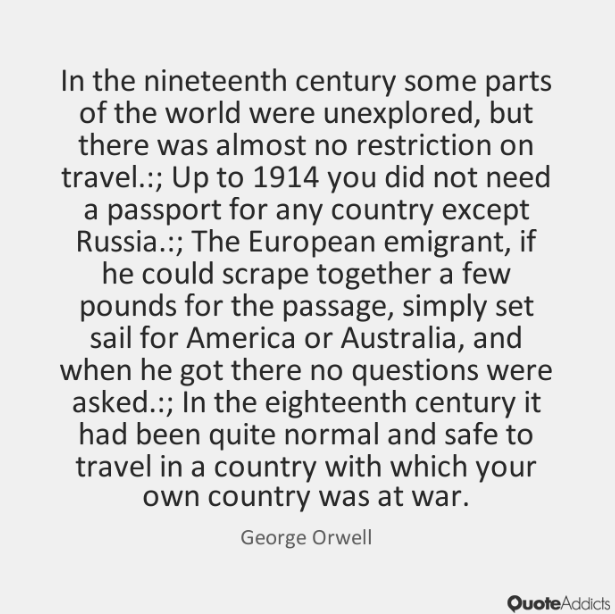
in economic history, international economic law, international economics, labour economics, labour supply Tags: age of empires, age of migration, economics of immigration, George Orwell, great migrations
Immigration to Israel since its Declaration of Independence in 1948
30 Sep 2016 Leave a comment
in economic history Tags: economics of immigration, Israel
Six-foot tall man found inside a suitcase trying to cross Italy-Switzerland border
07 Jul 2016 Leave a comment
in economics, international economics Tags: economics of immigration
No @sarahinthesen8 this is not acceptable. Stopping the boats saved hundreds of lives
30 May 2016 Leave a comment
in Economics of international refugee law, international economic law, International law, labour economics, politics - Australia Tags: Australian Greens, avoiding difficult choices, economics of immigration, Leftover Left, rational irrationality
People who enter illegally by boat do not increase the number of refugees of Australia admits in any one year. They change who was granted asylum within the same fixed quota. Increasing the quota will not change incentives for illegal entry if illegal entry allows for settlement in Australia.
 Utopia, you are standing in it!
Recent Comments